Sber’s GigaChat 4 Goes Open: a 708B Model Under the MIT Licence, With a Million-Token Context
Sber has released GigaChat 4 as open weights: a 708-billion-parameter flagship under the MIT licence and a compact 37-billion-parameter sibling, both with a million-token context. The benchmarks put it in the open frontier's band — with some clear weak spots.

Sber has released GigaChat 4, its largest model yet, as open weights: a 708-billion-parameter flagship under the MIT licence, alongside a compact 37-billion-parameter sibling, both with a one-million-token context window. The release, unveiled on 26 November at Sber’s AI Journey conference in Moscow, puts Russia’s largest bank squarely in the open-weights race alongside DeepSeek, Z.ai and Qwen — and it arrives with benchmark numbers that place it in the same band as the current open frontier, with some clear weak spots of its own.
Two models, one family
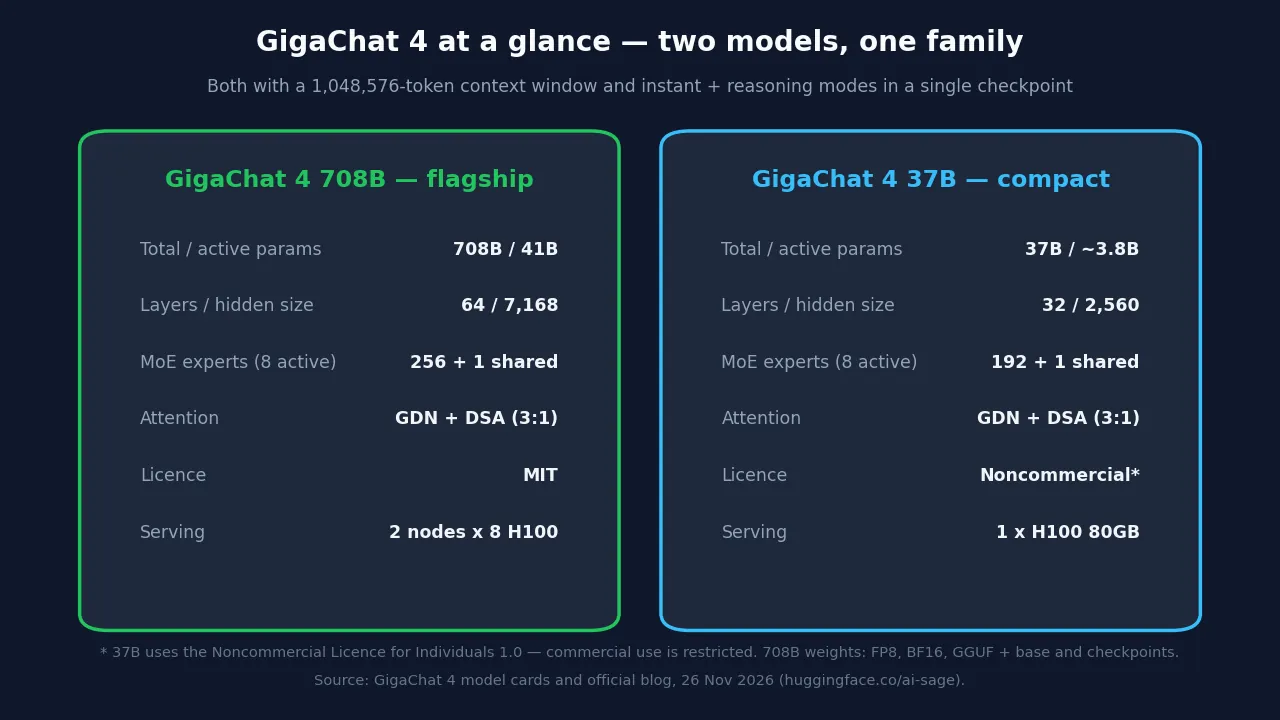
GigaChat 4 comes as a pair. The flagship, GigaChat4-708B-A41B, has 708 billion total parameters with 41 billion active per token. The compact model, GigaChat4-37B-A4B, has 37 billion total parameters with about 3.8 billion active per token. Both support a native context window of 1,048,576 tokens, and both pack instant and reasoning modes into a single checkpoint, selectable per request — a change from GigaChat 3.5, which needed separate checkpoints for fast answers and step-by-step reasoning.
The weights are published on Hugging Face under Sber’s ai-sage organisation, in FP8, BF16 and GGUF formats, with base models and intermediate training checkpoints alongside the instruction-tuned releases. The 708B technical report is already published on GitHub; the 37B report is promised later. Sber has not announced hosted API pricing, and the models are also rolling out through the GigaChat assistant and GigaPlatform AI Studio. The flagship’s own model card calls it “the flagship hybrid model of the GigaChat family”.
A hybrid design built for long context
The architecture is a hybrid. Each mixture-of-experts layer routes tokens to 8 of 256 experts, alongside one shared expert, and the attention stack interleaves Gated DeltaNet linear-attention layers with DeepSeek Sparse Attention (DSA) on multi-head latent attention layers, in a 3:1 ratio. The flagship has 64 decoder layers and a 7,168 hidden size; the compact model has 32 layers and a 2,560 hidden size. On a million-token context, DSA lets each query attend to 2,048 selected earlier tokens instead of the full history, which is what keeps long-context retrieval affordable.
Training at this scale needed new stability measures, including progressive residual warm-up, projection-specific z-loss, logit softcapping and dynamic learning-rate rescaling for imbalanced expert blocks. After supervised fine-tuning, Sber trained specialist models with reinforcement learning on maths, coding, tool use and multi-turn agent workflows, then consolidated them into one model through multi-teacher on-policy distillation, using the Muon optimiser. For faster generation, GigaChat 4 supports two speculative decoding paths: a recurrent multi-token prediction drafter, or DFlash2, a separate diffusion-based drafter trained from scratch.
The benchmark picture is mixed
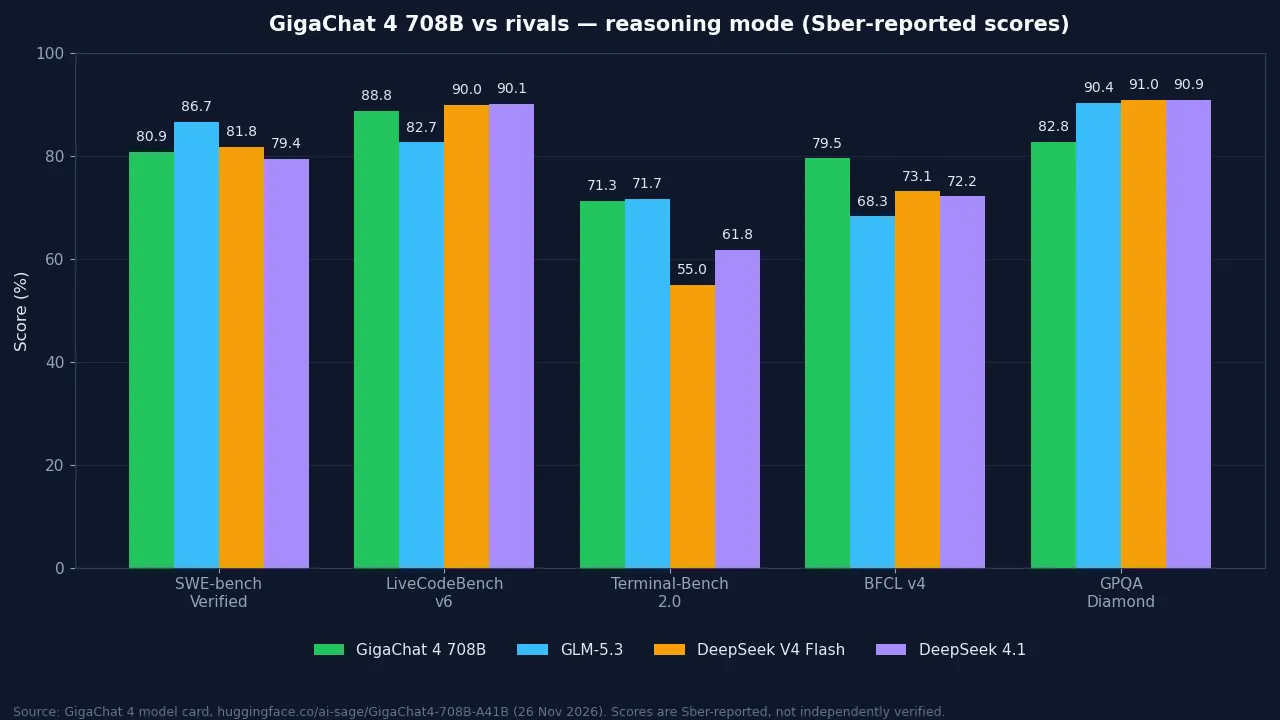
Sber published an extensive benchmark table with the release, and the picture it paints is genuinely mixed rather than dominant. On coding, the 708B model scores 80.89 on SWE-bench Verified and 88.82 on LiveCodeBench v6 in reasoning mode, and 71.26 on Terminal-Bench 2.0 — up from 30.30 for GigaChat 3.5 Ultra on the same test, the single largest generational jump in the table. On agentic tests it leads the comparison set on BFCL v4 at 79.55 and on CoworkBench at 83.00, against 25.00 for its predecessor. But it trails the same rivals on Humanity’s Last Exam, scoring 23.91 against 43.42 for DeepSeek 4.1 and 39.62 for GLM-5.3, and on DeepSWE, where it scores 35.40 against 74.34 for DeepSeek 4.1. On GPQA Diamond it reaches 82.83, behind DeepSeek V4 Flash at 91.00 and GLM-5.3 at 90.40.
One result deserves more attention than the headline numbers: the instant mode. Without any chain of thought, GigaChat 4 still scores 80.82 on SWE-bench Verified — almost identical to its reasoning-mode score of 80.89, and more than double the 39.70 that GigaChat 3.5 Ultra managed in the same mode. For teams that need fast, cheap coding help rather than slow deliberation, that is arguably the more useful number in the whole release. All of these figures are Sber’s own, reported in the model card; no independent verification exists yet, and the comparison table below uses those same vendor-reported scores.
| Benchmark (reasoning mode) | GigaChat 4 708B | GLM-5.3 | DeepSeek V4 Flash | DeepSeek 4.1 |
|---|---|---|---|---|
| SWE-bench Verified | 80.89 | 86.67 | 81.80 | 79.40 |
| LiveCodeBench v6 | 88.82 | 82.67 | 90.00 | 90.14 |
| Terminal-Bench 2.0 | 71.26 | 71.67 | 55.01 | 61.80 |
| BFCL v4 | 79.55 | 68.29 | 73.12 | 72.18 |
| GPQA Diamond | 82.83 | 90.40 | 91.00 | 90.91 |
| Humanity’s Last Exam | 23.91 | 39.62 | 37.80 | 43.42 |
The licence split matters more than the size
The most consequential detail in the release is not the parameter count but the licensing. The 708B instruction-tuned model is released under the permissive MIT licence, which makes it one of the largest openly licensed models available. The 37B model, by contrast, uses a Noncommercial Licence for Individuals 1.0, which restricts commercial use. That split creates an awkward trade-off: the model most developers can actually run — the 37B fits on a single H100 80GB GPU, with about 40GB needed for its weights — is the one they cannot use commercially, while the freely licensed flagship needs two nodes of eight H100 80GB GPUs to serve in FP8.
For teams that can afford the hardware, the deployment path is well prepared. GigaChat 4 is natively supported in SGLang, including recurrent MTP and DFlash2 speculative decoding, per-request instant and reasoning mode selection, and tool calling through an OpenAI-compatible API, with vLLM support also documented. Sber says the model works inside agent harnesses including Claude Code, Codex, pi, the DeepSeek harness and OpenHands, and its launch demos show the flagship editing the binary of an NES Mario cartridge dump to invert its colour palette, generating a 3D-printable vase as an STL file, and composing a music track through MCP access to a digital audio workstation. The demos are showpieces, but they signal where Sber thinks the model belongs: inside agent workflows, not chat windows.
The sanctions question cannot be ignored
There is one caveat that applies to GigaChat 4 and to no other model in this year’s open-weights wave. Sberbank has been under US and EU sanctions since 2022, which may restrict access to its commercial services in some jurisdictions. The MIT-licensed weights on Hugging Face are downloadable without an account, and the licence itself is permissive, but teams in regulated industries should check their own compliance position before building on a model from a sanctioned bank. That is a practical consideration, not a judgement on the weights themselves — and it is also, in part, why the release matters: open weights are the one distribution channel sanctions cannot easily close.
The release also fits a pattern that has defined the second half of 2026. Open-weights flagships keep arriving from outside the US labs: Z.ai’s GLM-5.4 with its Loop Transformer design, Baidu’s ERNIE 5.5 Flash under Apache 2.0, Ant’s Ling-3.2-air under the MIT licence, and the fully open K2-Horizon fleet with its complete technical paper. GigaChat 4 is the largest of them by total parameters, and the only one whose maker is a sanctioned bank. Whether it earns real adoption outside Russian-language use will depend on independent benchmarks and community testing in the coming weeks, but the scale, the licence and the agentic focus make it a release worth watching.
What to watch
Independent benchmark reruns will show whether the 80.89 on SWE-bench Verified and the 71.26 on Terminal-Bench 2.0 hold up outside Sber’s own harness. The 37B technical report, promised for later, will show how much of the flagship’s capability survives at a thirtieth of the size. And the licence split will be tested in practice: whether builders accept the 37B’s noncommercial terms for prototyping, or pay the sixteen-GPU price of the MIT-licensed flagship.
What is GigaChat 4?
GigaChat 4 is Sber’s flagship open model family, unveiled on 26 November 2026 at the AI Journey conference in Moscow. It has two models: a 708-billion-parameter flagship and a 37-billion-parameter compact model, both with a 1,048,576-token context window and instant plus reasoning modes in a single checkpoint. The weights are published on Hugging Face under Sber’s ai-sage organisation.
What licence is GigaChat 4 released under?
The 708B instruction-tuned model is released under the permissive MIT licence. The 37B compact model uses a Noncommercial Licence for Individuals 1.0, which restricts commercial use — so the model most developers can run on a single GPU is the one they cannot use commercially.
How does GigaChat 4 score on benchmarks?
Sber-reported reasoning-mode scores for the 708B model include 80.89 on SWE-bench Verified, 88.82 on LiveCodeBench v6, 71.26 on Terminal-Bench 2.0, 79.55 on BFCL v4 and 82.83 on GPQA Diamond. It trails rivals on Humanity’s Last Exam (23.91) and DeepSWE (35.40). No independent verification exists yet, so these are Sber’s own figures.
Can I run GigaChat 4 myself?
The 708B flagship in FP8 is documented for two nodes of eight H100 80GB GPUs (TP16) using SGLang, with vLLM support also documented. The 37B compact model runs on a single H100 80GB GPU, with about 40GB needed for its weights. Both support instant and reasoning modes through an OpenAI-compatible API.
Where can I download GigaChat 4?
On Hugging Face, under the ai-sage organisation: GigaChat4-708B-A41B (FP8, BF16 and GGUF instruction-tuned weights, plus base model and intermediate checkpoints) and GigaChat4-37B-A4B. The 708B technical report is published on GitHub; the 37B report is promised later.