
India Launches Chariot-1, a Sovereign AI Model That Speaks 11 Languages and Trains Three Sizes in One Run
India's Chariot-1 is an 11-billion-parameter sovereign foundation model built from scratch under the IndiaAI Mission, with a language model and a speech model for English and 10 Indian languages — and three research tricks that make Indian-language AI cheaper to train and run.
India has launched Chariot-1, a homegrown foundation model built from scratch under the IndiaAI Mission, and it is aimed squarely at a problem most frontier models ignore: India’s languages. The model suite was unveiled in New Delhi on 25 November by S. Krishnan, Secretary of the Ministry of Electronics and Information Technology (MeitY), and it pairs an 11-billion-parameter language model with a text-to-speech model covering English and 10 Indian languages.
Note that the launch is a research showcase as much as a product release. The government’s official release publishes the model’s design and its headline numbers, but it does not publish a model card, a licence, or a public download. For now, Chariot-1 is a capability India says it has built, not one developers can yet pick up and run.
What the launch actually covers
The suite has two parts. Chariot-1 LLM is an 11-billion-parameter mixture-of-experts modal, with 4 billion parameters active per token. It comes in three sizes — 10.7 billion, 1.7 billion and 745 million parameters — so the same model family can run in a data centre, on a laptop, on a smartphone, or on an edge device. Chariot-1 TTS generates speech in English and 10 India languages: Hindi, Bengali, Marathi, Tamil, Telugu, Kannada, Malayalam, Gujarati, Punjabi and Odia.
The two models share one backbone. Co-founder Parth Sarthi told reporters the model “combines text generation, text-to-speech (TTS) and automatic speech recognition (ASR) capabilities within a single architecture, reducing the need for multiple specialised AI models.” As he put it: “So, that is what makes Chariot One special: it is one model, a backbone that powers all these different applications.”
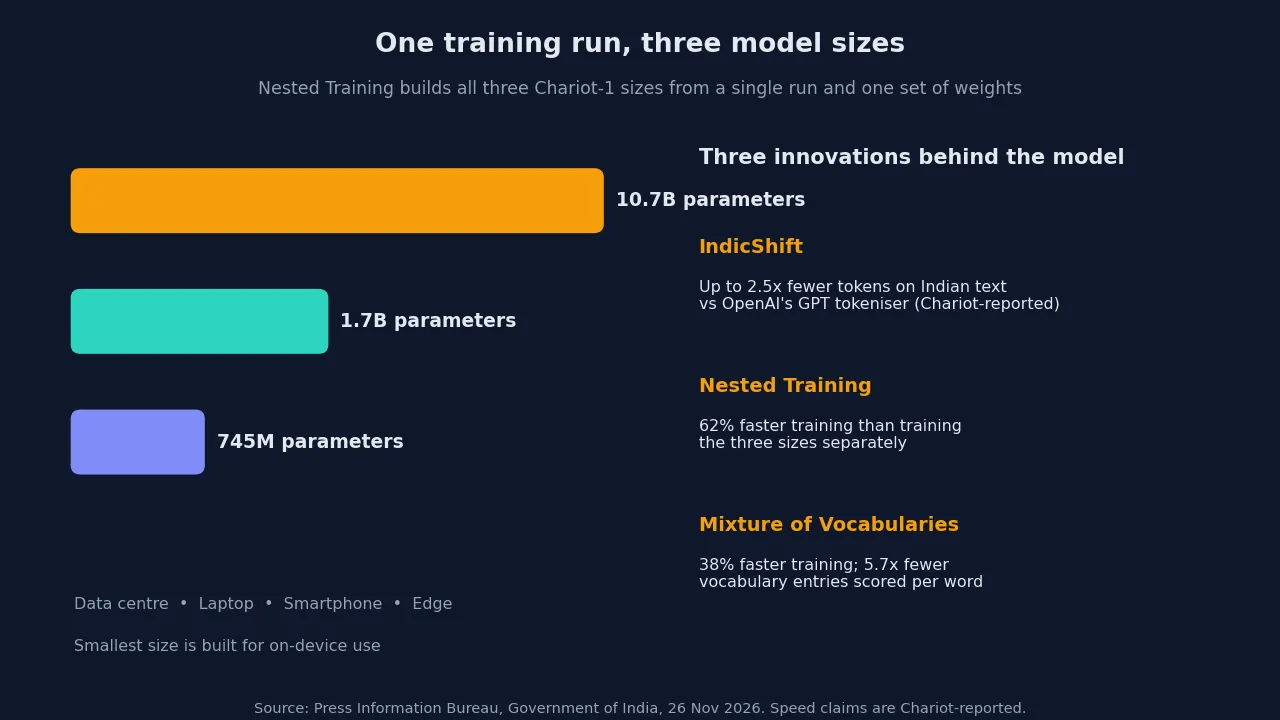
Three research ideas sit behind the model. IndicShift is a shared alphabet for Indian scripts, covering 1,012 characters across 12 scripts through 350 letters, so the model can use the similarities between scripts instead of treating each one separately. Nested Training produces all three model sizes from a single training run and one set of weights. Mixture of Vocabularies splits the vocabulary into 11 groups and scores only the relevant group for each word. Chariot reports that IndicShift uses up to 2.5 times fewer tokens on Indian text than OpenAI’s GPT tokeniser, that Nested Training is 62% faster than training the three sizes separately, and that Mixture of Vocabularies is 38% faster while scoring 5.7 times fewer vocabulary entries per word.
How we got here
Chariot Artificial Intelligence Pvt. Ltd. is one of the first four teams selected under the IndiaAI Mission to build sovereign foundation models. The mission, approved in March 2024 with an outlay of ₹10,371.92 crore, funds compute and research for teams building models for India’s own needs. Chariot was co-founded by Suvrat Bhooshan and Parth Sarthi, two Stanford graduates who returned to India to build the technology there — a detail Krishnan singled out at the launch.
Chariot-1 is the second wave of the mission’s foundation-model programme. On 3 November, the mission released Soket Labs’ EKA-1, a 26.3-billion-parameter model covering all 22 scheduled Indian languages, and ZenteiQ’s Dhīr 2B and 5B, small open-source models built to run offline on edge devices. Chariot-1 follows the same pattern — Indian languages first, small sizes included — but adds speech, with a single model behind text, voice and recognition. It is also part of a wider sovereign AI push: governments are no longer content to rent intelligence built elsewhere, and India is building its own stack, from compute to models to regulation.
The timing is worth noting. November has been crowded with new models built for specific jobs rather than general chat — from Z.ai’s 750-billion-parameter loop transformer to Amini’s document-intelligence model for African languages. Chariot-1 fits that pattern: it is not trying to be the biggest model in the world, it is trying to be the most useful one for 1.4 billion people who mostly do not speak English as a first language.
What it doesn’t mean
- It is not an open release. Only IndicShift is described as open-source. The release says nothing about the Chariot-1 model weights’ licence, and no public download or model card has appeared. The launch screen showed the model on the Chariot platform and on AIKosh, the mission’s datasets platform, but that is not the same as weights anyone can download. Contrast that with JetBrains’ open-weight coding model Mellum2.1, whose weights and licence were public on day one.
- The speed figures are Chariot’s own. The 62%, 38% and 2.5-times claims come from the company’s own tests, reported through the government release. No independent benchmark of the language model has been published, and the speech numbers come from a benchmark Chariot itself cites.
- It is not the biggest model in the race. Eleven billion parameters, with 4 billion active, is modest next to the 750-billion-parameter flagships announced this month. Chariot-1’s bet is efficiency and language coverage, not raw scale.
- It does not yet prove itself in public. The only performance numbers released are for the speech model. For the language model itself — reasoning, coding, maths — there is nothing to compare yet.
Why it matters for India
The tokeniser is the quiet story here. Tokenisers built mainly for English split Indian scripts into many more tokens than the same meaning takes in English, which makes Indian-language AI more expensive to run, token for token. IndicShift attacks exactly that gap: a shared alphabet across scripts, up to 2.5 times fewer tokens, and a reported 5% to 8% improvement on Indian languages at the same compute, with English and code performance maintained. If the figure holds up, Indian-language AI gets cheaper for everyone who builds on it — and IndicShift is open-source, so others can use it.
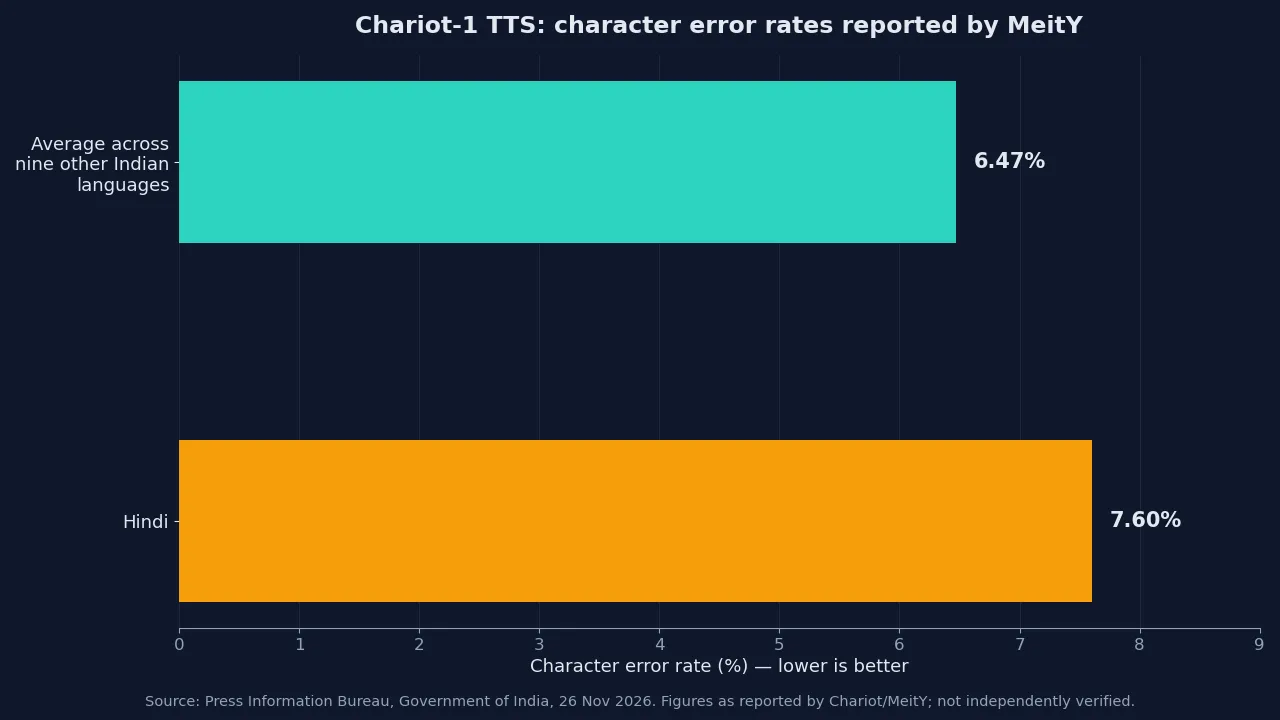
The speech numbers are concrete, and they are the only ones that can be checked. Chariot-1 TTS recorded over 97% verbalisation accuracy on the Async TTS Pronunciation Benchmark, which tests how numbers, dates, currencies, units, URLs and abbreviations should be spoken aloud across 1,029 real-world sentences. Its character error rate is 7.60% in Hindi and 6.47% on average across nine other Indian languages, which the release says is the lowest among the systems evaluated.
The small sizes matter too. A 745-million-parameter model can run on a phone, and the Dhīr models before it were designed to work offline, even in air-gapped systems. For government services, classrooms and clinics where connectivity is thin, a model that runs on the device is worth more than a bigger one that needs a data centre.
There is a regulatory angle as well. Asked on the sidelines of the launch about the government’s upcoming AI regulation papers, Krishnan said they are “in the final stages” and “we’ll bring it out shortly.” Sovereign models and sovereign rules are arriving together.
What to watch
Four things will decide whether Chariot-1 is a real milestone or a press release. First, a model card: licence, training data, and the language model’s own benchmark scores. Second, access: whether the models actually appear on AIKosh for researchers and startups to use. Third, independent testing — the TTS numbers need a second opinion, and the LLM needs any public numbers at all. And fourth, the AI regulation papers Krishnan promised, which will show how far Delhi intends to go in steering its AI ecosystem.
This article is for information only and is not financial advice.
What is Chariot-1?
Chariot-1 is a suite of two foundation models built from scratch in India by Chariot Artificial Intelligence under the IndiaAI Mission: Chariot-1 LLM, an 11-billion-parameter mixture-of-experts language model with 4 billion active parameters per token, and Chariot-1 TTS, a text-to-speech model for English and 10 Indian languages. It was launched in New Delhi on 25 November 2026.
Which languages does Chariot-1 support?
Chariot-1 TTS generates speech in English and 10 Indian languages: Hindi, Bengali, Marathi, Tamil, Telugu, Kannada, Malayalam, Gujarati, Punjabi and Odia. The release does not state which languages the Chariot-1 LLM itself was trained on.
Is Chariot-1 open source?
Only IndicShift, the shared-alphabet technique behind the model, is described as open-source. The launch release does not state the Chariot-1 models’ licence or how developers can access them. The launch screen showed the model on the Chariot platform and on AIKosh, the IndiaAI Mission’s datasets and models platform.
How accurate is the Chariot-1 speech model?
Chariot-1 TTS recorded over 97% verbalisation accuracy on the Async TTS Pronunciation Benchmark, which covers 1,029 real-world sentences and 2,251 instances of non-standard text across 42 categories. Its character error rate is 7.60% in Hindi and 6.47% on average across nine other Indian languages, which the release says is the lowest among the systems evaluated. These figures are Chariot-reported and have not been independently verified.