Trump and Xi Agree on Joint AI Guardrails. What Was Actually Agreed?
Donald Trump says he and Xi Jinping have agreed to joint guardrails on AI, with humans kept in charge of military decisions. No text has been published yet — here is what was actually agreed, and what it does not mean.
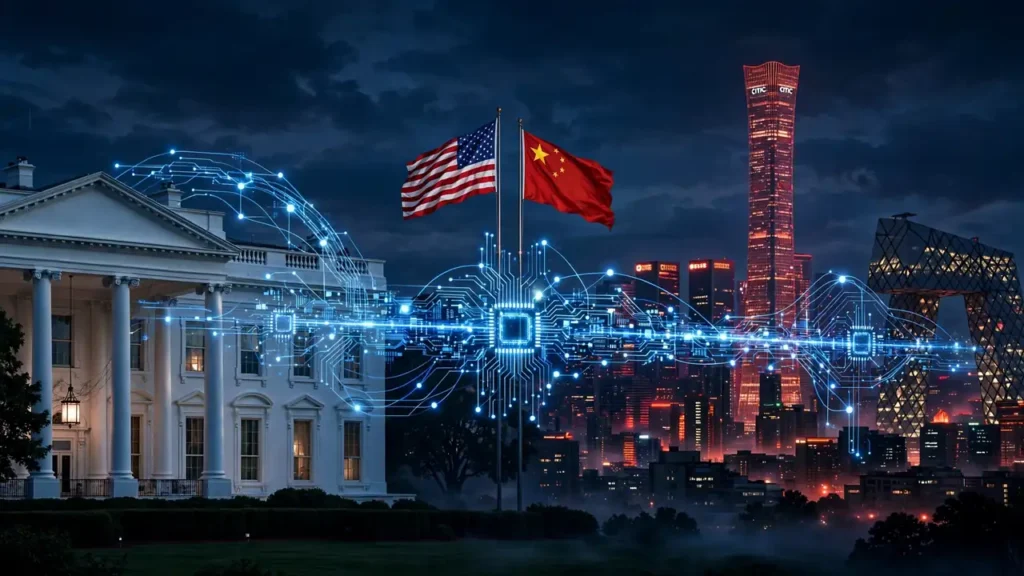
Donald Trump says he and Xi Jinping have agreed to write joint rules for artificial intelligence. The announcement came at a White House press conference on Friday, after Trump’s trip to China this week, and it marks a sharp turn for a president who has spent months arguing that global AI regulation would hold American innovation back and hand the lead to Beijing.
Note that what was announced is an agreement to agree. No text has been published, no timetable has been set, and it is not yet clear whether Beijing has confirmed the deal in its own words. What follows is what Trump and his Treasury Secretary, Scott Bessent, actually said, and what it does and does not amount to.
What the briefing says
Trump put it plainly in the middle of his press remarks. “President Xi and I agree that we’re going to do some joint guardrails, the two of us,” he said. He calls the technology “super intelligence” rather than artificial intelligence, and added that the problem is “it may be too super.” The idea was first floated in a Fox News interview on Thursday, a day after the two leaders met in Shenzhen, and Friday’s press conference turned it into a public commitment.
Bessent, speaking to CNBC on Friday after returning from the trip, gave the one concrete detail so far. Trump and Xi, he said, agreed that humans should always be involved in military decisions that AI makes. “I think it was very important that President Trump and President Xi agreed that humans should always be involved in any military decisions that SI makes, and the SI should not be allowed to be autonomous for major military actions,” Bessent said. He called the agreement one of the major achievements of the trip, and said it would not be affected by the two countries’ competition for AI supremacy.
Trump added a second pledge in the same briefing, aimed at the companies building the infrastructure. He said his administration will not allow American companies to build AI data centres outside the United States, and threatened a “tremendous tax” on any that try. No formal policy or enforcement plan has been published for that either.
How we got here
The agreement, such as it is, came out of a week of face-to-face diplomacy. Trump met Xi in Shenzhen during the APEC summit, in a trip that also included a first-ever trilateral meeting with Xi and Vladimir Putin. The two sides agreed to keep talking about reducing nuclear risks, and the AI understanding was presented as the trip’s main substantive outcome.
It arrived against a backdrop of tightening controls, not loosening ones. On Monday, the Commerce Department issued an interim rule restricting remote access to advanced AI chips through overseas data centres, closing a route by which Chinese companies could rent American computing power abroad instead of importing the chips. The rule was published in the Federal Register on Thursday and took effect the same day. Bessent said Nvidia’s H200 remains the most advanced chip China can buy with licences, and that Chinese orders for it have been thin, “a paucity of orders,” as Beijing builds its own chip stack, where he said China is “probably many years behind.”
The model race, meanwhile, is not waiting for the rules to be written. Microsoft’s MAI Code 2 launched at Ignite this week, and Google’s Gemini 4 Neon arrived days earlier. The guardrails, if they ever take written form, will be trying to govern a field that is still accelerating.
What it doesn’t mean
The announcement is easy to overread. Here is what it is not:
- No signed agreement. There is no joint statement, no published text and no date for negotiations to begin. Trump described an understanding between two leaders, not a document.
- No Chinese confirmation. Beijing has not published its own account of what was agreed, and it is unclear whether China sees the guardrails the same way Washington does.
- No pause in the chip race. The H200 line, the Monday export rule and the data-centre threat all point the other way. Washington is tightening access to advanced computing even as it talks about shared rules.
- No rules for civilian AI. Everything described so far concerns military decisions and the most powerful systems. It says nothing about everyday AI use, open-weight models or commercial deployment.
Why it matters for AI labs
Bessent was blunt about where he thinks safety comes from. He said US AI labs need to keep their technological lead as the best defence against “dangerous” Chinese AI models being used in cyberattacks. In that framing, the guardrails are a complement to American dominance, not a substitute for it, and the chip controls are the other half of the same policy.
Chinese labs are not standing still either. Tencent’s open-weight Hy4 landed this week as a 770-billion-parameter flagship, and the gap between the two countries’ frontier models is now measured in weeks rather than years. That is the tension at the heart of Friday’s announcement: the two governments are talking about shared rules while their labs and their chip policies pull in opposite directions.
Investors are watching the same race from a different angle. Anthropic’s record $83 IPO turned a frontier AI lab into a listed company this week, and the market’s verdict on AI stocks has swung hard in both directions within days. A US-China understanding on AI safety, if it holds, is the kind of news that steadies that market. A vague one that falls apart could do the opposite.
Outside the US and China
The Monday export rule reaches well beyond China. It adds new licence requirements for advanced chips going to Indonesia, Malaysia, Singapore, Thailand and Brazil, countries the Commerce Department sees as carrying a higher-than-normal risk of diversion. Data-centre operators and cloud providers in those countries will feel the rule first, and exporters now have 90 days to get licences for existing operations that fall under it.
Allies hosting AI infrastructure are caught in the middle. A data centre in Singapore or Malaysia that rents compute to a Chinese customer now needs a licence, and operators must run due diligence on who their customers ultimately are. The rule also formally scraps the Biden-era AI Diffusion Rule, replacing country-level chip caps with controls aimed at specific end uses.
What to watch
- Whether Beijing confirms the agreement in its own words, and whether its version matches Washington’s.
- Any published text or timetable for the guardrails, and whether military AI is the only subject.
- How the Commerce Department handles licence applications from overseas data centres, and whether any are refused.
- The fourth Trump-Xi meeting, expected in mid-December at the G20 summit in Miami, where both the tariff truce and the guardrails idea may be finalised.
- Whether the threat to ban data centres abroad becomes a formal policy, or stays a line from a press conference.
Two leaders agreeing that humans must stay in charge of military AI is, on its face, the easiest agreement in the history of arms control. The hard part is everything that follows: writing it down, defining it, and enforcing it while both sides race to build the very systems it is meant to govern. Friday gave us the headline. The text, if it ever comes, is the story.
This article is for information only and is not financial advice.
What did Trump and Xi agree on AI?
At a White House press conference on Friday 20 November 2026, Donald Trump said he and Xi Jinping agreed to establish joint guardrails on artificial intelligence, which Trump calls super intelligence. Treasury Secretary Scott Bessent added that the two leaders agreed humans should always be involved in military decisions made with AI, and that AI should not be allowed to act autonomously in major military actions.
Are the joint AI guardrails a signed agreement?
No. There is no joint statement, no published text and no timetable for negotiations. Beijing has not published its own account of what was agreed, so it is unclear whether China sees the guardrails the same way Washington does.
What is the US rule on AI chips and overseas data centres?
On 16 November 2026 the Commerce Department issued an interim final rule restricting remote access to advanced AI chips. It requires licences to export advanced chips and servers to data centres anywhere in the world that supply large volumes of compute to companies headquartered in China, Macau or other restricted countries, and adds licence requirements for chips going to Indonesia, Malaysia, Singapore, Thailand and Brazil. The rule was published in the Federal Register and took effect on 19 November 2026.
Can China still buy Nvidia H200 chips?
Yes, with licences. Treasury Secretary Scott Bessent said the H200 remains the most advanced chip China can purchase with licences, but that Chinese orders for it have been thin, describing a paucity of orders as Beijing builds its own chip stack, where he said China is probably many years behind.