
Baseten Launches Bison-1 and Groundhog-1: Open Decision Models That Top the Artificial Analysis Index
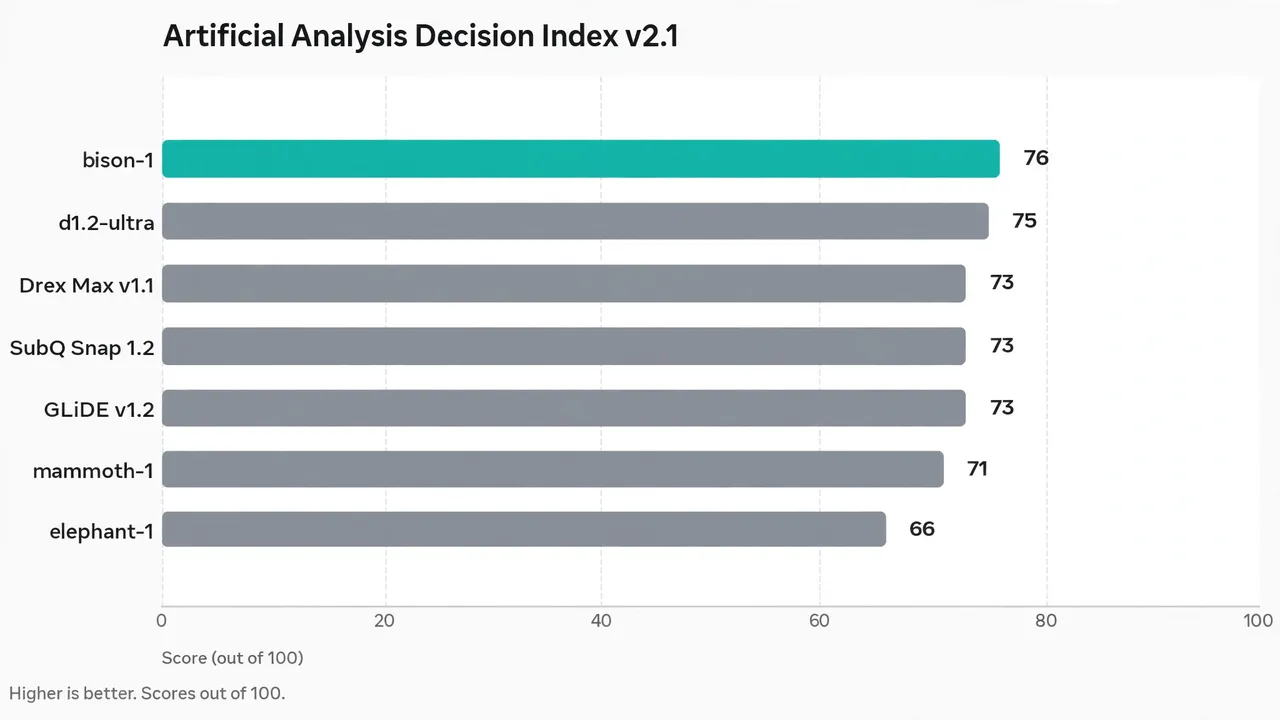
Baseten has released bison-1 and groundhog-1, two open-weight decision models built on Google's Gemma 4. bison-1 scores 76 on the Artificial Analysis Decision Index, first of 19 models, with 128k context and image input at $0.10 per million tokens.

Baseten has released two new decision models, bison-1 and groundhog-1, and the larger of the two now sits at the top of the Artificial Analysis Decision Index. Bison-1 scored 76 on the index, one point ahead of Liquid AI’s d1.2-ultra and five ahead of Baseten’s own mammoth-1, which makes it the highest-ranked decision model Artificial Analysis has benchmarked. Both models are built on Google’s Gemma 4, both take 128,000 tokens of context, and both are available now on Baseten’s Model APIs with open weights on Hugging Face. Baseten announced the pair on November 20, a month after mammoth-1 and elephant-1 set the previous standard for the category.
What a decision model actually does
A decision model does not write essays, hold conversations or generate text of any kind. It answers one fixed question with a calibrated probability. A request carries a state, which is text and optionally images, and a set of questions about that state. Each question is one of three types: a yes or no question, a choice between named options, or a score on ordered levels. The model answers every question in a single prefill pass and returns the probability for each option. Nothing is generated token by token.
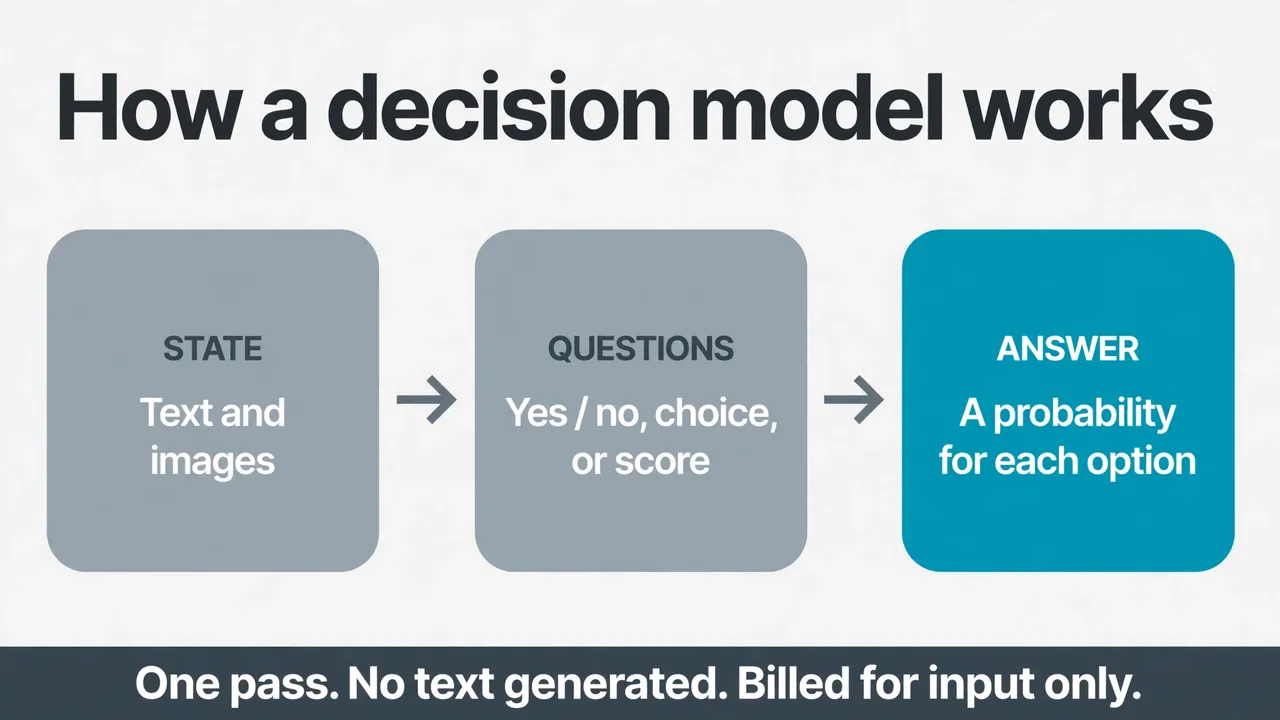
The point is volume and trust. A support team might need a thousand small judgments a day: is this customer asking for a refund, which team should handle it, and how urgent is it. A chat model would write a paragraph for each one, which is slow and expensive and hard to act on. A decision model returns three probabilities in one call, and the system acts on them directly. The same pattern fits spam detection, jailbreak guardrails and routing work between models, where the question is fixed and the answer has to be instant.
Calibration is what makes the probability useful. A model that says 83 percent should be right about 83 percent of the time, because the systems built on top of it act on thresholds. A score above a cutoff goes through automatically and anything below it goes to a person. A model that is confident and wrong is worse than a model that is cautious, since the confident error sails through the threshold uncaught. That is why the benchmark that matters here scores confidence as well as correctness.
Bison-1 tops the index
The Artificial Analysis Decision Index is an independent benchmark run by Artificial Analysis, and version 2.1 covers 19 decision models. The headline score is a weighted average across six evaluations. AA-Paperclip carries the most weight at 30 percent and tests decisions and extraction on 1,500 private documents, including resumes, receipts, invoices and research papers passed to the model as extracted text, where each document counts as one decision and all 15 of its answers have to be right. EvalSafe-O*NET-AA at 15 percent tests judgment on workplace documents. When2Call at 10 percent tests tool calling from NVIDIA’s evaluation. AA-Omniscience-Decision at 15 percent tests knowledge and hallucination, with the option to decline rather than guess. HLE-MultiChoice at 15 percent tests reasoning on multiple-choice questions from Humanity’s Last Exam. AA-Symmetry at 15 percent checks that a decision holds when its options are reordered or reworded, or the question is negated.
Bison-1 leads the field at 76. Liquid AI’s d1.2-ultra follows at 75, then Drex Max v1.1, SubQ Snap 1.2 and GLiDE v1.2 at 73, and Baseten’s own mammoth-1 at 71. The model card breaks the score down further. Bison-1 ranks first of 19 on When2Call at 98, on EvalSafe-O*NET-AA at 93, on HLE-MultiChoice at 51 and on AA-Symmetry at 89. It ranks second on AA-Paperclip at 73. The weak spot is knowledge-heavy decisions: it ranks 11th on AA-Omniscience-Decision at 60, which is the one component where the model looks ordinary.
The more telling number is the Brier score. At 0.14, bison-1 has the lowest on the index, ahead of d1.2-ultra at 0.15. The Brier score measures the gap between the confidence a model states and whether it was right, so a lower number means the probabilities can be trusted further. Baseten credits two things for the gain: the Gemma base, and a larger share of soft labels in training, where the model is taught that an answer is 83 percent one option and 17 percent another instead of 100 percent one option. About one example in seven in the 6.71 million-example training set carries a probability target instead of a single right answer, and the training objective adds a Brier calibration term alongside ordinary cross-entropy. The model also has a trained option to say it does not know.
Groundhog-1 is the cheaper sibling
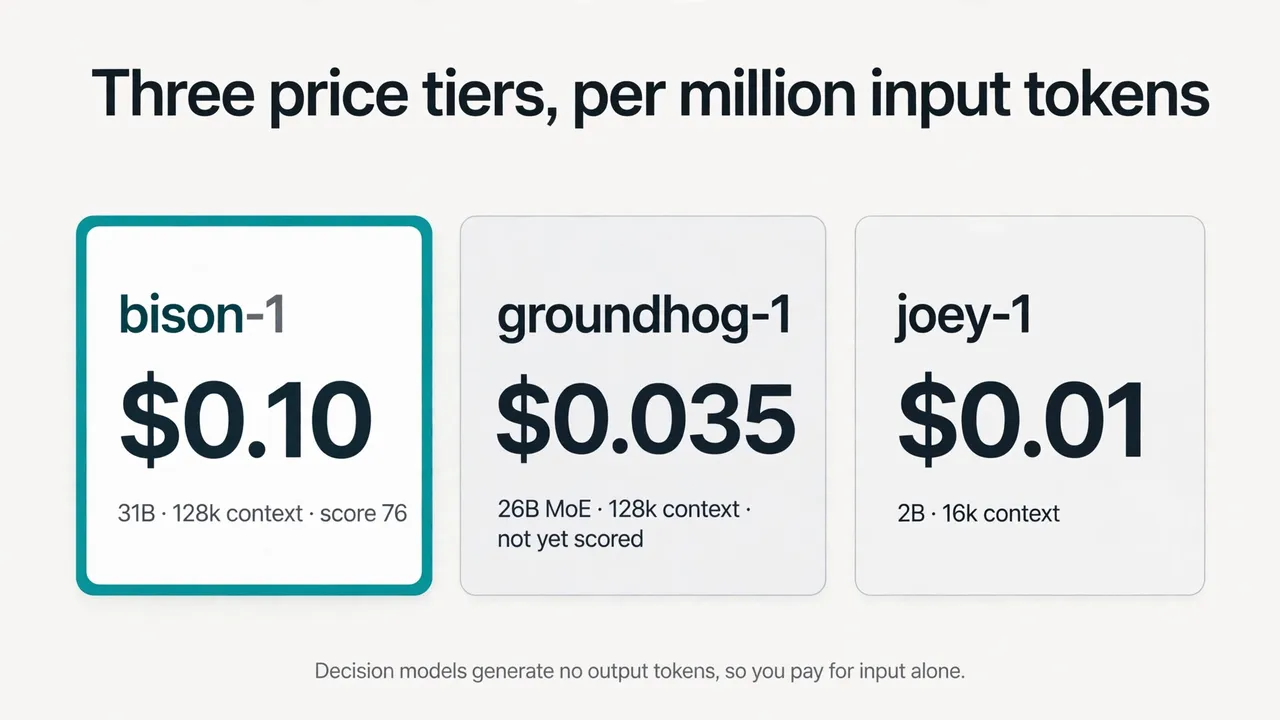
Groundhog-1 is built for the same work at a lower price. It is a 26 billion parameter mixture-of-experts model, with about 4 billion parameters active per token, post-trained from Gemma 4 26B-A4B. It takes the same 128,000 tokens of context, accepts text and images, and uses the same API. The price is $0.035 per million tokens, the same as elephant-1, against $0.10 for bison-1. For high-volume triage and routing, where the cost of each decision dominates, that gap matters more than the last few points of accuracy.
Groundhog-1 has not yet received an official Artificial Analysis Decision Index score. Baseten expects it to match mammoth-1, which scored 71, but that is the company’s expectation rather than a measured result. On Baseten’s own long-context runs at 128,000 tokens, groundhog-1 scored 77.4 on LongMemEval M and 79.3 on LongMemEval S, against 84.8 and 87.1 for bison-1. Those numbers come from Baseten’s own testing, not from an independent lab, and the official index score is the result to wait for.
The Baseten decision model family
With the new pair, Baseten’s Base Labs family runs to five models across three price tiers. The table below uses Baseten’s own figures for size, backbone, context and price, with Decision Index scores where Artificial Analysis has published them.
| Model | Parameters | Backbone | Context | Price per 1M tokens | Decision Index v2.1 |
|---|---|---|---|---|---|
| bison-1 | 31B | Gemma 4 31B | 128k | $0.10 | 76 |
| groundhog-1 | 26B MoE, ~4B active | Gemma 4 26B-A4B | 128k | $0.035 | Not yet scored |
| mammoth-1 | 27B | Qwen3.5-27B | 16k | $0.10 | 71 |
| elephant-1 | 9B | Qwen3.5-9B | 16k | $0.035 | 66 |
| joey-1 | 2B | Qwen3.5-2B | 16k | $0.01 | Not published |
The pricing is deliberate. Bison-1 costs exactly what mammoth-1 cost, and groundhog-1 costs exactly what elephant-1 cost, so existing customers can move to the new models without repricing their workloads. Baseten says the choice between them comes down to the decision at hand: bison-1 when accuracy and long context matter most, groundhog-1 when long context is needed at low latency and cost. The company also says the family now sits on the Pareto frontier for accuracy against time per task, meaning that at each size no other model is both faster and more accurate. The claim rests on the three models with published index scores, bison-1, mammoth-1 and elephant-1, and is Baseten’s own reading of the index data.
The context window is the real upgrade
The headline score will get the attention, but the context window is the change that alters what teams can do with these models. The previous generation topped out at 16,384 tokens (16k) through the Model APIs. The new pair takes 131,072 tokens (128k), eight times as much. Long context matters because the detail that changes a decision is often buried far from the question. An invoice can look ready for payment until an earlier email in the thread shows the order was cancelled. Without that history, a model can approve a payment it should reject.
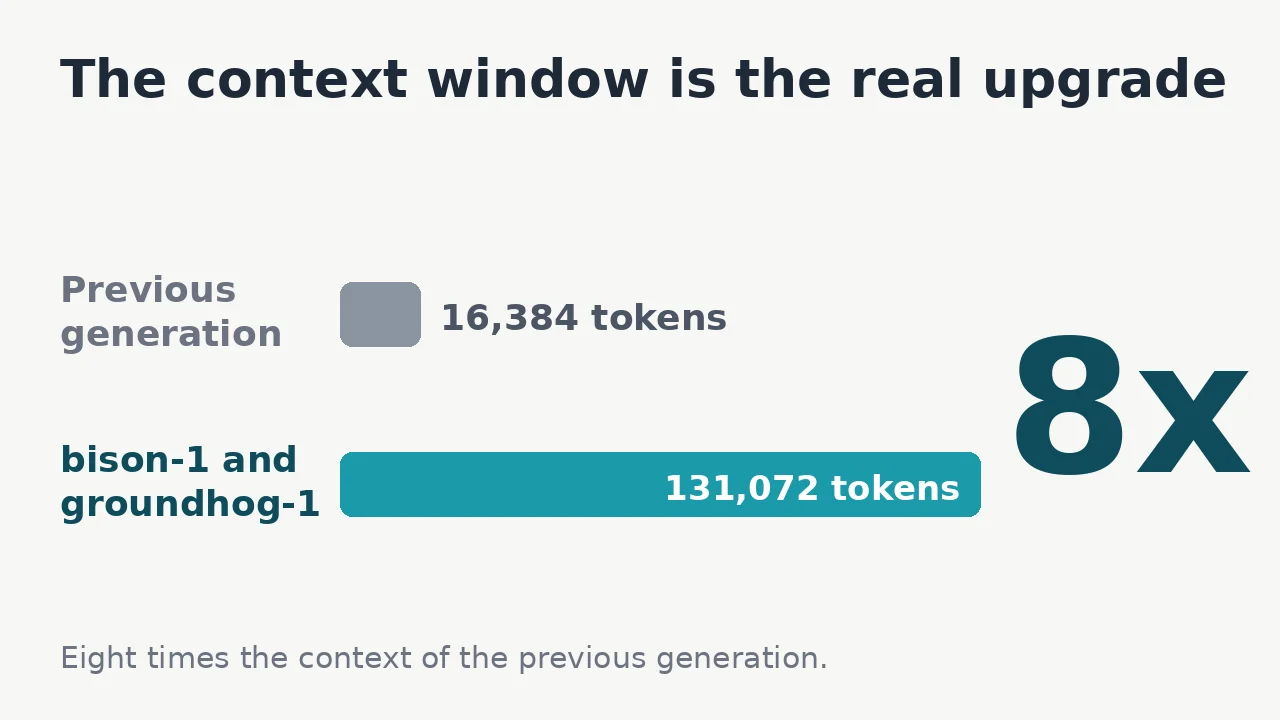
With 128,000 tokens, teams can include full policies or whole conversation histories instead of selecting excerpts or summarizing them first, which removes a step where information gets lost. The trade-off is that requests longer than the trained length limits are refused rather than truncated, so a system built on these models has to handle the refusal instead of silently receiving a partial answer. Both models were trained on sequences up to 131,072 tokens, and the training data ran to 6.71 million decision examples covering core decision skills, safety and abstention, judging, expert domains, documents and long-context tasks. Bison-1 trained on 192 B200 GPUs and groundhog-1 on 128.
Pricing and access
Both models are live on Baseten Model APIs now, under the names decision-models/baseten-bison-latest and decision-models/baseten-groundhog-latest, and they use the same API as mammoth-1 and elephant-1. Trying them is as simple as changing the model name in the request. The weights are also open on Hugging Face, so teams can run the models themselves. The Gemma 4 base carries the Apache License 2.0 and Baseten’s modifications are released under the MIT License, with use subject to both. Open-weight competition is moving toward open weights elsewhere in the broader AI market: Tencent’s Hy4 family is open-weight too, though under its own Tencent Hy License rather than Apache 2.0, and the open side of the market is where the fastest iteration is happening.
The pricing itself is simple. Bison-1 costs $0.10 per million tokens and groundhog-1 costs $0.035, matching the upper two tiers Baseten already charged. Because a decision model generates no output tokens, the bill is for the input alone, which keeps the cost of a single decision small. A support desk routing ten thousand tickets a day through groundhog-1 is paying for the text of the tickets and nothing else.
An American backbone
The backbone is the part Baseten wants noticed. Mammoth-1, elephant-1 and joey-1 were built on Qwen, a Chinese base model. Bison-1 and groundhog-1 are built on Google’s Gemma 4, and the company frames the switch as giving teams a reason to choose American models on performance rather than preference alone. The argument is that provenance matters to the teams buying these models, and that a model should win the work on merit. The launch is a starting point for more of Baseten’s research on American backbones, and the company says it will bring the same training advances to the rest of the family.
Google’s model strategy pairs its commercial Gemini 4 lineup with its open-weight Gemma family. While Gemini 4 Carbon sits at the top of the company’s commercial line alongside the high-efficiency mid-tier Gemini 4 Neon, the Gemma family gives builders an open base to fine-tune. The decision-model category is widening at the same time: Google, Microsoft and OpenAI all list decision products on the same Artificial Analysis index, and the open-weight side is moving just as fast. The launch lands three days after OpenAI’s GPT-6.2 family, which shows how crowded the model release calendar has become.
What the launch does not prove
A careful read of the launch leaves several open questions. The LongMemEval numbers are Baseten’s own runs, and the company says so on the model cards. Groundhog-1 has no independent score yet, so its expected match with mammoth-1 is a prediction. Bison-1’s weakest component is knowledge-heavy decisions, where it ranks 11th of 19, and that is the area where a chat model with retrieval would still be the safer choice. The index itself scores text-based decisions, so the new image-input capability is not reflected in the 76 at all. And the lead at the top is narrow: one point over d1.2-ultra and five over mammoth-1, on an index that is already at version 2.1 and will keep moving as new models are scored.
None of that takes away from the result. A first-place finish and the best calibration on an independent index, at unchanged prices and with eight times the context, is a strong release. But the numbers that will matter most are the ones that come next: groundhog-1’s official score, and how these models behave on real workloads rather than benchmarks. Calibration measured on a test suite is a promise; calibration on a team’s own tickets and documents is the proof.
What to watch
Groundhog-1’s official Decision Index score is the first number to wait for, since it decides whether the cheaper model is genuinely close to mammoth-1 or a step behind it. Liquid AI (d1.2-ultra), Nace (Drex Max v1.1), Subquadratic (SubQ Snap 1.2) and Fastino (GLiDE v1.2) all sit within a few points of bison-1, so the next round of releases will show whether the lead holds. The more interesting question is adoption: whether agents and guardrail systems start routing their small judgments through decision models at scale, and whether the 128,000-token window changes what teams put into a decision. Agents will pair frontier reasoning models such as GPT-6.2 or Gemini 4 with fast, calibrated decision models like these for pre-dispatch routing, tool-call gating and policy guardrails, and that combination is where the category earns its keep.
What is a decision model?
A decision model answers a fixed question with a calibrated probability instead of generating text. You send it a state, such as a support ticket or a document, and a set of questions, and it returns the probability for each option. It is built for high-volume judgments like triage, spam detection and routing.
What is Baseten bison-1?
Bison-1 is a 31 billion parameter decision model from Baseten, post-trained from Google’s Gemma 4 31B. It ranks first of 19 models on the Artificial Analysis Decision Index v2.1 with a score of 76, takes 128,000 tokens of context, accepts text and image input, and costs $0.10 per million tokens.
How much do bison-1 and groundhog-1 cost?
Bison-1 costs $0.10 per million input tokens and groundhog-1 costs $0.035 per million input tokens on Baseten Model APIs. Decision models generate no output tokens, so requests are billed for input alone. The prices match Baseten’s previous tiers, so bison-1 costs what mammoth-1 cost and groundhog-1 costs what elephant-1 cost.
How do I use bison-1 and groundhog-1?
Both models are live on Baseten Model APIs under the names decision-models/baseten-bison-latest and decision-models/baseten-groundhog-latest, using the same API as Baseten’s earlier decision models. The weights are also open on Hugging Face for teams that want to run the models themselves.