OpenRouter Cuts Three Providers and Pulls 125 Endpoints From Zero Data Retention After Prompt-Theft Findings
OpenRouter has off-boarded three inference providers and removed 125 endpoints from Zero Data Retention eligibility after Dragos researchers found prompts being copied for months. No breach of OpenRouter itself — but the findings show ZDR promises were not always kept.
At a glance: OpenRouter has off-boarded three inference providers and removed 125 endpoints from Zero Data Retention eligibility, after security researchers found customer prompts being copied and kept for months. The gateway says it was not itself breached, and it has notified every customer who may be affected. The three providers it removed have not been named, and neither have the three the researchers found compromised.
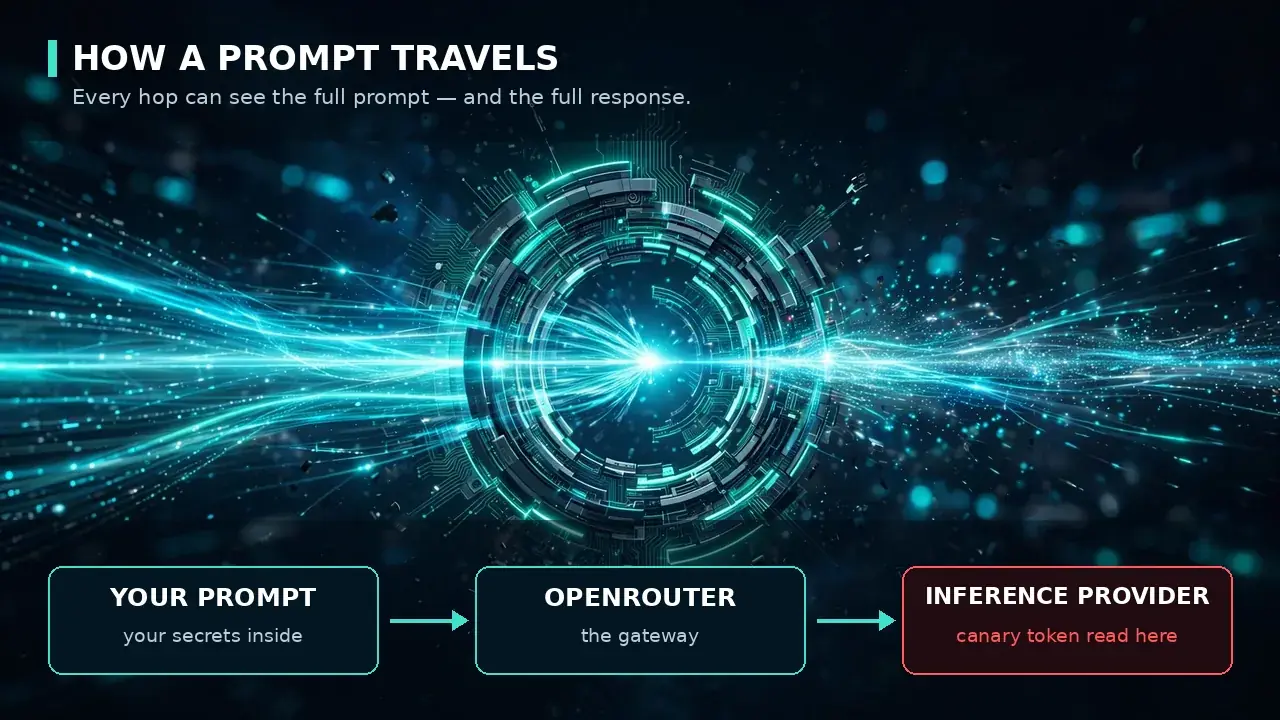
OpenRouter is the routing layer between AI users and the companies that actually run the models. A developer sends a prompt to OpenRouter, and OpenRouter hands it to whichever inference provider is serving that model. That is also the problem here. Every company along the path can see the full prompt and the full response, and the researchers found that some of them were doing exactly that, even when the request was marked not to be stored. Tencent’s Hy4 Flash is one of many models served through OpenRouter, which is how widely this touches the AI ecosystem.
What did the researchers actually find?
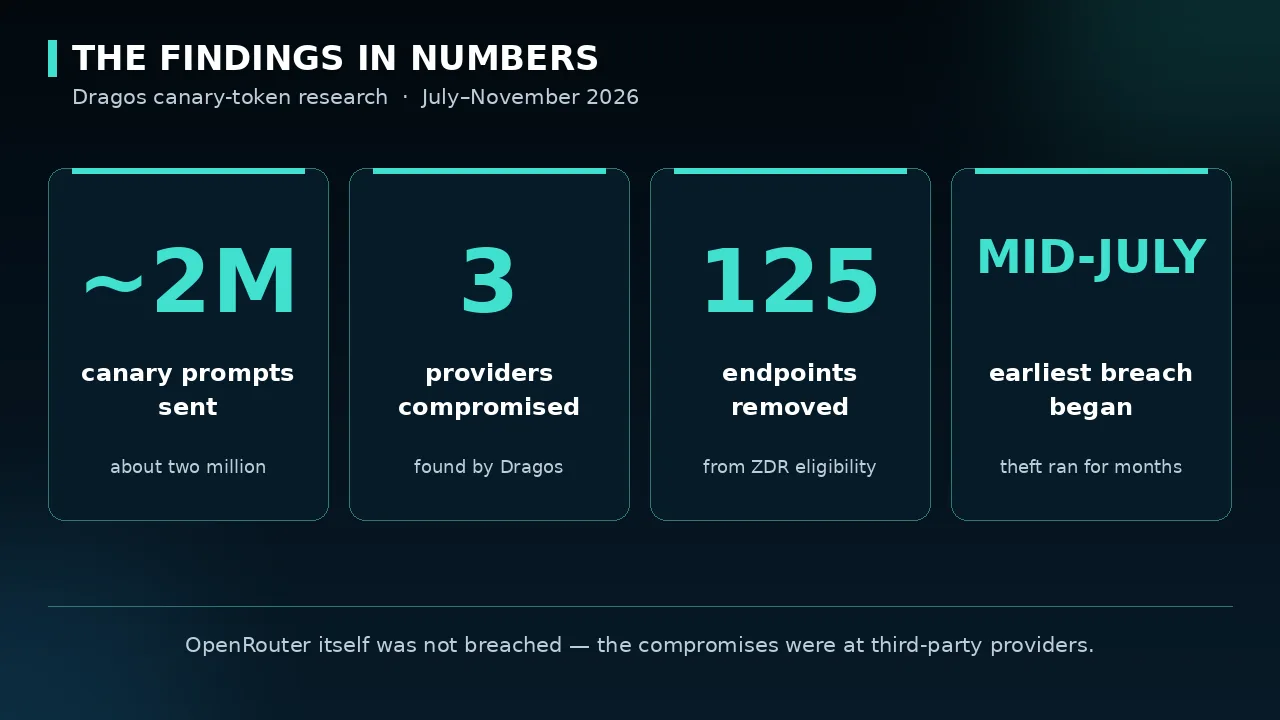
Dragos, an industrial cybersecurity firm, published its research on 19 November. Between July and November 2026 it sent about two million prompts to widely used AI services. Each prompt carried a unique web link or test credential, a canary token. A planted secret can only be learned in one place, so if anyone opened the link or used the credential, the researchers knew the prompt had been read.
The results were blunt. Data at three AI providers had been exposed, and in some cases the providers were not following their own data policies. The earliest of the three breaches began in mid-July. The largest involved a couple of hundred planted AWS keys, each sent in exactly one request during short windows in late October. The thief tested some keys within hours, listed S3 buckets, searched Secrets Manager and Parameter Store, and tried to create Bedrock API keys and add IAM users to keep access. The keys drove tens of thousands of AWS API calls.
One attacker appears to have compromised two of the providers at once, using secrets from both from a single rented server. On 1 November the same attacker brought in ARTEX, an AI-driven penetration testing framework, and used it only to confirm that keys it already held were still live. The researchers are now working with about a dozen providers, and planted keys and secret links were still being accessed months after the first thefts, as of this week. The Hacker News reported the full findings, including the AWS key theft and the lab that fetched links from more than half of its seeded prompts.
Then there is the finding that should worry anyone who trusted a privacy setting. An unnamed Chinese AI lab fetched the secret links from more than half of the prompts sent to its models between July and October, including about two-thirds of the requests marked no data collection or Zero Data Retention. In one case, a test link sent to a US provider surfaced in a company chat in China 24 days later. Some test requests were copied even though the model rejected them before processing, which Dragos read as evidence that the copying happened when the request first reached the provider, not during model processing.
- Two million prompts, three compromised providers: the canary tokens proved prompts were read, not just stored.
- The theft was active, not passive: stolen AWS keys were tested within hours and used for tens of thousands of API calls.
- Privacy settings did not hold: requests marked Zero Data Retention were still fetched and kept at some providers.
Key numbers: ~2 million canary prompts sent, July–November 2026; 3 providers compromised; 3 providers off-boarded; 125 endpoints removed from ZDR eligibility; ~200 planted AWS keys stolen in late October; tens of thousands of AWS API calls made with them; ~2,000 inference routes traced, several hundred including an unidentified system.
Which providers have published incident notices?
OpenRouter links three provider security notices in its announcement, from Novita, Phala and Together AI. Here is the part that needs care: OpenRouter does not say these are the three providers it off-boarded, and Dragos has not named the three it found breached. The two lists cannot be matched publicly, and the 125 endpoints removed from ZDR eligibility include flagged providers plus others cut as a precaution. Do not read the three public notices as the three removed providers.
Novita said a routing configuration issue broadened an API forwarding path meant for specific customers, sending some MiniMax requests to MiniMax’s official API instead of Novita-hosted infrastructure. Requests made directly through Novita or routed through OpenRouter between 28 May and 11 November 2026 may have had their contents accessed or retained by a third party. Novita suspended the affected models.
Phala published a preliminary incident report on 10 November. An attacker controlled an inference server and could view request data, and users whose DeepSeek V4 Flash 0731 requests were routed to Phala between 21 October and 8 November are exposed. Together AI disclosed a security event in which an unauthorised party downloaded stored prompt samples after a coding agent leaked a credential. The samples came from June and July requests to MiniMax, GLM and Kimi models.
- Novita: routing fault sent MiniMax requests outside the chosen route, 28 May–11 November.
- Phala: attacker-controlled inference server, DeepSeek V4 Flash 0731 requests, 21 October–8 November.
- Together AI: stored prompt samples downloaded after a leaked credential, June–July MiniMax, GLM and Kimi requests.
What does Zero Data Retention mean here?
Zero Data Retention, or ZDR, is a promise: prompts and responses are not stored. On OpenRouter you can enforce it per request, so traffic only routes to ZDR endpoints. The Dragos findings show the promise was only as strong as the provider keeping it. Some providers kept or forwarded requests that were marked ZDR, and OpenRouter is now treating that as a verification problem, not a settings problem. It is adapting the researchers’ testing approach so the checks run on an ongoing basis, and it is technically verifying network paths to find where requests and responses may be forwarded to third parties. Removed endpoints will only regain ZDR eligibility after what OpenRouter calls appropriate assurances and validation.
That matters beyond OpenRouter. The same multi-hop routing sits behind most AI gateways, and the researchers traced about 2,000 inference routes. Several hundred included an unidentified system, and in a handful a company absent from the advertised path fetched the test image. If you route through a gateway, you are trusting every hop, not just the name on the invoice. Gemini 4 Neon and GPT-6.2 Astra are among the frontier models developers reach through these gateways, and the same routing questions apply to all of them.
- ZDR is a provider promise, not a technical guarantee: the setting only works if every hop honours it.
- 125 is not 125 breaches: the removals include precautionary cuts, not only confirmed compromises.
- Verification is now the policy: OpenRouter will test providers continuously instead of taking their word for it.
What should OpenRouter users do now?
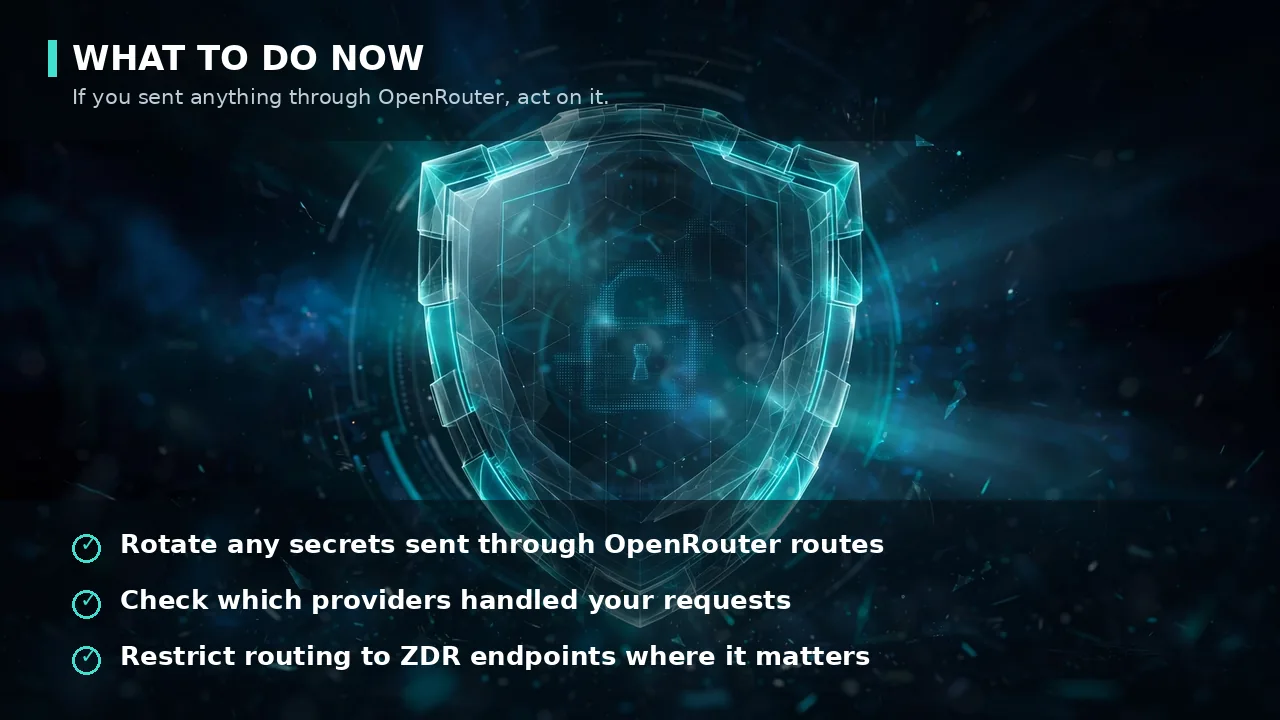
OpenRouter says it has notified all potentially affected customers. That is the starting point, not the end of it. Anyone who sent secrets, API keys or credentials through OpenRouter routes should rotate them. That advice stands even if you were never notified, because the researchers found prompts copied at providers that have not published notices, and OpenRouter itself says not all affected providers have posted publicly.
Check which providers your requests actually routed to, and restrict routing to ZDR endpoints where the setting matters. Microsoft’s MAI Code 2 launch showed how quickly model routing and pricing can change, and the same applies to provider trust: the list of who is allowed to carry your prompts is now something to check, not assume. OpenRouter says it will keep updating its list of provider security announcements as more providers publish write-ups.
- Rotate any secrets sent through OpenRouter routes: API keys, tokens and credentials, whether or not you were notified.
- Check your routing: confirm which providers handled your requests and restrict to ZDR endpoints where it matters.
- Watch the provider list: OpenRouter is updating its security announcements as more providers publish write-ups.
Bottom line: OpenRouter cut three providers and pulled 125 endpoints from Zero Data Retention because researchers proved, with planted secrets, that prompts were being read and kept anyway — and a privacy setting is only worth what the provider behind it actually does.
What did OpenRouter announce on 22 November 2026?
OpenRouter off-boarded three inference providers from its platform and removed 125 endpoints from Zero Data Retention (ZDR) eligibility, after security researchers found evidence that some providers had data compromised or were not upholding their data policies. It also notified all potentially affected customers.
Was OpenRouter itself breached?
No. OpenRouter says the findings did not show any breach or unauthorised access of OpenRouter itself. The compromises were at specific third-party inference providers that serve models through the gateway.
How did researchers find the prompt theft?
Dragos sent about two million prompts carrying canary tokens — unique web links and test credentials — to AI services between July and November 2026. If a link was opened or a credential was used, researchers knew the prompt had been read. The tests produced evidence of compromises at three providers, including a couple of hundred planted AWS keys stolen in late October and used for tens of thousands of AWS API calls.
Which providers were removed by OpenRouter?
OpenRouter has not named the three providers it off-boarded, and Dragos has not named the three providers it found breached. OpenRouter links public incident notices from Novita, Phala and Together AI, but those are not identified as the three removed providers, so the two lists cannot be matched publicly.
What is Zero Data Retention on OpenRouter?
Zero Data Retention (ZDR) means prompts and responses are not stored. On OpenRouter you can enforce it per request so traffic only routes to ZDR endpoints. The Dragos research showed some providers kept or forwarded requests marked ZDR, which is why OpenRouter removed 125 endpoints from ZDR eligibility, including some cut as a precaution.