X Square Robot Unveils WALL-OSS-1.0, a Robot Model That Works Without Task-Specific Training
X Square Robot has unveiled WALL-OSS-1.0, a vision-language-action model that scored 55.1% zero-shot across 312 real-robot tasks. The code and weights are promised soon, not yet released.

X Square Robot has unveiled WALL-OSS-1.0, a vision-language-action model built to let robots work in places they have never seen, following instructions they have never heard. The Shenzhen company announced the model on 23 November, alongside an agentic framework called XR Harness and an interface, WALL-API-1.0, for developers who want to use the system.
Note that the name is doing some work here. WALL-OSS-1.0 sounds like an open-source release, and the company says the code and model weights will open-source soon. They have not been released yet, so nobody outside the company can download the model, check the results, or run it on their own hardware. Everything below that rests on the company’s own numbers should be read with that in mind.
What the model actually does
WALL-OSS-1.0 is a VLA model: it takes in what a robot sees and what it is told, and decides what its hands should do next. Most models of this kind start with a pretrained vision-language model and add robot actions later, in a second round of training. X Square Robot did the opposite. It trained vision, language and robot action together from the start, a method it calls native VLA pretraining, built on a Qwen3.5 base.
The training mix blends language data, vision-language data and robot-action data into one process. An improved action tokenizer turns continuous robot movement into compact sequences of discrete tokens, and a flow-matching Action Expert converts visual and language context into precise, continuous robot commands, with real-time chunking to keep successive movements smooth. The model is also trained to do more than copy demonstrated movements: its objectives include understanding actions, evaluating proposed behaviour and learning to correct errors.

“What if a robot could enter an unfamiliar environment, understand a new instruction, and start working without being trained specifically for that task?”
X Square Robot, announcing WALL-OSS-1.0
That question is the pitch. The test is whether a robot trained this way can carry what it learned into a room it has never entered. It is a different bet from the one Google’s Genie 4 makes, which generates interactive worlds rather than moving a physical body, but both point at the same problem: models that understand a scene are only useful when they can act on it.
How it scored
The headline number is 55.1%. In an open-ended real-robot evaluation, evaluators freely chose 312 tasks, covering unfamiliar objects, tool use, bimanual coordination and multi-step manipulation, and WALL-OSS-1.0 succeeded on 55.1% of them with no task-specific demonstrations and no fine-tuning.
In simulation, the model scored 67.55 out of 100 on X2Real, a benchmark of more than 40 reasoning and manipulation tasks, the highest overall score among the models evaluated and a 65.0% improvement over Lingbot-VLA-2.0, the strongest other open-source baseline at 40.94. In mobile manipulation tasks under out-of-distribution conditions it reached a mean score of 44.17, against 24.83 for π0.5, a 77.9% relative improvement. On the public RoboDojo simulation leaderboard, the compact WALL-OSS-1.0-Lite ranked first among policies without agent systems as of 5 November 2026, with an overall score of 42.59.
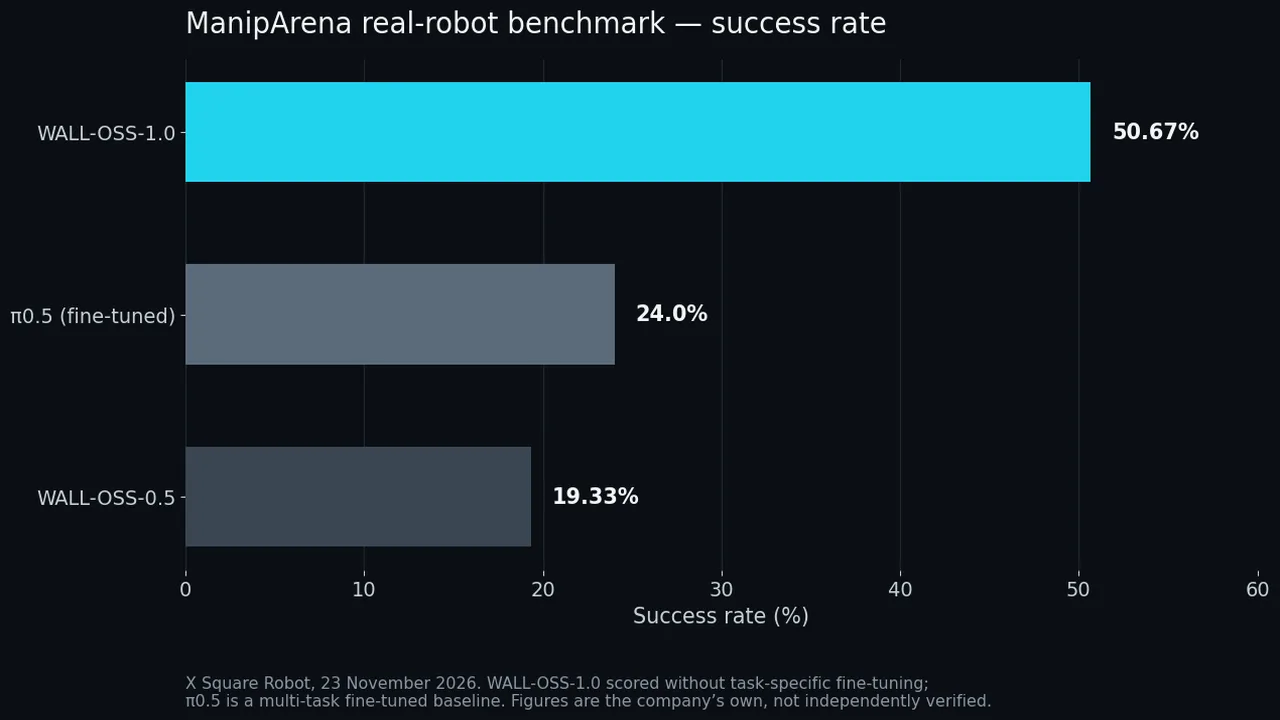
On ManipArena, a real-world benchmark of 15 tabletop tasks, WALL-OSS-1.0 scored 1,101 out of 1,500 points directly after pretraining, without task-specific fine-tuning. Its overall success rate reached 50.67%, against 19.33% for its predecessor WALL-OSS-0.5 and 24.0% for the multi-task fine-tuned π0.5 baseline, and it led or tied for the top score on 14 of the 15 tasks. The gap was widest on tasks that combine semantic understanding with physical manipulation, such as sorting, matching and instruction-based object selection, where WALL-OSS-1.0 reached a 78% success rate against 44% for π0.5. That is the same pattern as most model launches: OpenAI’s GPT-6.2 Astra arrived with vendor numbers first, and independent rankings followed. Here the independent check has not happened yet.
What it doesn’t mean
It is not open source yet. The name and the announcement both point toward an open release, but the code and weights are still to come, with no date and no licence named. Tencent’s Hy4 shipped its weights on Hugging Face the same week it was announced; WALL-OSS-1.0 has not.
A 55.1% success rate is a milestone, not a finished product. The robot failed nearly half of unfamiliar tasks without help, and the evaluators chose the tasks themselves.
The benchmarks are the company’s own. X Square Robot ran the tests, picked the baselines and reported the scores. No outside lab has reproduced them, and the simulation numbers come from benchmarks the company itself built or selected.
One logistics customer is not a market. Parcel sorting is a real deployment, but the cross-site figures come from the company’s own evaluation of its own adapted policy, not from an independent deployment.
Why it matters beyond the lab
The model did not arrive alone. XR Harness, the agentic framework released with it, connects task planning, model execution and robot control: one system interprets goals and revises plans, another coordinates physical execution, and a third connects actions and observations to robot controllers and sensors through the Robot Agent Protocol. Robot trajectories are annotated at four levels, task, subtask, action and segment, so the model can follow instructions ranging from broad goals to precise requirements on objects, positions and movements. A developer preview of XR Harness is available now.
The model family is built for different budgets. WALL-OSS-1.0-Lite (4B) and Nano (2B) are the smaller options; in an evaluation based on production robot workloads, Nano supported 18 robots on a single NVIDIA Blackwell GPU under the tested serving configuration. WALL-OSS-1.0-Gen extends learning beyond labelled robot-action data, using generative supervision to learn from broader visual experience, including first-person videos of human manipulation. WALL-OSS-1.0-AR explores more efficient autoregressive action generation, letting robots begin executing completed movement segments while later actions are still being generated. WALL-API-1.0, an API interface, is meant to make the same capabilities available to developers and enterprise partners.
The first real-world application is parcel sorting for a logistics customer, where robots must orient barcodes, align parcel edges and feed packages into sorting systems at production speed. The WALL-OSS-1.0-based policy retained more than 90% of its original-site sorting speed and success rate across production sites with different lighting, worktables, conveyors and parcel distributions, while a policy trained without WALL-OSS-1.0 pretraining saw its success rate drop by more than 90% across sites. The company also reports more than a fourfold inference speedup from kernel optimisation and quantisation, and shared GPU serving that lets several robots use common computing resources.
What to watch
The open-source release comes first: the date, the licence, and whether the community can reproduce 55.1% on its own hardware. Z.ai’s GLM-5.4 promised open weights after safety work, and the same question hangs over WALL-OSS-1.0 until the files actually appear. Then come independent tests of WALL-OSS-1.0 against π0.5 and other VLA models on the same tasks, WALL-API-1.0 access and pricing, and what developers build with XR Harness in its preview. If a second logistics customer reports the same cross-site transfer, the parcel-sorting claim stops being a single-company story.
This article is for information only and is not financial advice.
What is WALL-OSS-1.0?
WALL-OSS-1.0 is a vision-language-action (VLA) foundation model from X Square Robot, unveiled on 23 November 2026. It combines vision, language and physical action in one model, trained together from the start, so a robot can take a new instruction in an unfamiliar place and act on it without task-specific demonstrations or fine-tuning.
Is WALL-OSS-1.0 open source?
Not yet. X Square Robot says the code and model weights will open-source soon, but no date or licence has been announced, and the model cannot be downloaded today.
How well does WALL-OSS-1.0 perform?
In the company’s own tests, WALL-OSS-1.0 scored 55.1% zero-shot across 312 real-robot tasks, and 50.67% on the ManipArena benchmark of 15 tabletop tasks, against 24.0% for the fine-tuned pi0.5 baseline. These are vendor-reported figures with no independent reproduction yet.
What is XR Harness?
XR Harness is an agentic framework released alongside WALL-OSS-1.0 that connects task planning with physical execution, linking the model’s manipulation skills to robot controllers through the Robot Agent Protocol. A developer preview is available now, alongside a new interface, WALL-API-1.0.