MemTensor and NVIDIA Open-Source MemT-1.0-Pro, a 554B Model That Remembers Without the Transcript
MemTensor and NVIDIA have open-sourced MemT-1.0-Pro, a 554B-parameter model that keeps a fixed-size memory of past interactions inside the model, scoring 41.80 on BEAM-1M and averaging 53.08 across 11 memory benchmarks in MemTensor's own tests.

MemTensor has released MemT-1.0-Pro, a 554-billion-parameter open-weight model built jointly with NVIDIA that keeps a running memory of past interactions inside the model itself, instead of pasting the whole conversation back into the prompt every turn. Announced on 24 November, it is the largest model yet in the company’s memory-native family, and it arrives in a month when open-weight releases have mostly competed on size — this one competes on remembering.
Memory becomes part of the model
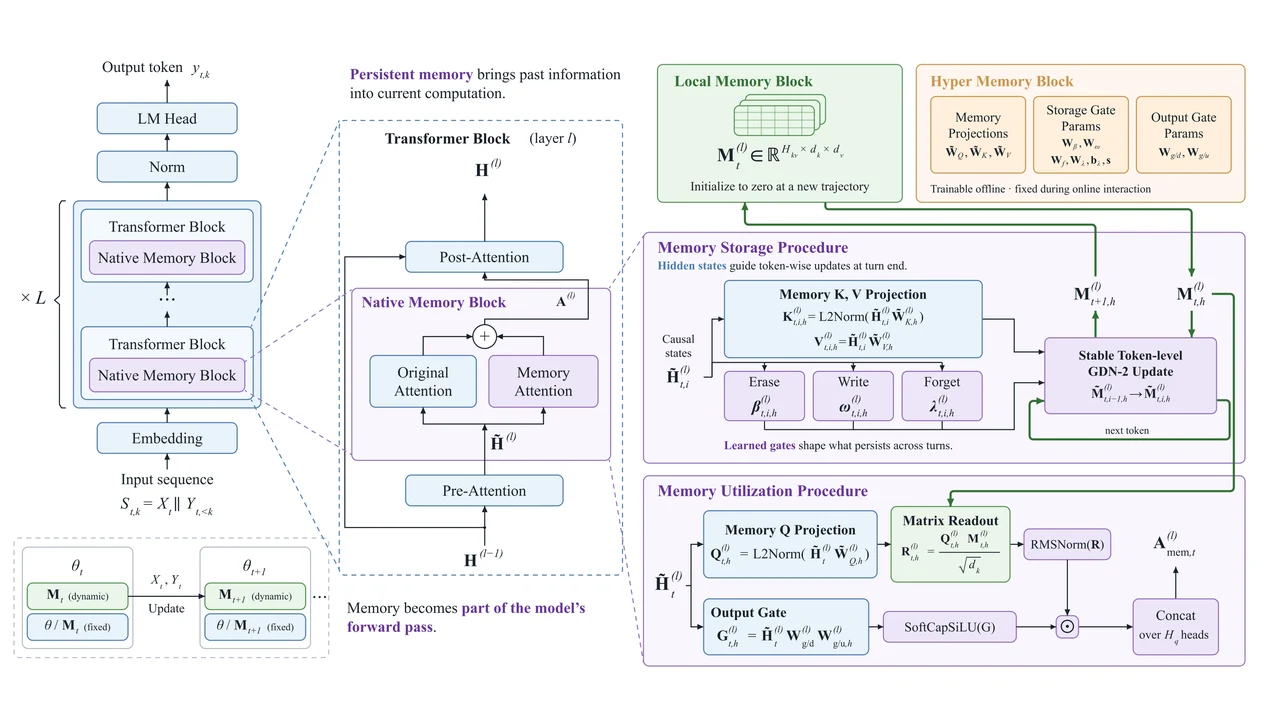
Most models today treat memory as a storage problem solved outside the model: keep the transcript, retrieve the relevant passages, paste them in. That works, but the context grows with every turn and the cost grows with it. MemT-1.0 takes the opposite route. A Native Memory Block runs alongside the model’s attention in selected layers. It has two parts: a Local Memory Block, a dynamic matrix that holds what the model has learned during the interaction, and a Hyper Memory Block, trainable machinery that decides what to write, erase and read. After each turn, a stabilised token-level update based on Gated DeltaNet-2 folds the new information into the memory state, and the original text can be dropped.
Because the memory state stays a fixed size, the storage cost stops growing with history length. MemTensor reports that at 128,000 tokens of history, the smallest model in the family, Nano, stores about 66 times less per conversation than a full-context key-value cache and runs about 1.86 times faster end to end. Those figures are for Nano, not Pro, and they describe one test configuration — but they are the reason the architecture matters: if the memory scales, long-running agents stop paying a growing tax for everything they have already seen.
The family, at a glance
Nano and Flash were released on 20 October, alongside the technical report; Pro is the third member of the family and the first built with NVIDIA. The collaboration covered model adaptation, operator optimisation, training methods and experimental review, according to the release. Training ran in two stages — continued pre-training, then post-training in which a full-context teacher distilled its responses into the memory model — on 34 billion tokens of data.
| Model | Backbone | Total parameters | Active per token | Trainable memory | Dynamic memory state |
|---|---|---|---|---|---|
| Nano | Qwen3.6-35B-A3B | 36B | 3B | 451M | 10M |
| Flash | DeepSeek-V4-Flash | 288B | 17B | 3.61B | 336M |
| Pro | NVIDIA Nemotron 3 Ultra | 554B | 59B | 4.23B | 13M |
What the numbers say
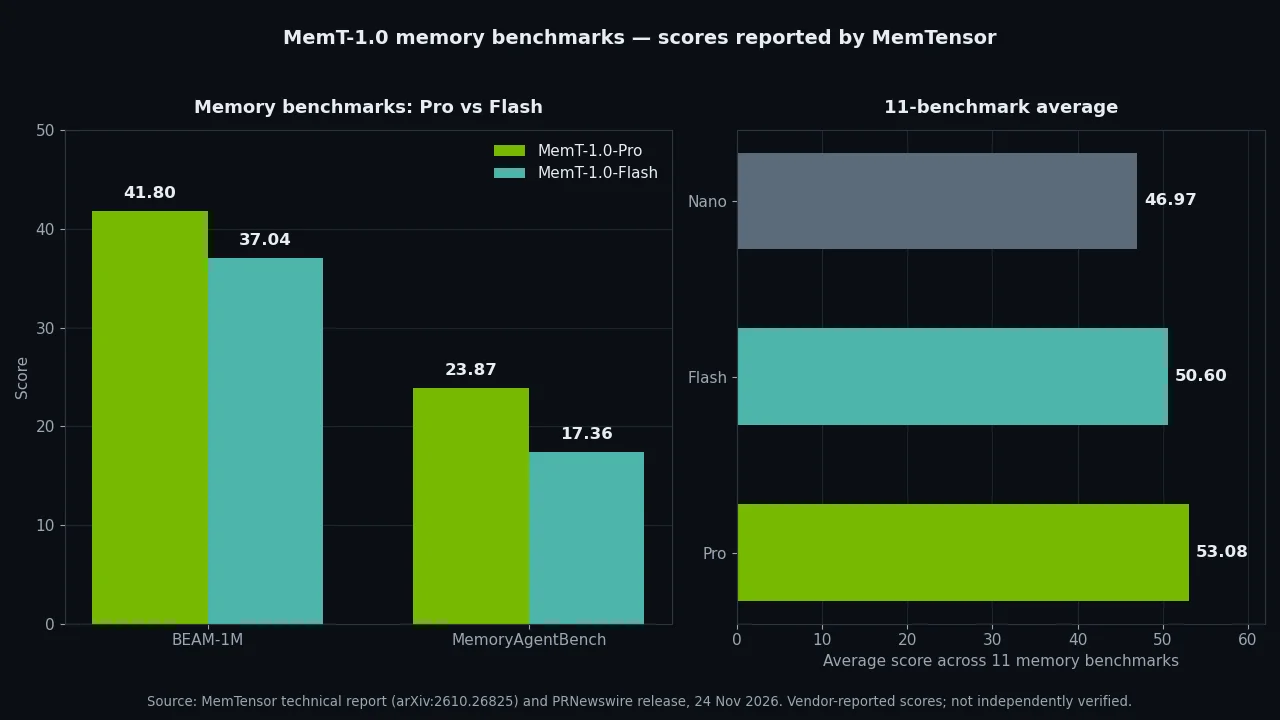
On the benchmarks MemTensor reports, Pro leads the family. It scores 41.80 on BEAM-1M, a ten-task test of long-history memory covering extraction, contradiction resolution, updating, preference following and temporal reasoning, against 37.04 for Flash. On MemoryAgentBench it reaches 23.87 against 17.36. Across all 11 memory benchmarks in the report, Pro averages 53.08, ahead of Flash at 50.60 and Nano at 46.97 — the highest average among the parametric-memory methods the report evaluates. All of these figures are MemTensor’s own, reported in its technical report; none has yet been reproduced by an independent harness.
The report also tests whether stored experience helps an agent do real work. On SWE-bench Verified, 500 real software issues, a model that could draw on a lesson stored in memory before the task solved 69.33% on average, up from 66.07% with no stored experience, and slightly above pasting the same lesson in as text (68.87%). The share of tasks solved in all three attempts rose from 54.0% to 61.6%. The gain is modest, but it points in the direction the architecture promises: experience that lives in the model, rather than in the prompt, is at least as useful as the text itself.
The limits the release states itself
The numbers come with qualifications that MemTensor states plainly, and they matter. Pro and Flash run on different backbones, so the gap between them is not a clean like-for-like comparison. Strong text-based memory systems — retrieval pipelines that keep the original documents — remain ahead on some evaluations, particularly where a long history has to yield precise evidence. And a fixed-size memory is a trade-off by design: it can hold only so much, so what it keeps and what it forgets decides how useful it is. Improving memory fidelity, selective retention and query-dependent readout is, in the release’s own words, central to further research.
Why this release lands now
November has been the busiest month yet for open-weight releases, and most of the big ones have competed on the same axes: more parameters, longer context, a more permissive licence. Tencent’s Hy4 arrived at 770B parameters, Baidu’s ERNIE 5.5 Flash Preview at 280B under Apache 2.0, Ant Group’s Ling-3.2-air at 124B under MIT, and Z.ai’s GLM-5.4 with a looped transformer that reuses 28 layers twice. MemT-1.0-Pro is different in kind rather than degree: it is not trying to be the biggest model of the month, but the first large one that treats memory as a built-in capability. That is a narrower claim, and a more testable one — either the memory holds up over long interactions, or it does not.
The licence follows the backbone. Pro is released under OpenMDW-1.1, the licence NVIDIA uses for Nemotron, rather than Apache 2.0 or MIT, so teams that plan to ship it commercially should read the terms rather than assume the usual open-weight freedoms. The weights, inference code and technical report are on Hugging Face and GitHub, and the release carries no hosted API or pricing — this is a download-and-run model, not a service.
What to watch
Whether independent evaluations reproduce MemTensor’s memory-benchmark leads, and where retrieval-based systems still win.
Whether the fixed-size memory holds up over very long agent workflows, where forgetting the wrong detail is costlier than forgetting nothing.
Whether other labs follow the memory-native route, or treat Pro as a one-off experiment.
What is MemT-1.0-Pro?
MemT-1.0-Pro is a 554-billion-parameter open-weight language model from MemTensor, built jointly with NVIDIA on the Nemotron 3 Ultra backbone. It is the largest model in the MemT-1.0 family, whose defining feature is native memory: the model keeps a fixed-size memory of past interactions inside its own computation, instead of re-reading the full conversation transcript.
How does MemT-1.0-Pro remember without the transcript?
A Native Memory Block runs alongside the model’s attention. A Local Memory Block stores what the model learns during the interaction, and a trainable Hyper Memory Block decides what to write, erase and read. After each turn, a token-level update based on Gated DeltaNet-2 folds new information into the memory state, so the original text can be dropped and the memory stays a fixed size.
What licence is MemT-1.0-Pro released under?
MemT-1.0-Pro is released under the OpenMDW-1.1 licence, following the NVIDIA Nemotron backbone. That is different from the Apache 2.0 licence used by Baidu’s ERNIE 5.5 Flash Preview or the MIT licence used by Ant Group’s Ling-3.2-air, so commercial users should read the OpenMDW-1.1 terms before shipping it.
How strong are MemT-1.0-Pro’s benchmark results?
In MemTensor’s own tests, Pro scores 41.80 on BEAM-1M and 23.87 on MemoryAgentBench, and averages 53.08 across 11 memory benchmarks — the highest average among the parametric-memory methods evaluated in the report. These are vendor-reported figures, not independently verified, and Pro and Flash run on different backbones, so the comparison is not like-for-like.