
Ant Ling Opens the Weights on Ling-3.2-air: a 124B Model Built for Office Work
Ant Ling has released the open weights for Ling-3.2-air, a 124-billion-parameter multimodal model built for workflow automation and document reasoning. Its vendor scores jump sharply over its predecessor — but one strict legal benchmark tells a more cautious story.

Ant Group’s AI lab Ant Ling has released the open weights for Ling-3.2-air, a 124-billion-parameter multimodal model built for office work: workflow automation and reasoning over professional documents. Its first scores show a sharp jump over the model it replaces, the weights are live now on Hugging Face under the MIT licence, and SGLang and vLLM both shipped support on day one. For a model of this size, that combination — open, permissively licensed and immediately runnable — is what makes the release worth noting.
A smaller model with a specific job
Ling-3.2-air is a hybrid-linear mixture-of-experts model with 124 billion parameters in total and only 5.5 billion active per token. It runs 35 KDA layers and 7 gated MLA layers, routes each token to 8 of 512 routed experts plus one shared expert, and carries two dense layers, a hidden size of 2,560 and a vocabulary of 157,184 tokens. It shares its native multimodal architecture with Ling-3.0-flash-VL, the predecessor it is measured against, and takes text, image and video input with up to a million tokens of context. The weights are published in FP8.
The design is the point. Most of the model stays dormant on any given token, so the cost of running it looks more like a 5.5-billion-parameter model than a 124-billion one. That is a different trade from the other open-weight releases landing this month: China Telecom’s Xing4.1-Preview is a 285-billion-parameter model aimed at agentic coding, and Tencent’s Hy4 is a 770-billion-parameter flagship. Ling-3.2-air is smaller than both, and it is aimed at a narrower job: the documents, spreadsheets and multi-step workflows of an office, rather than the frontier.

The benchmark jump, in Ant’s own numbers
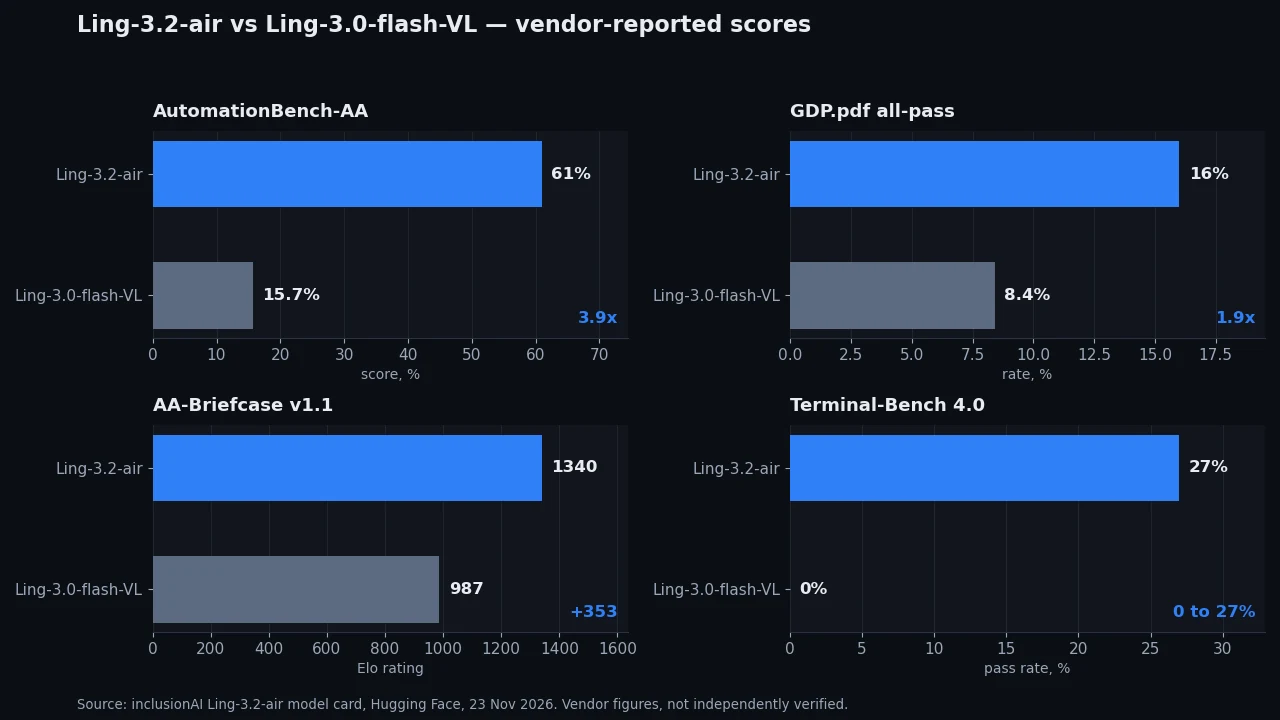
Every score below comes from Ant’s own model card, and none of it has been independently verified yet. Taken on those terms, the improvement over Ling-3.0-flash-VL is large on all four tests Ant chose to highlight: workflow automation, document reasoning, professional briefcase tasks and terminal work.
| Benchmark | Ling-3.0-flash-VL | Ling-3.2-air | Change |
|---|---|---|---|
| AutomationBench-AA | 15.7% | 61% | Nearly 4x |
| GDP.pdf all-pass rate | 8.4% | 16% | Nearly 2x |
| AA-Briefcase v1.1 (Elo) | 987 | 1,340 | +353 |
| Terminal-Bench 4.0 | 0% | 27% | From zero |
The model also scores 23 on the Artificial Analysis Intelligence Index v5.0.1. But the most honest number in the model card is not a headline score. On Harvey LAB-AA v1.1, a legal-work evaluation, Ling-3.2-air earns an 87.7% criterion pass rate — yet its all-pass rate is 8.3% before the material hallucination check and 0.8% after it. The strict check nearly wipes out the all-pass rate, which is worth stating plainly: legal document work that hallucinates material facts is not usable work, however good the criterion scores look. Vendor benchmarks for decision-making models deserve the same scepticism as any other release numbers; Baseten’s bison-1 topped the Artificial Analysis Decision Index the same week, and independent runs are the only way to settle which of these models actually holds up.
Four GPUs and day-one tooling
Ant’s recommended recipe runs the model at 256K context on four 141GB-class GPUs — H20-3e or H200 cards — or on four-GPU Blackwell nodes such as the B300 or GB300. On 80GB cards the guidance is to scale out to tensor-parallel 8. The FP8 weights keep the footprint down, and the model ships with a day-one SGLang image including MTP speculative decoding and Hopper decode optimisations, plus vLLM support. Recommended sampling is temperature 1.0, top_p 0.95 and top_k 20, with thinking enabled.
That readiness matters because the pace of releases from Chinese labs is now weekly: Z.ai’s GLM-5.4 arrived the same day, built on a loop transformer that reuses its layers twice. A model that cannot be run on release day loses the window in which developers actually try it. Ling-3.2-air can be run the same day it was published, which is the practical difference between an announcement and a release.
Where it sits in the Ling family
Ling-3.2-air is the smaller, open sibling of Ling-3.2-flash, the 560-billion-parameter flagship Ant launched on 5 November with 25 billion active parameters per token. The flagship is API-only, and Ant’s vendor claim is that it beats Claude Opus 5 (max) on three release evaluations. The air model trades that scale for openness: anyone can download it, fine-tune it and run it locally. It should not be confused with LingSante-3.1, Ant’s medical model family announced the same week. The two share the 124-billion / 5.5-billion scale, but LingSante is built for clinical work, while Ling-3.2-air is built for the office.
The licence is the notable part. Ling-3.2-air is MIT-licensed, which is about as permissive as open weights get, and a clear contrast with the custom licence Tencent attached to Hy4. The full specs, weights and quickstart are published in the model card on Hugging Face.
What to watch
Independent runs come first: the Artificial Analysis score of 23 is a starting point, and full leaderboard results will show whether Ant’s own numbers survive outside its test harness. Then pricing — Ant has not published API pricing for Ling-3.2-air, and whether it appears on the Ant Ling platform now that the flagship’s two-week free window has ended will say how Ant wants the model used. Finally, adoption: community fine-tunes and quantised builds will show whether the model is actually useful for office agents, or only good on Ant’s own tests.
What is Ling-3.2-air?
Ling-3.2-air is Ant Ling’s open-weight native multimodal mixture-of-experts model, with 124 billion total parameters and 5.5 billion active per token. It is built for workflow automation and reasoning over professional documents, takes text, image and video input, and its weights are published on Hugging Face under the MIT licence.
How much better is Ling-3.2-air than its predecessor?
On Ant’s own vendor-reported figures, AutomationBench-AA rises from 15.7% to 61%, the GDP.pdf all-pass rate from 8.4% to 16%, the AA-Briefcase v1.1 Elo rating from 987 to 1,340, and Terminal-Bench 4.0 from 0% to 27%, all against Ling-3.0-flash-VL. These are Ant’s numbers, not independently verified results.
Is Ling-3.2-air free to use commercially?
Yes. Ling-3.2-air is released under the MIT licence, one of the most permissive open licences, with FP8 weights published on Hugging Face. Check the licence file in the repository for the full terms before commercial use.
What hardware does Ling-3.2-air need?
Ant’s recommended recipe runs Ling-3.2-air at 256K context on four 141GB-class GPUs (H20-3e or H200) or four-GPU Blackwell nodes (B300 or GB300). On 80GB cards, scale out to tensor-parallel 8. SGLang and vLLM both support it from day one.
How does Ling-3.2-air differ from Ling-3.2-flash?
Ling-3.2-flash is the 560-billion-parameter flagship Ant launched on 5 November 2026, with 25 billion active parameters per token and API-only access. Ling-3.2-air is the smaller, open-weight sibling at 124 billion total and 5.5 billion active parameters, aimed at workflow automation and document reasoning.
What did Ling-3.2-air score on the Harvey legal benchmark?
On Harvey LAB-AA v1.1, Ling-3.2-air earns an 87.7% criterion pass rate, but its all-pass rate is 8.3% before the material hallucination check and 0.8% after it. The strict hallucination check nearly wipes out the all-pass rate, which is a vendor-reported result worth reading alongside the headline scores.