Midjourney Launches Niji V8, Its Fastest Anime Model Yet
Midjourney and Spellbrush have released Niji 8, the new version of the anime-focused image model. It is the fastest Niji yet, and a new Edit feature brings back the character consistency Niji 6 users lost — but the same prompt will no longer give you the same character twice.
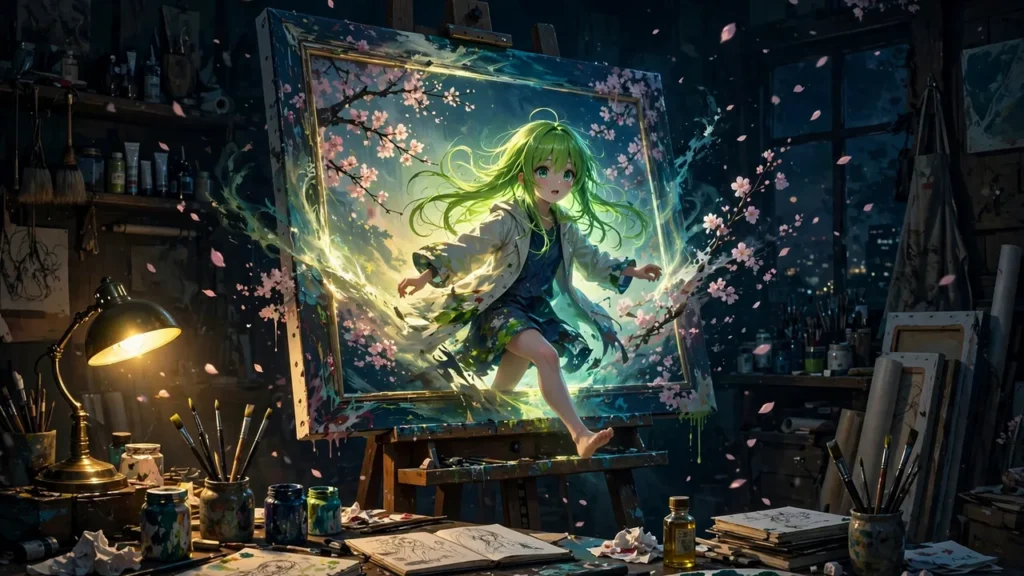
Midjourney and Spellbrush have released Niji 8, the new version of the anime and illustration model, and the headline change is not the pictures it makes. It is what happens after you make one: a new Edit feature that keeps a character looking like the same character across different scenes.
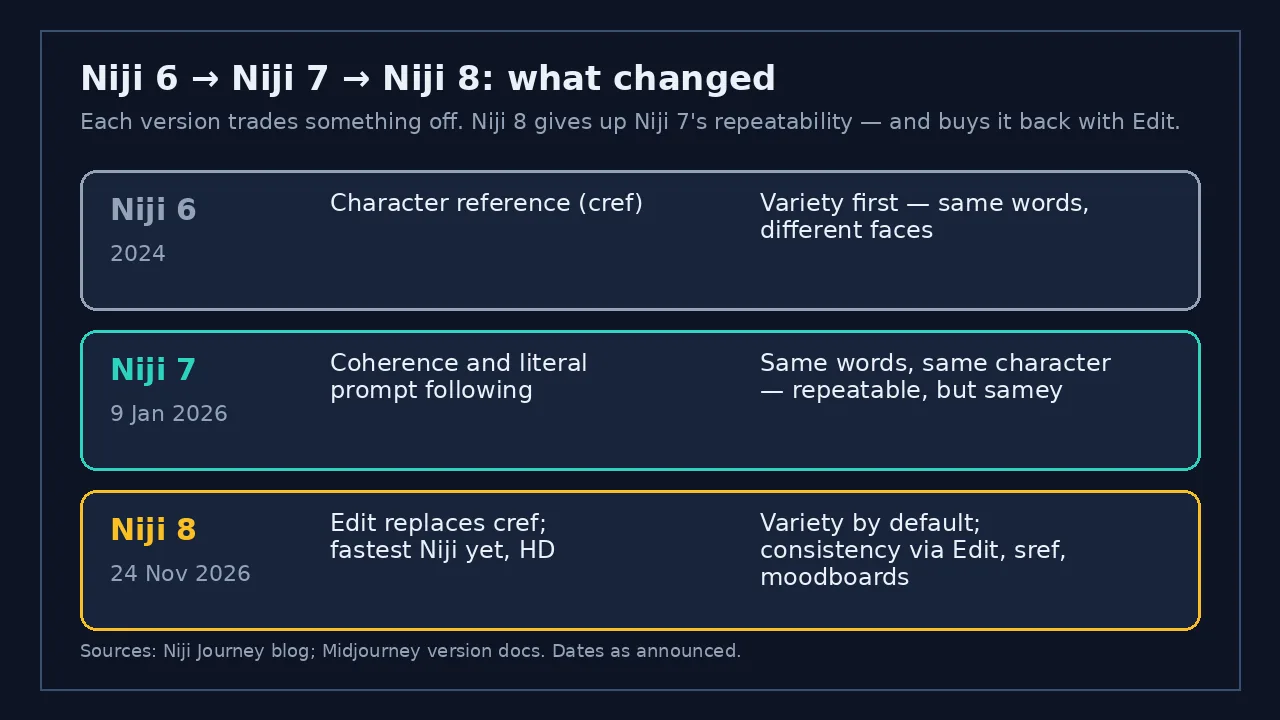
Note that Niji is a separate line from Midjourney’s main model. The default photo model remains V8.2, in place since 24 July 2026. Niji 8 is the anime lane, and it is the first new Niji version since Niji 7 arrived in January.
What the launch brings
Midjourney describes Niji 8 as the fastest and most coherent Niji model yet, and the announcement puts particular emphasis on the HD feature, which the team says is both very beautiful and very fast. The other headline is prompt following: the model handles spatial detail and multi-part instructions better than Niji 7 did, to the point where a single prompt can produce a simple comic page. One example in the announcement asks for a three-panel manga page — a plane landing, the wheels on a suitcase, a pleased traveller at the airport — and gets a usable page back.
The launch was announced on the Niji Journey blog on 24 November, and it is live now for subscribers. Type --niji 8 after a prompt in Discord, or pick “Niji 8” from the Version dropdown on the web. Plans start at $10 a month for the Basic tier, and Midjourney publishes no benchmark scores for Niji models, so the speed and coherence claims are the company’s own.
How the Edit feature works
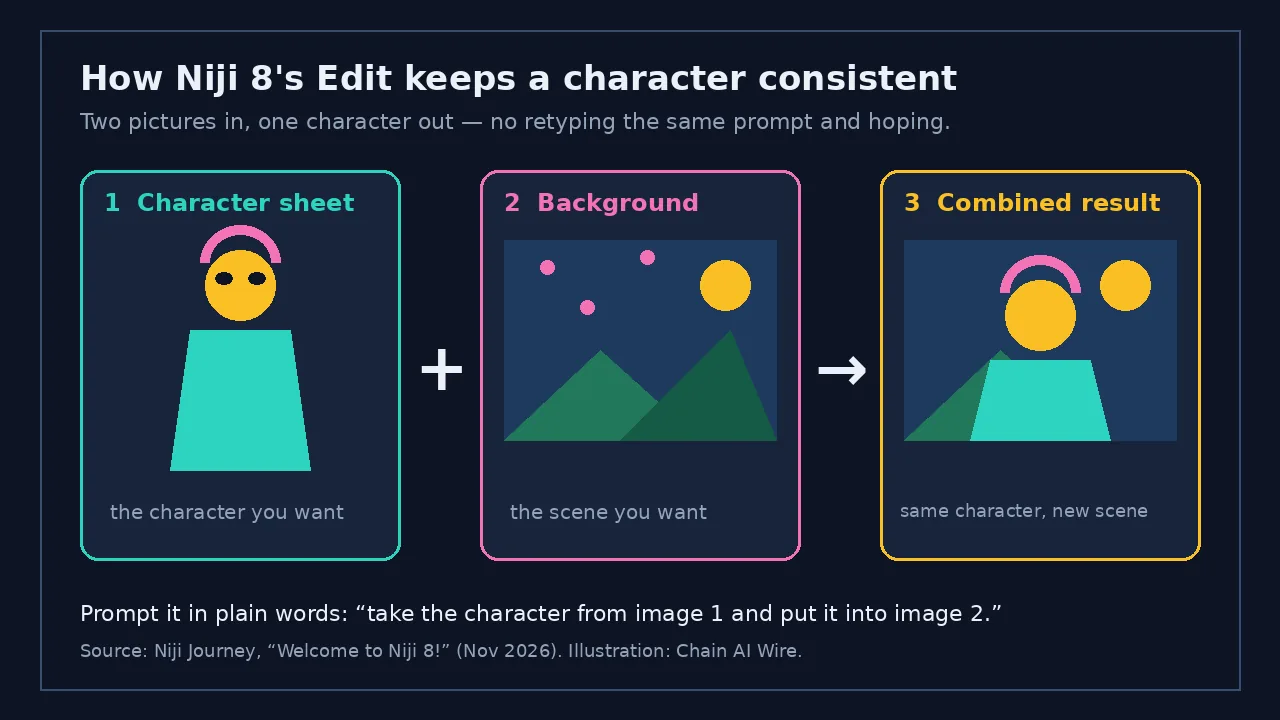
The Edit feature is the answer to the most-missed capability in the Niji line. Niji 6 had a character reference tool, known as cref, that let creators hold a character steady. It disappeared in Niji 7, and users have asked for it back ever since. Niji 8 brings it back in a different form: instead of a reference slot, you edit a finished image.
Press the quick edit button on a completed generation and attach more pictures — a character sheet and a background, for example — then describe the change in plain words. The blog’s own example is “take the character from image 1 and put it into image 2, lying down.” One picture is enough for small touchups, like adding a hair bun, but the team says two pictures give the most control over quality and style.
The same update improves the consistency tools around Edit. Style references and moodboards are both better in Niji 8, which matters because the model itself has changed its mind about repetition.
“Many of you missed the cref feature from Niji 6. After much work, we’re finally back with its replacement: the edit feature, which allows you to pose your characters into different backgrounds while keeping consistency.”
What changed from Niji 7
Niji 7’s strength was also its limitation. Type the same words and you got the same character, which made series work easy and made everything look alike. Niji 8 deliberately breaks that. The same prompt now produces a wide variety of characters, much like Niji 6 did, and consistency has to be earned through Edit, style references or moodboards rather than assumed.
The team frames it as a trade-off between two things creators want at once: range before you know what you want, and lock-in after you have found it. The blog puts it plainly: “We made the decision to hold back on launching it until we could make sure that the characters could be reproducible through other means, like the edit function.” In other words, the launch waited until the replacement for cref was ready, rather than shipping a model that could not hold a character at all.
There is one more behaviour worth knowing before you type. Niji 8 reads prompt length as intent: longer, more specific prompts produce less variety, shorter prompts more. The team says it worked out that a longer prompt means you have a stronger idea of what you want, so the model narrows its range accordingly.
The timing fits a wider pattern. Image models have spent the last month competing on control rather than raw quality: SenseTime’s self-correcting image model reads its own output back and fixes it, while the text-model launches — GPT-6.2, GLM-5.4 and Ling-3.2-air — have all been judged as much on how reliably they follow instructions as on what they can do. Niji 8 is Midjourney’s version of the same argument, aimed squarely at people making comics, manga and game art.
What it doesn’t mean
- Niji 8 is not a free upgrade for everyone. There is no free tier; it is available to paid subscribers, from $10 a month on Basic.
- It does not keep characters consistent on its own. Repeating a prompt will now give you different characters. Consistency comes from Edit, style references or moodboards, not from the prompt alone.
- It is not a general-purpose Midjourney upgrade. Niji 8 covers anime and illustration. Photo work still runs on V8.2.
- The speed and coherence claims are not independently verified. Midjourney publishes no benchmark numbers for Niji models, so “fastest yet” is the company’s own description, not a measured result.
What to watch
The first test is whether Edit actually holds a character across a full comic sequence, not just a single edit — that is the claim the launch is built on, and early users are already putting it through manga pages and character sheets. The second is whether Midjourney extends the same editing idea to the main V8 line, where character consistency is just as wanted and just as hard. And the third is the Niji Journey app, where the model is reaching a newer, younger audience than Midjourney’s Discord-first crowd.
This article is for information only and is not financial advice.
What is Niji V8?
Niji V8 is the latest version of Midjourney’s anime and illustration model, built with Spellbrush. It launched on 24 November 2026, succeeding Niji 7 from January 2026. Midjourney calls it the fastest and most coherent Niji model yet.
How do I use Niji V8?
Type –niji 8 after your prompt in Discord, or select “Niji 8” from the Version dropdown in the Midjourney web interface. Niji V8 is available to paid subscribers; Midjourney’s plans start at $10 a month for the Basic tier.
How does the Edit feature keep a character consistent?
Press the quick edit button on a finished image, then attach a character sheet and a background and describe the change in plain words, for example “take the character from image 1 and put it into image 2, lying down.” Two images give the most control; one image works for small touchups. The feature replaces the character reference (cref) tool from Niji 6.
What is the difference between Niji 8 and V8.2?
Niji 8 is Midjourney’s anime and illustration line, built with Spellbrush. V8.2 is the default photo model, in place since 24 July 2026. The two run side by side under the same subscription.