
NVIDIA Quietly Drops Open Weights for Nemotron-Labs-Image-30B-A3B, an Image Model That Tops GPT Image 2
NVIDIA has quietly released open weights for Nemotron-Labs-Image-30B-A3B, a 30B image generator that beats GPT Image 2 on NVIDIA’s own benchmarks — but the weights are for non-commercial research only, and the harness behind the headline scores is not out yet.

At a glance: NVIDIA has quietly released open weights for Nemotron-Labs-Image-30B-A3B, a 30-billion-parameter image generator that builds pictures from discrete visual tokens. On NVIDIA’s own benchmarks, the full system beats GPT Image 2 on GenEval. The catch: the weights are licensed for non-commercial research only, and the agentic harness behind the headline scores is not released yet.
No blog post. No launch event. NVIDIA just pushed the weights to Hugging Face and let the community find them.
The release surfaced on Reddit’s r/LocalLLaMA around midnight, and Wccftech picked it up on Tuesday morning. The paper behind it went up on arXiv on 23 November.
What did NVIDIA actually release?
The weights for Nemotron-Labs-Image-30B-A3B, an autoregressive image generator. It predicts discrete visual tokens, one after another, and a bundled tokenizer decodes them into pixels.
It is a mixture-of-experts model with 30 billion parameters in total and 3 billion active per token. The architecture is NVIDIA’s Nemotron-H hybrid design, blending Mamba-2 state-space layers with attention, and it was initialised from Nemotron 3 Nano. Training was progressive mid-training followed by GRPO, a reinforcement-learning method, for semantic alignment and image quality.
- 30B total parameters, 3B active per token — a mixture-of-experts design
- Autoregressive: it generates images token by token, the way a language model writes words
- Bundled visual tokenizer: roughly 642M parameters, 16×16 patches, a codebook of 196,560 vectors
What is VisualCreation?
The image model is one part of a bigger framework called Nemotron-Labs-VisualCreation. Its idea is “Pixel as Code”: the same system generates raster images and editable artefacts — webpages, presentations, documents, charts and scientific figures — through a harness that plans, renders, inspects and repairs its own output.
The harness routes work three ways: direct raster generation, browser-based structured or hybrid creation, and native-format generation for presentations, documents and SVG. A visual model checks the rendered result and sends it back for repairs, with up to three accepted fixes in eight cycles.
- The harness is not released yet — it is marked “will be released upon legal clearance”
- VisionCode, the structured-coding models in 30B and 120B sizes, is also still held back
- What you can download today is the image generator and its tokenizer — 32 safetensors shards

How do the numbers look?
NVIDIA reports its best score for each benchmark across the configurations in its paper. On GenEval, the full VisualCreation system scores 92.86 against 89.00 for GPT Image 2. On LongTextBench, which tests dense text inside images, it scores 97.98 against 96.00. On BizGenEval it leads 86.0 to 83.2, and on WISE Verified 91.50 against 87.60 for Nano Banana Pro.
Those are NVIDIA’s own numbers, and they describe the full system, not the model alone. The image generator on its own scores 80.97 on GenEval. With NVIDIA’s agents it reaches 86.40, and with GPT-6 agents 92.86. The system also loses some: GPT Image 2 leads on GenEval2, 81.00 to 65.43, and on Qwen-Image-Bench, 65.23 to 52.46. SenseNova’s U1.5 — covered here this week — still leads LongTextBench at 98.80.
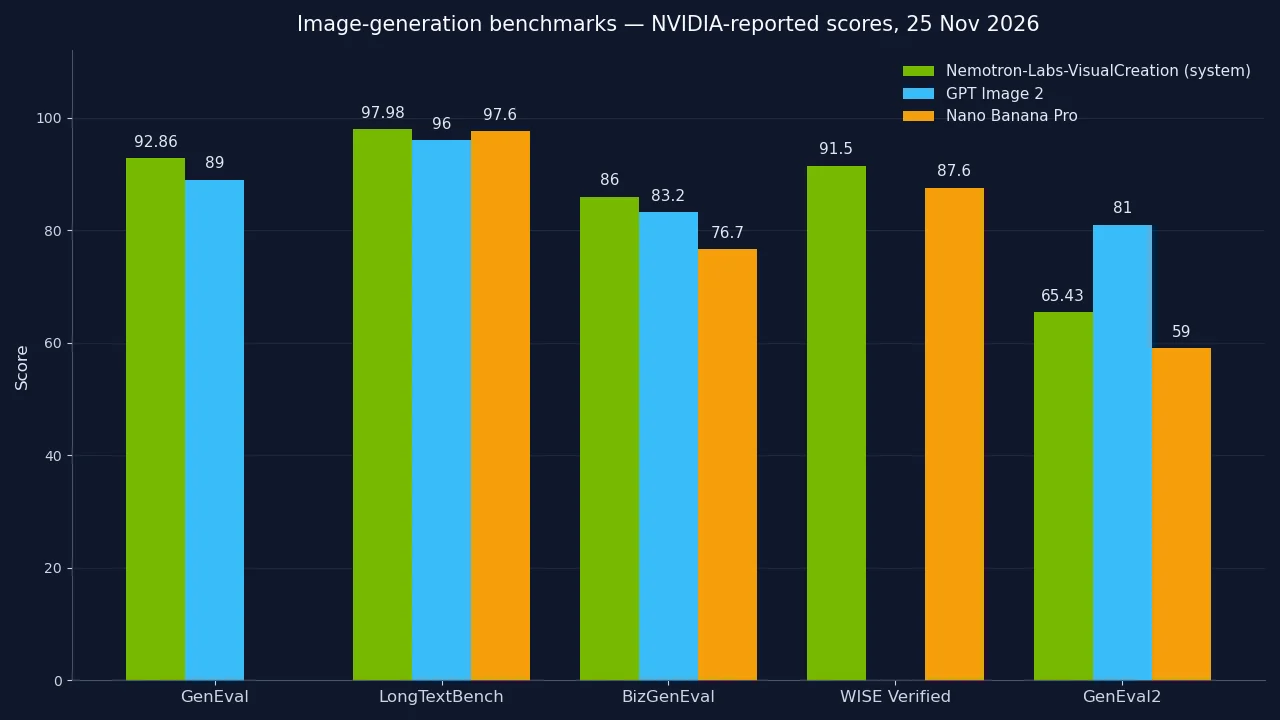
- GenEval 92.86 vs 89.00 for GPT Image 2 — but only with the full agent system
- Standalone image model: 80.97 on GenEval
- LongTextBench 97.98 — the model’s strongest result, and text is where image models usually fail
Can you actually run it?
Only with serious hardware. The download is about 133 GB across 32 shards, and NVIDIA’s reference setup wants four H100 80GB cards, Python 3.12 and CUDA 13. This is a research release, not a model for a laptop.
The licence is the part that matters most. The weights are released under NVIDIA’s own licence for non-commercial research and evaluation only. That makes this a research release, not an open model in the permissive sense — anyone building a product on it would need a different arrangement with NVIDIA. It follows MemT-1.0-Pro, the memory-native model NVIDIA opened with MemTensor on Monday, and Baidu’s ERNIE 5.5 Flash Preview, which opened under Apache 2.0 the same day. It is a big week for image models, too: Midjourney launched Niji V8, its fastest anime model yet, on Monday.
Key numbers:
- 30B total parameters, 3B active per token
- 133 GB download, 32 safetensors shards
- 4× H100 80GB GPUs in the reference setup
- 92.86 GenEval for the full system, 80.97 for the image model alone
- 97.98 LongTextBench, vs 96.00 for GPT Image 2
- Non-commercial licence — research and evaluation only
Read the model card on Hugging Face for the full results and the release plan.
Bottom line: NVIDIA’s first serious image model is real, downloadable and strong on text-heavy images — but the headline scores belong to a system you cannot download yet, and the licence keeps it out of products.
Is Nemotron-Labs-Image-30B-A3B open source?
No. The weights are released under NVIDIA’s own licence for non-commercial research and evaluation only. It is a research release, not an open-source model, and anyone building a product on it would need a different arrangement with NVIDIA.
How big is the model?
Nemotron-Labs-Image-30B-A3B has 30 billion parameters in total, with 3 billion active per token. The download is about 133 GB in 32 safetensors shards, and NVIDIA’s reference setup uses four H100 80GB GPUs.
How does it compare with GPT Image 2?
On NVIDIA’s own benchmarks, the full VisualCreation system scores 92.86 on GenEval against 89.00 for GPT Image 2. The image model alone scores 80.97. GPT Image 2 leads on GenEval2 (81.00 to 65.43) and on Qwen-Image-Bench (65.23 to 52.46).
What is still missing?
The VisualCreation harness and the VisionCode models are marked “will be released upon legal clearance” on the model card. The full system behind the headline benchmark scores cannot be downloaded or reproduced yet.