Robbyant Open-Sources LingBot-Map 2.0 and LingBot-Navi: Robots That Remember Where They Have Been
Robbyant has open-sourced LingBot-Map 2.0, a streaming 3D mapping model that cuts drift by about 85%, and LingBot-Navi, a navigation model that remembers maps between jobs. Navi is Apache 2.0, but the Map 2.0 weights are non-commercial.

At a glance: Robbyant, Ant Group’s embodied AI company, has open-sourced two robot models that work as a pair. LingBot-Map 2.0 builds a live 3D map from a single camera and corrects its own drift as it goes. LingBot-Navi remembers that map between jobs and navigates from it. The catch is in the licences: Navi is Apache 2.0, but the Map 2.0 weights are non-commercial.
The release landed on Friday 27 November, announced by Robbyant on BusinessWire, with the code, weights, technical reports and a 511-scene dataset published the same day. Robots have a memory problem. They can see, and they can move, but most of them forget the room the moment the job ends. Robbyant’s answer is to give them a memory that persists.
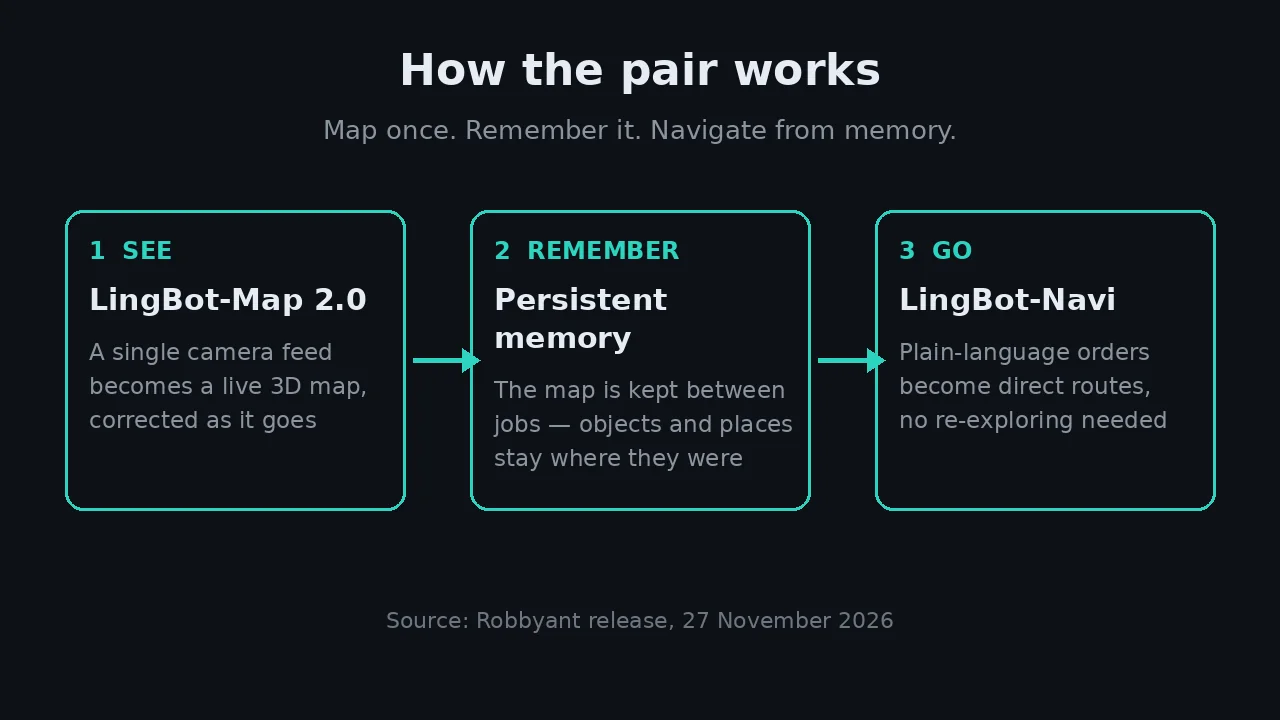
What does LingBot-Map 2.0 actually do?
It watches the world through one ordinary camera and builds a 3D map while the video is still streaming. No LiDAR. No offline batch pass. Each frame produces camera pose, depth and a dense point cloud in a single forward pass.
The new part is what happens inside the model. Version 1.0, released in April 2026, could map long routes but drifted: small errors piled up until the map no longer matched the room. Version 2.0 adds Geometric Context Reshaping, a mechanism Robbyant says is inspired by memory reconsolidation in the human brain. It reuses extracted local geometry and realigns the model’s high-level historical memory without re-encoding images.
That matters because the correction lands in the model’s internal memory layer, not just in the output. Every fix becomes a reliable reference for the next movement. No external place-recognition module. No pose-graph optimisation backend. The model fixes itself, in real time.
Robbyant’s visual foundation model, LingBot-Vision, sits underneath it all, providing sub-pixel boundary detection to cut geometric errors at the source. The whole thing runs at 27.51 frames per second on a single NVIDIA RTX 5090, according to the company.
- One camera, no LiDAR: a monocular RGB feed becomes a dense, metrically consistent 3D map.
- It corrects itself: Geometric Context Reshaping fixes drift inside the model’s memory, not just in the output.
- Real-time speed: 27.51 frames per second on a single RTX 5090, Robbyant-reported.
How much better is the new mapping?
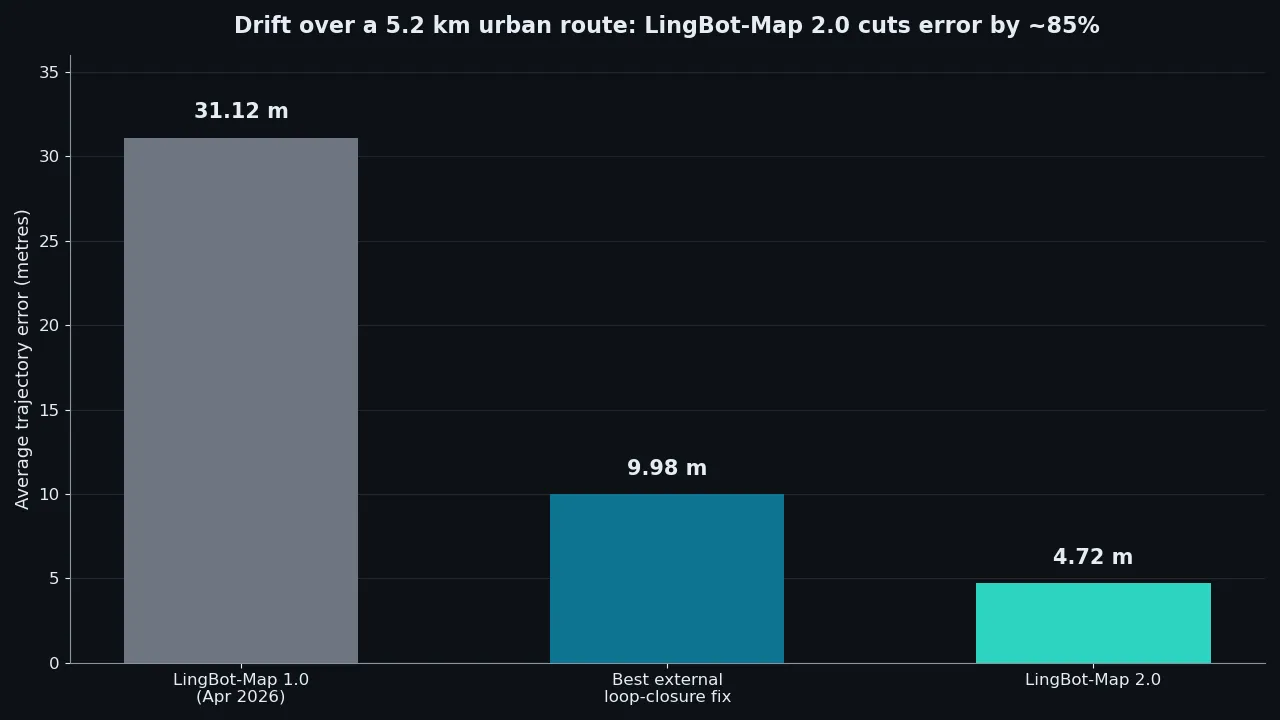
On Robbyant’s own numbers, the gap is large. The headline test is a 5.2 km urban route of nearly 19,000 frames. Average trajectory error fell from 31.12 metres in version 1.0 to 4.72 metres in version 2.0. That is a reduction of nearly 85%.
It also beats the conventional fix. The best external loop-closure solution Robbyant compared against managed 9.98 metres on the same route. Map 2.0 is more than twice as accurate, without any external correction step at all. On the Oxford Spires and KITTI benchmarks, error fell to 3.92 metres and 9.42 metres respectively. The model also took first place across three dense 3D reconstruction benchmarks: CroCoDL, EuRoC and Oxford.
One honest note: every number here is Robbyant-reported. No independent leaderboard has replicated them yet. The pattern is familiar from the open-weights releases of recent weeks, where vendor benchmarks arrive first and outside checks follow. Treat the 4.72 metres as a claim to watch, not a settled fact.
Key numbers: 27.51 FPS on one RTX 5090; 31.12 m to 4.72 m trajectory error over 5.2 km; 9.98 m for the best external loop-closure fix; 3.92 m on Oxford Spires; 9.42 m on KITTI; first place on CroCoDL, EuRoC and Oxford.
- Drift down ~85%: 31.12 metres of error in version 1.0 becomes 4.72 metres in 2.0.
- Twice as accurate as the old fix, with no external loop-closure step needed.
- All figures are vendor-reported. Independent replication has not happened yet.
What does LingBot-Navi add?
A map is only half the job. The other half is using it twice. LingBot-Navi is built on LingBot-Map 2.0’s 3D perception, and it adds the part robots usually lack: a memory that survives the end of a task.
Today’s navigation models mostly wipe their map when the job finishes. The next order starts from scratch, and the robot re-explores rooms it has already seen. Navi keeps object and location data between missions. Give it a plain-language order, and it pulls the relevant context, plans a direct route, and goes. Each run refines its understanding of the space, so execution gets faster over time.
It also runs on-device, keeping commands and scene data local. That means lower latency and no video leaving the building, which matters for warehouses, hospitals and homes alike.
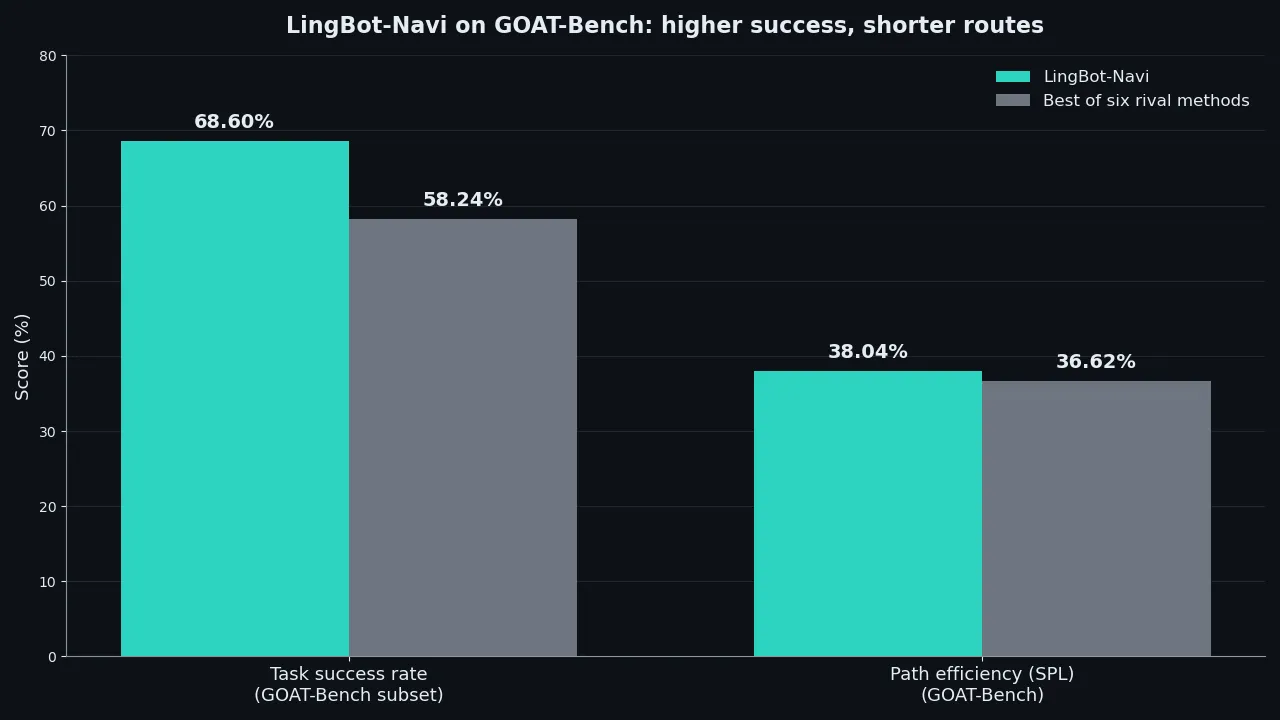
The scores, again Robbyant-reported, are strong. In simulations where the model picks targets and a simulator drives, Navi hit a 68.60% success rate on a GOAT-Bench subset, beating the best of six rival methods by 10.36 percentage points. Fully end-to-end, where it plans and drives itself, it reached 56.09% on GOAT-Bench and 32.36% on Robbyant’s own dataset, rebuilt from 36 real-world sites.
Routes are shorter too. Its path-efficiency score, which rewards reaching the target without detours, came in at 38.04% on GOAT-Bench and 26.35% on the company’s own data. And the pairing pays off directly: simply swapping the mapping engine underneath Navi from version 1.0 to 2.0 lifted success rates by 4.15 and 2.35 percentage points across two test sets, with no retraining of the navigation model at all.
- Memory that persists: maps and object locations survive between jobs.
- Plain-language orders: tell it where to go in words, and it plans the route.
- 68.60% success on GOAT-Bench, 10.36 points clear of the best of six rivals.
- Better maps mean better navigation: the 2.0 upgrade alone added up to 4.15 points, with zero retraining.
Can developers really use it for free?
Mostly, with one big asterisk. The release covers the technical reports, the code, the weights and a dataset of 511 real-world scenes. But the two models carry different licences, and they point in opposite directions.
LingBot-Navi is the open one. Its Navigation Transformer, built on Alibaba’s Qwen3.5-4B, and its Local Planner are both released under the Apache 2.0 licence. Commercial use is allowed.
LingBot-Map 2.0 is not. Its base streaming weights are licensed under CC BY-NC 4.0, a non-commercial licence. That is a step back from version 1.0, which shipped under Apache 2.0 in April. Anyone planning a product on the mapper needs to read that licence first, not the press release.
There is a second wrinkle. The Map 2.0 model card on Hugging Face says authentication is required while the repository is private. The release calls the weights fully open-sourced, but for now downloading them may need a Hugging Face sign-in. Worth checking before promising a team a frictionless install.
- LingBot-Navi: Apache 2.0. Commercial use allowed.
- LingBot-Map 2.0 weights: CC BY-NC 4.0. Non-commercial only, unlike version 1.0.
- Access may need a sign-in while the base weights repository stays private.
Why does this matter beyond the warehouse?
Because the bottleneck in physical AI is not seeing. It is remembering. A robot that re-maps the same room every morning wastes time, compute and battery on work it has already done. A robot that remembers gets faster at its job instead of starting over.
Robbyant is explicit about where this goes. The company, part of Ant Group, lists warehouse logistics and last-mile delivery first, then elderly care, medical assistance and household tasks. The same stack already includes LingBot-Depth, LingBot-VLA, LingBot-World and LingBot-Vision, so Map 2.0 and Navi slot into a larger embodied-AI system rather than standing alone.
The timing is part of a wider pattern. Robot models are having their open-weights moment: X Square Robot’s WALL-OSS-1.0, a vision-language-action model that works without task-specific training, landed days ago, and autonomous AI agents are now a design target for whole blockchains. Mapping and navigation are the unglamorous half of that story, and they are the half everything else depends on.
- The bottleneck is memory, not vision. Robots that remember get faster; robots that forget start over.
- It fits a bigger stack: Depth, VLA, World and Vision models already exist alongside it.
- Robot models are going open in waves, and mapping is the foundation the rest stands on.
Bottom line: Robbyant gave robots a memory — now the licence on the map decides who gets to use it.
What is LingBot-Map 2.0?
LingBot-Map 2.0 is Robbyant’s streaming 3D reconstruction model, released on 27 November 2026. It turns a single ordinary camera feed into a live, dense 3D map as the robot moves, correcting its own drift while it goes instead of relying on external loop-closure tools. It runs at 27.51 frames per second on a single NVIDIA RTX 5090, according to Robbyant.
What does LingBot-Navi do?
LingBot-Navi is Robbyant’s navigation model, released the same day. It keeps the map LingBot-Map 2.0 builds and reuses it across jobs, so a robot can take plain-language orders, plan a direct route to a remembered object or place, and skip re-exploring rooms it already knows. On the GOAT-Bench subset it reached a 68.60% task success rate, Robbyant-reported.
Are LingBot-Map 2.0 and LingBot-Navi free for commercial use?
Not both, and the split matters. LingBot-Navi is released under the Apache 2.0 licence, which allows commercial use. The LingBot-Map 2.0 base streaming weights are licensed under CC BY-NC 4.0, which is non-commercial. Check the licence on each Hugging Face repository before building a product on either model.
Where can developers download LingBot-Map 2.0 and LingBot-Navi?
From Robbyant’s GitHub repositories and Hugging Face collections, linked in the company’s 27 November 2026 announcement. The release also includes technical reports and a dataset of 511 real-world captured scenes. Note that the LingBot-Map 2.0 base streaming model card currently says authentication is required while the repository is private, so access may need a Hugging Face sign-in for now.
How much better is LingBot-Map 2.0 than version 1.0?
On Robbyant’s own numbers, a lot. Over a 5.2 km urban route of nearly 19,000 frames, average trajectory error fell from 31.12 metres in version 1.0 to 4.72 metres in version 2.0, a reduction of nearly 85%. That is also more than twice as accurate as the best external loop-closure fix Robbyant compared against, at 9.98 metres. All figures are Robbyant-reported and not yet independently verified.
What is Robbyant?
Robbyant is an embodied AI company within Ant Group, the Chinese fintech group behind Alipay. It builds foundation models for robots, including LingBot-Depth, LingBot-VLA, LingBot-World and LingBot-Vision, and says it is working toward robotic companions and caregivers for elderly care, medical assistance and household tasks.