
Liquid AI d1.3-ultra Tops the Decision Index and Undercuts Bison-1 on Price
Liquid AI's d1.3-ultra scores 76.4 on the Artificial Analysis Decision Index, edging out Baseten's Bison 31B at about 60% lower cost per task. The lead is half a point, and the model is API-only.

Liquid AI has released d1.3-ultra, the newest model in its d1 family of decision models, and it now sits at the top of the Artificial Analysis Decision Index with a score of 76.4. The company announced the release on 27 November 2026, eleven days after d1.2-ultra, and the model is live now in the Liquid console and API at $0.042 per million input tokens, with no charge for output tokens.
Note that the headline needs a small correction before it is repeated. Rounded to whole numbers, d1.3-ultra and Bison 31B both display a score of 76, which is why some coverage calls the result a tie. On the unrounded figures in the index table, d1.3-ultra leads 76.4 to 75.9. The lead is half a point, not a rout, and the rest of this article keeps the two readings separate.
What the announcement says
Liquid announced the model in a post on X, calling it the most powerful decision model it has shipped and saying it was recursively improved from d1-ultra, the second model in the family. A decision model does not chat. It takes an input, a document, a receipt photo, an audio clip, plus a list of questions, and returns an answer to each question with a probability for every option, in a single pass, generating no text. That is also why it bills input tokens only: there is no output stream to pay for.
“Today we release d1.3-ultra, our most powerful decision model, recursively improved from d1-ultra. #1 on @ArtificialAnlys decision index 2.1. (76.4)”
Liquid AI (@liquidai), 27 November 2026
Three capabilities are new in this release. Rankings let the model order a set of options or return the top results, instead of only approving or rejecting one item at a time. Extraction, which d1.2 introduced for documents, now reads numbers and dates straight from pictures and audio, such as a receipt total off a photo or a date spoken in a clip. Spans, which d1.2 introduced for finding passages, now return start and end times for where something is said in an audio recording. Liquid also says the model follows policies and contracts more closely, handles hard questions better, refuses more reliably when it is unsure, and copes better with messy inputs, after training on real scanned documents, receipts, tables and long reports, dates in local formats, more languages, and instructions planted inside the input that it is meant to treat as data rather than as commands.
How we got here
The d1 line has moved fast. The original d1 arrived on 5 October, d1-ultra followed on 15 October, d1.2 landed on 16 November, and d1.3-ultra now arrives eleven days after that. The lead on the index has changed hands with each release since 16 November: d1.2-ultra held it, then Baseten’s Bison-1 took it on 20 November, and now d1.3-ultra has it back. Liquid AI is a spin-out of MIT’s computer science lab, founded by Ramin Hasani, Mathias Lechner, Alexander Amini and Daniela Rus, which raised a $250 million Series A in December 2024 with AMD Ventures as strategic lead. Decision models are its newer line, and a separate category from the chat models that dominate the headlines, such as OpenAI’s GPT-6.2. The release lands in a crowded week for model launches: Sber’s GigaAM-v4 speech model arrived the same day.
What the numbers actually show
The score that matters here is not Liquid’s own. Artificial Analysis runs every test on its Decision Index itself, so the 76.4 is an independent measurement, and the index tracks 27 decision models. Version 2.1 scores each model on six evaluations: AA-Paperclip, which carries 30% of the weight, plus EvalSafe-O*NET-AA, AA-Omniscience-Decision, HLE-MultiChoice and AA-Symmetry at 15% each, and When2Call at 10%. The index subtracts a penalty when a model is confidently wrong, so a hesitant miss costs less than a certain one.
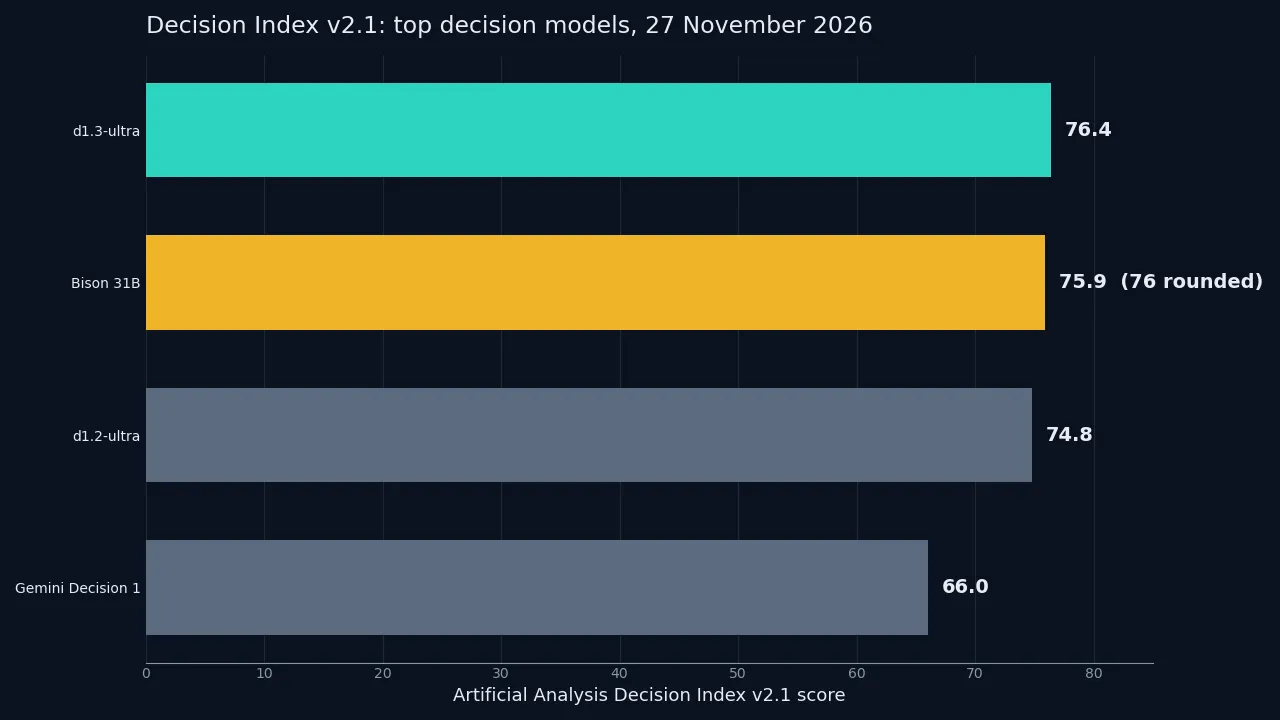
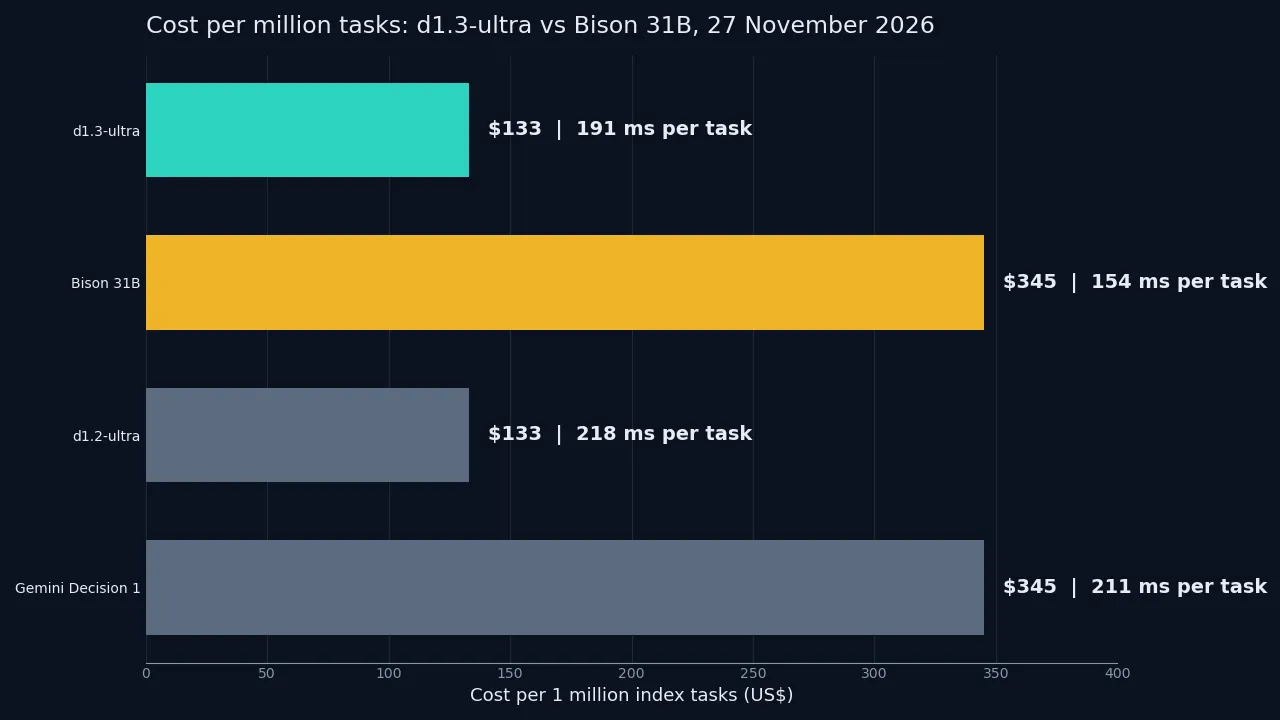
The full table puts the price gap in plain view. Artificial Analysis measures cost by running its own index, so the per-task figures are its numbers, not Liquid’s. The token prices are the vendors’ list prices: $0.042 per million input tokens for d1.3-ultra against $0.10 for Bison 31B.
| Model | Decision Index v2.1 | Cost per 1M tasks | Time per task |
|---|---|---|---|
| d1.3-ultra (Liquid AI) | 76.4 | $133 | 191 ms |
| Bison 31B (Baseten) | 75.9 (76 rounded) | $345 | 154 ms |
| d1.2-ultra (Liquid AI) | 74.8 | $133 | 218 ms |
| Gemini Decision 1 (Google) | 66 | $345 | 211 ms |
The sub-test spread shows where the new model is strong and where it is not. Its best result is When2Call at 97.0, and EvalSafe-O*NET-AA at 89.7 and AA-Symmetry at 86.2 are close behind. Its weakest is HLE-MultiChoice at 48.3, with AA-Paperclip at 77.2 and Omniscience-Decision at 66.2 in between. Two honest caveats sit alongside the headline. Artificial Analysis puts d1.3-ultra 11th of 27 on cost and 13th on speed, so this is a top score at a middling price, not the cheapest route on the board. And the gain over its own predecessor is 1.6 points, from 74.8 to 76.4, with the first six models on the index bunched within about four points of each other.
What it doesn’t mean
- It is not a clear win. Half a point on one index, with the top six models bunched within about four points, is a lead, not a verdict.
- It is not cheaper for every workload. The $133 against $345 gap is measured on Artificial Analysis’s own index workload. Real bills depend on how a customer’s work maps onto per-task and per-token pricing.
- It is not open. d1.3-ultra is a hosted API model only. There are no weights, no model card and no technical report, and Liquid says OpenRouter and Vercel support is coming soon. The company has reaffirmed a commitment to releasing an open-source version, with no date given.
- It is not independently verified beyond the index. Liquid’s claim of improvements across more than 100 internal benchmarks is its own, and it has published no figures for that suite.
- It is not faster. Bison 31B answers each task in 154 milliseconds against 191 for d1.3-ultra, so the cheaper model is also the slower one per call.
- It is not fully documented yet. As of 28 November, Liquid’s own documentation still listed d1.2-ultra as its most capable model, with no entry for d1.3-ultra.
Why it matters for buyers
Decision models are plumbing, not conversation. They sit behind support desks, invoice checks, contract reviews and triage queues, where a system needs a firm yes or no and a probability it can act on, not a paragraph. A single-pass model that returns a probability and charges only for input tokens is built for that volume, and at Artificial Analysis’s measured rates a million decisions costs $133 on d1.3-ultra against $345 on Bison 31B. That gap is the story now that the scores are effectively tied: the choice between the two is about price, latency and features, not quality. It is a different question from the one general models answer. A model such as Google’s Gemini 4 Carbon is judged on broad capability; a decision model is judged on one narrow question, how well it makes a call, and on what each call costs.
What to watch
Whether the OpenRouter and Vercel listings Liquid promises actually appear, and when. Whether Liquid publishes a model card or technical detail for d1.3-ultra, and whether its documentation catches up with its own announcement. Whether the half-point lead survives the next Artificial Analysis rescore, and whether Baseten answers with a new Bison. And whether anyone outside Liquid replicates the 100-plus internal benchmarks the company cites but has not published.
This article is for information only and is not financial advice.
What is Liquid AI’s d1.3-ultra?
d1.3-ultra is a hosted decision model from Liquid AI. It takes an input and a list of questions and returns an answer to each question with a probability for every option, in a single pass, generating no text. It has a 64,000-token context window and is live in the Liquid console and API at $0.042 per million input tokens, with no charge for output tokens.
How does d1.3-ultra compare with Bison 31B?
On the Artificial Analysis Decision Index v2.1, d1.3-ultra scores 76.4 against 75.9 for Baseten’s Bison 31B on the unrounded figures; both display as 76 when rounded. d1.3-ultra costs $133 per million index tasks against $345 for Bison 31B, but answers more slowly, at 191 milliseconds per task against 154 milliseconds.
Is d1.3-ultra open source?
No. d1.3-ultra is available only through Liquid AI’s console and API. Liquid says OpenRouter and Vercel support is coming soon and has reaffirmed a commitment to releasing an open-source version, but it has given no date.