GigaAM-v4: Sber’s 238M Speech Model Outhears Whisper — and Speaks 21 Languages
Sber has open-sourced GigaAM-v4, a 238M-parameter speech model that beats Whisper large-v3 on English tests in Sber's own measurements. Its 21-language sibling covers languages Whisper barely speaks — both under the MIT licence.
At a glance: Sber has released GigaAM-v4 and GigaAM Multilingual-v2, two open speech-recognition models under the MIT licence. The 238-million-parameter GigaAM-v4 beats OpenAI’s 1.55-billion-parameter Whisper large-v3 on English tests in Sber’s own measurements, and the 776-million-parameter multilingual model covers 21 languages with live streaming transcription.
Whisper has been the default answer for speech recognition for years. It is big, it is general, and it is free to use. Sber just made the case that it does not have to be the best answer, at least not in the languages these models were built for.
The release landed on 27 November, announced in a detailed post on Sber’s corporate blog on Habr. Two models arrived together: GigaAM-v4, a 238-million-parameter model for Russian and English, and GigaAM Multilingual-v2, a 776-million-parameter model covering 21 languages. Both ship under the MIT licence, with weights on Hugging Face under Sber’s ai-sage organisation and code on GitHub.
What did Sber actually release?
GigaAM-v4 is the specialist. It handles Russian and English, and Sber positions it as the best open model in its class (models up to 300 million parameters). It comes in two decoder flavours, CTC for speed and RNN-T for accuracy, and both run on the same new encoder.
Multilingual-v2 is the polyglot. It covers 21 languages: Russian and English, European languages like German and French, and languages of the former Soviet Union such as Kazakh, Uzbek and Tatar. It was pretrained on more than 10 million hours of unlabeled speech and fine-tuned on 155,900 hours across those 21 languages.
Both models transcribe as you speak. They split audio into chunks of 160, 320 or 640 milliseconds and return partial transcripts while the speaker is still talking. And both output two versions of every transcript at once: a raw version in lowercase with numbers spelled out, and a formatted version with punctuation, capitals and digits.
Takeaways:
- Two models, one release: v4 for Russian and English (238M parameters), Multilingual-v2 for 21 languages (776M).
- Both MIT-licensed, both stream live, both output raw and formatted text.
How does a 238M model beat a 1.55B one?
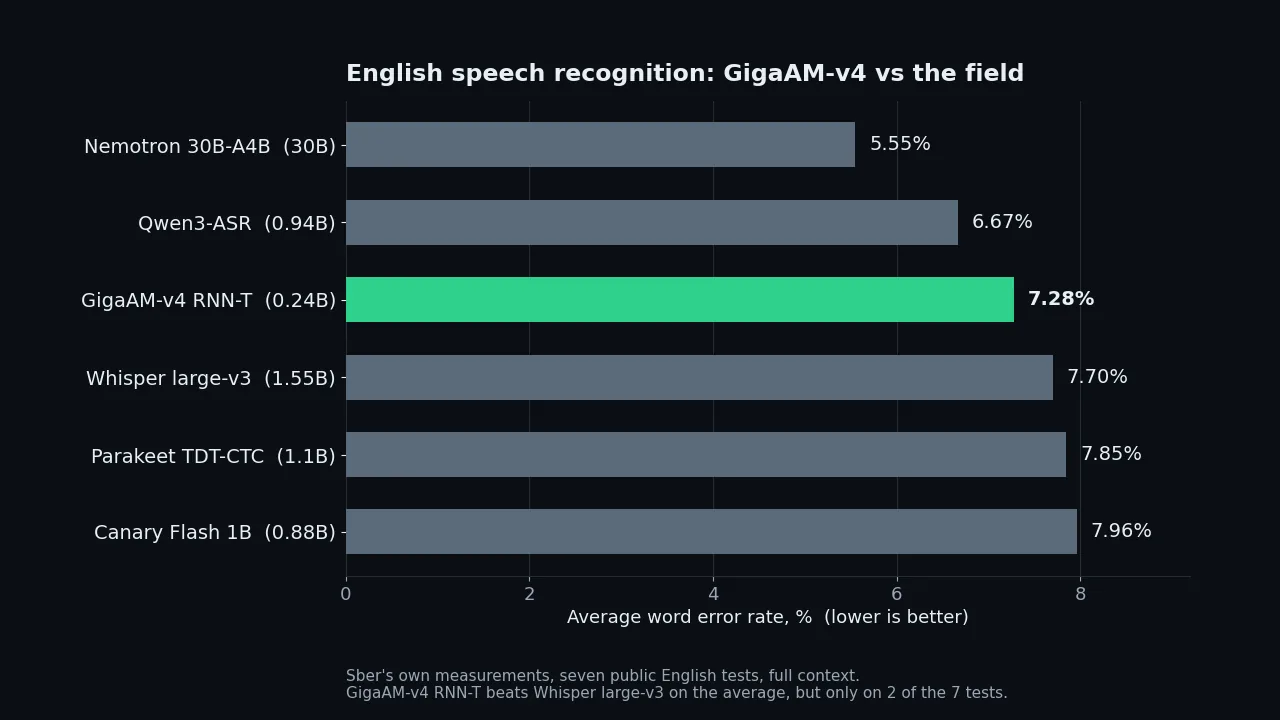
On the headline number, it does. Across seven public English tests, GigaAM-v4’s RNN-T version averages a 7.28% word error rate, the share of words transcribed wrong. Whisper large-v3 averages 7.70% on the same tests. The smaller model wins by 0.42 points at less than a sixth of the size.
Read the fine print before celebrating. GigaAM-v4 beats Whisper on only two of the seven tests. On a noisy meeting-recording test it wins big: 7.47% against Whisper’s 13.66%. On the other five, Whisper is ahead. And two rivals sit below both of them: Alibaba’s Qwen3-ASR at 6.67% and NVIDIA’s Nemotron 30B-A4B at 5.55%.
The faster CTC version of GigaAM-v4 averages 7.83%, above Whisper. So the win belongs to the accurate RNN-T build, not to the whole family. All of these figures are Sber’s own measurements, published in the model card, and no independent rerun exists yet.
Takeaways:
- English average word error rate: GigaAM-v4 RNN-T 7.28%, Whisper large-v3 7.70%.
- Only 2 of the 7 individual tests go GigaAM-v4’s way, and Qwen3-ASR (6.67%) and Nemotron 30B-A4B (5.55%) score lower.
- The CTC version (7.83%) trails Whisper, so the RNN-T build carries the win.
What about the languages Whisper barely speaks?
This is where the release stops being a curiosity and starts being a genuinely useful tool. Across 21 languages, Multilingual-v2 averages a 3.96% word error rate. The nearest rival Sber lists, Omni LLM 7B v2, scores 14.10%. Whisper large-v3 scores 44.09%.
That gap is not a typo. On several languages of the former Soviet Union, rival models score above 100% error: they produce more wrong words than the transcript contains. Multilingual-v2 was trained on those languages properly, with 60% of its training examples spread across the 19 languages beyond Russian and English.
Russian is the strongest case. GigaAM-v4 averages 5.99% across nine Russian test groups, down from 9.51% for GigaAM-v3 a year ago. Whisper large-v3 scores 16.01% on the same tests. Multilingual-v2 does slightly better still, at 5.57%.
The formatting gap is just as wide. Multilingual-v2 restores punctuation with an 88.38% F1 score on average, best on 16 of the 21 languages. Whisper large-v3 manages 65.42%.
Takeaways:
- 21-language average word error rate: Multilingual-v2 3.96%, Whisper large-v3 44.09%.
- Russian word error rate: GigaAM-v4 5.99% (v3 was 9.51%), Whisper large-v3 16.01%.
- Punctuation F1: Multilingual-v2 88.38%, Whisper large-v3 65.42%.
Can it keep up with live speech?
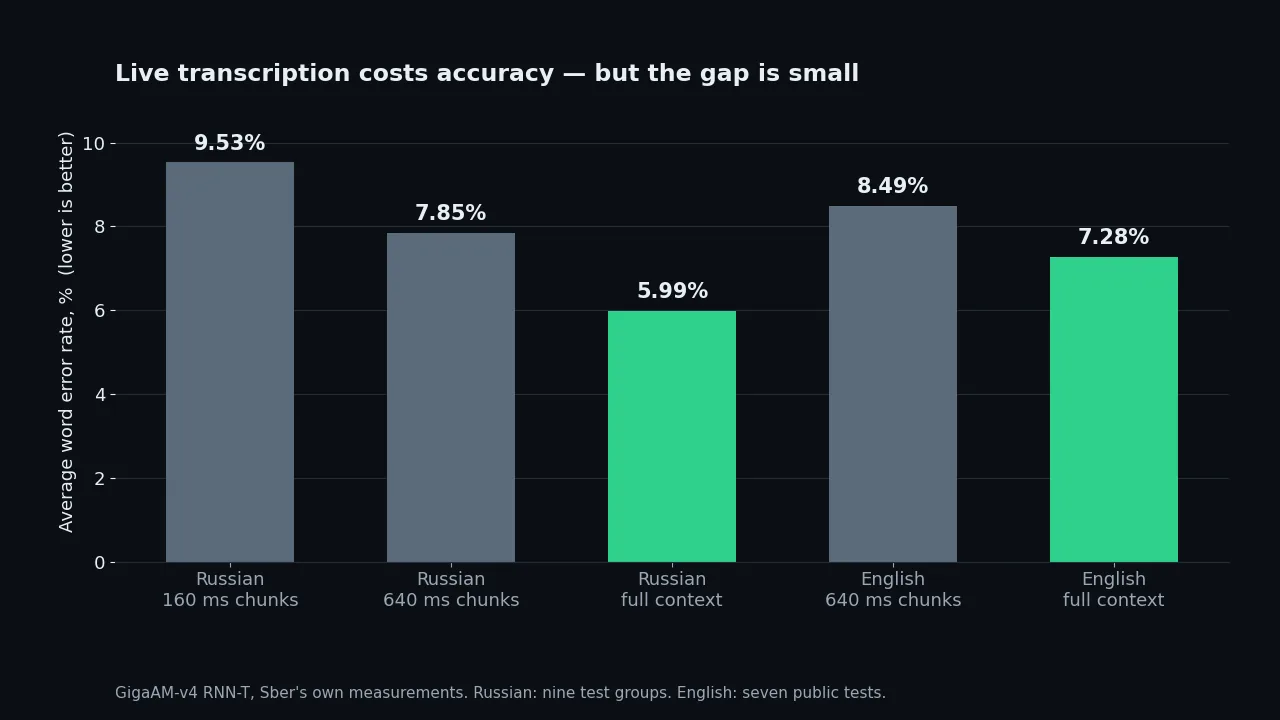
Yes, with a small accuracy cost. In Russian, the error rate rises from 5.99% with full context to 7.85% in 640-millisecond chunks, and 9.53% in 160-millisecond chunks. In English, 640-millisecond streaming scores 8.49% against 7.28% with the whole recording in view.
That trade-off is the point of the design. A 160-millisecond chunk means text appears almost as the words are spoken, and the model keeps a 1.28-second sliding window of past audio so it never loses the thread mid-sentence.
Long recordings get their own help. Sber trained a tiny 1.33-million-parameter voice activity detector, GigaAM VAD, to find speech in hours of audio and cut it into clean segments. Swapping it in for the old pyannote-based cutting dropped long-form error rates from 10.8% to 10.1%.
Takeaways:
- Streaming in 160 ms chunks: Russian word error rate 9.53%; in 640 ms chunks: 7.85%; full context: 5.99%.
- English streaming at 640 ms: 8.49% vs 7.28% with full context.
- The new GigaAM VAD cuts long recordings better than pyannote: 10.8% to 10.1% word error rate.
What’s new under the hood?
The headline change is the encoder. GigaAM-v4 drops the Conformer architecture of its predecessors for a new design Sber calls Zapformer, which merges neighbouring audio frames in the middle layers so the model does less work per second of speech. Training switched to the ScaledMuon optimiser, which Sber says converged faster and more stably.
The multilingual model gets its language awareness in two places: a FiLM mechanism that retunes acoustic features after every fourth encoder block, and a late-fusion correction just before the decoder. You can tell it the language, give it two languages, or let it detect the language itself, and naming the language helps, cutting the 21-language streaming error rate from 7.00% to 5.47% at 160-millisecond chunks.
Sber also trained for the messy cases. About 2 million synthetic recordings mix foreign words into Russian speech, so the model keeps names like PostgreSQL in Latin letters instead of transliterating them. An 11,000-term dictionary across 14 technical domains backs that up.
Takeaways:
- New Zapformer encoder replaces Conformer; ScaledMuon optimiser replaces AdamW.
- Language hints (FiLM plus late fusion) cut streaming errors when the language is named.
- Code-switching training keeps Latin terms intact in Russian speech.
What should you watch out for?
First, the numbers. Every benchmark in this article is Sber’s own. The company measured its models against rivals on public tests, but nobody independent has rerun them yet, and the English win over Whisper is an average, not a sweep.
Second, the maker. Sberbank has been under US blocking sanctions since April 2022, which may restrict access to its commercial services in some jurisdictions. The MIT-licensed weights are downloadable from Hugging Face without an account, the same position as Sber’s GigaChat 4, released a day earlier, but teams in regulated industries should check their compliance position before building on a model from a sanctioned bank.
Third, the setup. Loading the models through Hugging Face Transformers needs trust_remote_code=True, which runs the model’s own code, standard for this family but worth knowing. ONNX export is supported, and a 249 MB int8 ONNX version of the v4 model ships in Sber’s GigaEdge SDK for offline use.
None of that changes the core result. A 238-million-parameter model that runs on a laptop and beats Whisper on English averages, and a 776-million-parameter model that covers 21 languages Whisper barely speaks, is a release worth a download. The open-weights wave keeps coming from outside the US labs: the fully open K2-Horizon fleet, Ant’s Ling-3.2-air under MIT, SenseTime’s self-correcting SenseNova U1.6. GigaAM-v4 is the smallest of the recent arrivals, and the one most likely to end up running on a device near you.
Key numbers
- 238M parameters (GigaAM-v4) / 776M (Multilingual-v2)
- 7.28% English word error rate vs Whisper large-v3’s 7.70% (Sber’s measurements)
- 3.96% average word error rate across 21 languages
- 5.99% Russian word error rate, down from 9.51% in v3
- 160 ms smallest streaming chunk
- 10M+ hours of unlabeled speech for pretraining
- MIT licence, both models
Bottom line: Small, open and MIT-licensed, GigaAM-v4 proves that beating Whisper is now a question of training data and design, not size.
What is GigaAM-v4?
GigaAM-v4 is Sber’s open speech-recognition model, announced on 27 November 2026. It has 238 million parameters, handles Russian and English, and is released under the MIT licence, with weights on Hugging Face under Sber’s ai-sage organisation and code on GitHub.
How does GigaAM-v4 compare with Whisper large-v3?
On seven public English tests, GigaAM-v4’s RNN-T version averages a 7.28% word error rate against 7.70% for Whisper large-v3, but it beats Whisper on only 2 of the 7 individual tests, and Alibaba’s Qwen3-ASR (6.67%) and NVIDIA’s Nemotron 30B-A4B (5.55%) score lower. All figures are Sber’s own measurements, not independently verified.
What is GigaAM Multilingual-v2?
GigaAM Multilingual-v2 is Sber’s 776-million-parameter speech model covering 21 languages, including Russian, English, German, French, Kazakh, Uzbek and Tatar. It averages a 3.96% word error rate across those languages, against 44.09% for Whisper large-v3, in Sber’s own measurements. It is released under the MIT licence.
Can GigaAM-v4 transcribe live speech?
Yes. Both models transcribe in 160, 320 or 640-millisecond chunks, returning partial transcripts as the speaker talks. In Russian, GigaAM-v4’s error rate rises from 5.99% with full context to 7.85% in 640-millisecond chunks and 9.53% in 160-millisecond chunks, in Sber’s own measurements.
Where can I download GigaAM-v4?
On Hugging Face, under Sber’s ai-sage organisation, and the code is on GitHub at salute-developers/GigaAM. Both models are MIT-licensed. Loading through Hugging Face Transformers needs trust_remote_code=True, and ONNX export is supported.