Gemini 4 Carbon Proves Hadwiger’s 3D Covering Conjecture — a 70-Year-Old Geometry Problem, Verified in Lean 4
Google's Gemini 4 Carbon found the proof of a geometry problem open since 1957: every three-dimensional convex body can be covered by eight smaller copies of itself. The 13,663-line proof is formally verified in Lean 4.

Google’s Gemini 4 Carbon has found a proof of a geometry problem that has stood open since 1957. A preprint posted on arXiv on 24 November claims a complete proof of Hadwiger’s covering conjecture in three dimensions, that any solid convex body can be covered by eight smaller copies of itself, and says the proof was discovered by an experimental harness built on Gemini 4 Carbon, then formally verified in Lean 4.
Note that the claim is a preprint, not a peer-reviewed result, and the model did not work alone: two Google researchers steered the harness, and a mathematician at the University of Illinois helped verify the mathematics. What sets this one apart from the usual AI-maths headline is the check that comes with it. The full proof has been machine-checked in Lean 4 (13,663 lines across 34 files), with no unproved steps beyond Lean’s standard axioms.
What the paper claims
Hadwiger’s conjecture, posed in 1957 by the Swiss mathematician Hugo Hadwiger and independently by Gohberg and Markus, says that any convex body in d dimensions can be covered by at most 2d smaller copies of itself, each a scaled-down, shifted version of the original. In two dimensions the answer has been known since 1955, when Levi proved that four copies always suffice. In three dimensions the conjecture says eight. The new paper, arXiv:2611.32334, by Dror Aiger of Google, Sariel Har-Peled of the University of Illinois and Goran Žužić of Google Research, says the three-dimensional case is now proved, for every convex body, with no symmetry assumptions and no exceptions.
The result was posted on 24 November and revised on 25 November. It is, at the time of writing, covered only by niche outlets and a fast-growing thread on r/singularity. No major newsroom has picked it up yet.
How we got here
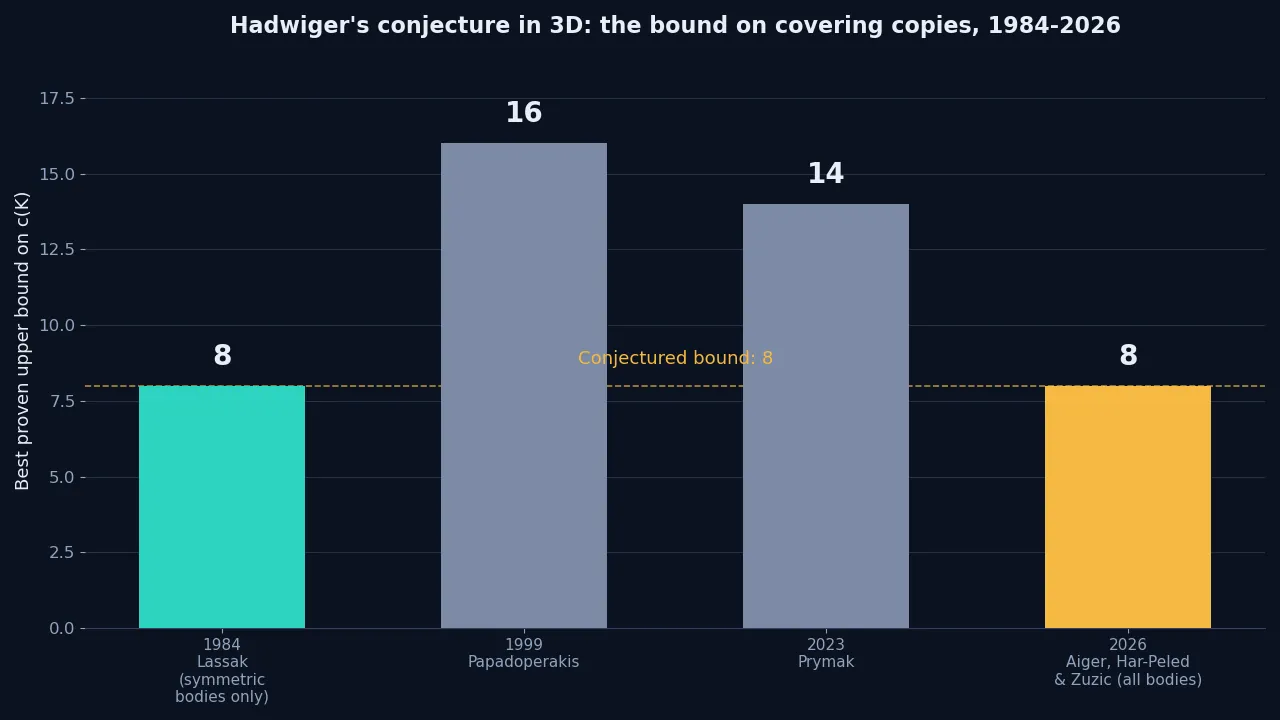
The bound on the number of copies has been falling for four decades. Lassak proved in 1984 that eight copies suffice for centrally symmetric bodies, shapes that look the same from opposite sides. For general bodies, with no symmetry to lean on, Papadoperakis got the bound down to 16 in 1999, and Prymak improved it to 14 in 2023. The new paper closes the gap to the conjectured eight, for all bodies at once.
The model behind the discovery is Google’s flagship reasoning system, launched on 10 November with a million-token context window and built for long-horizon work. It has spent its first weeks being measured on benchmarks; this is the first time it is credited in a paper’s abstract with discovering the proof of a named open problem.
“The proof was discovered using an experimental harness on top of Gemini 4 Carbon and formally verified in Lean 4.”
Abstract, arXiv:2611.32334
How the proof works
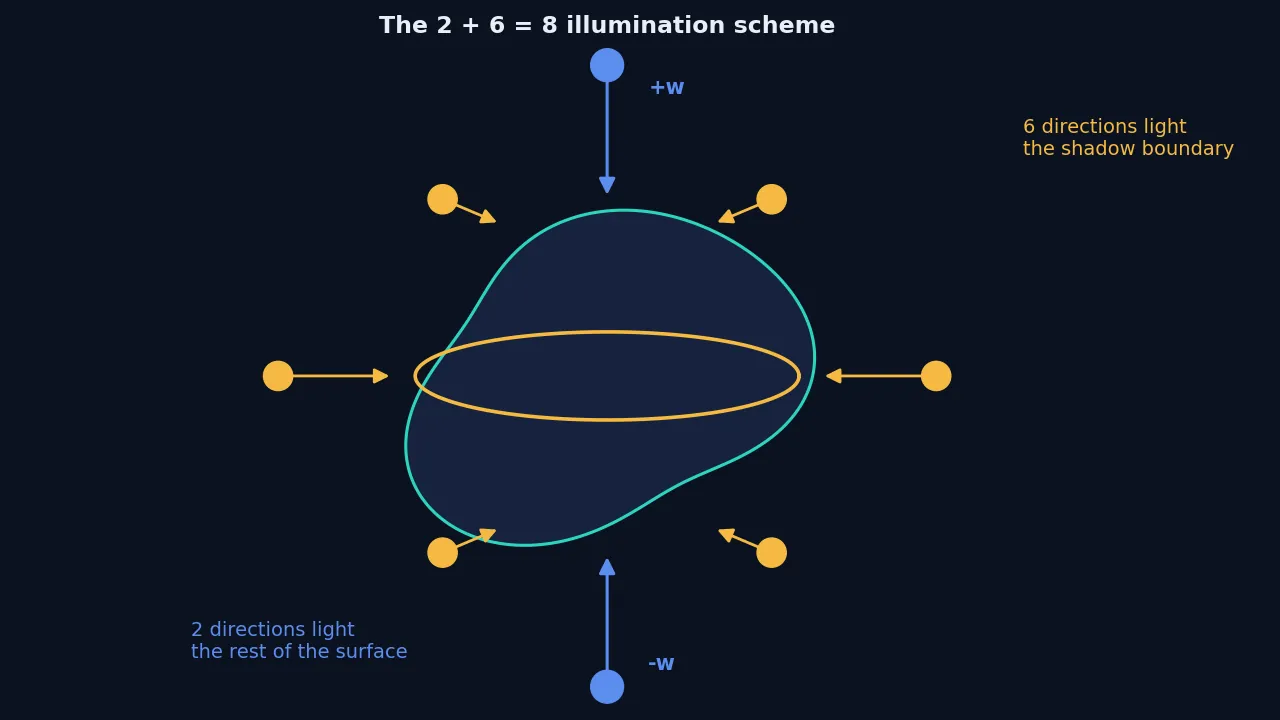
The proof runs through a reformulation due to Boltyanski: covering a body with eight smaller copies is the same as lighting its entire surface from eight directions. The paper’s scheme is 2 + 6 = 8. Boxes, parallelepipeds, are dealt with directly, covered by eight copies scaled by two-thirds. For every other shape, the authors pick a direction and let two opposite lights, +w and −w, illuminate everything except the body’s shadow boundary: the closed curve where the light just grazes the surface. That curve turns out to be short enough, shorter than 12 in the paper’s measure, to split into six arcs, each short enough that Helly’s theorem guarantees a single direction lights it. Two lights plus six lights: eight in total.
The hard part is finding a direction where the shadow boundary is short enough, and that is where the classical machinery comes in: John’s position, a mean-width bound that is strict except for cubes, outer polyhedral approximations, Cauchy’s perimeter formula and Fatou’s lemma. The paper is careful about a known trap: smooth bodies can need as few as four copies yet converge to a cube that needs eight, so no argument that merely approximates the body by simpler shapes can work. The authors never cover the approximating shapes; they use them only as a measuring tool, and prove the bound directly on the unapproximated body.
On the AI side, the paper’s disclosure is short and specific. An experimental harness at Google, built on Gemini 4 Carbon, discovered the proof with minimal human steering from Aiger and Žužić, and an agentic harness on the same model produced the formal verification in Lean 4. The three authors verified the mathematics themselves and prepared the presentation. The Lean source (34 files) is attached to the arXiv posting as an ancillary file, so anyone can run the check.
What it doesn’t mean
- It is not a peer-reviewed theorem yet. The paper is a preprint, and no independent check has been published. The Lean formalisation lets anyone verify the proof mechanically, but the mathematics community has not yet had its say.
- Gemini did not do this alone. The paper is explicit: the harness ran with minimal human steering, and the human authors verified the mathematics and wrote the paper. The model found the proof; people checked it and stand behind it.
- It does not settle Hadwiger in higher dimensions. The conjecture remains open in every dimension above three, where the conjectured bound is 16, 32, and so on.
- It does not mean AI can now prove anything. The discovery used a purpose-built experimental harness on one hard problem, and the paper discloses nothing about what the harness cost or whether the approach generalises.
Why it matters
Frontier models have spent 2026 moving from benchmarks into real research output: GPT-6 designing proteins that were then tested in a wet lab, and DeepMind’s Humanity’s First Exam measuring whether models answer simple questions reliably every time. This is the sharpest example yet: a model credited with the discovery itself, on a problem that has resisted human mathematicians for 69 years. And the verification changes the game in a quieter way. A 13,663-line formal proof can be checked by anyone with the software, without trusting the authors’ handwriting. If the preprint holds up, that combination, machine discovery plus machine verification, is the template other fields will copy. The open-weights wave, from Sber’s GigaChat 4 to the week’s smaller releases, has been about access to the models; this paper is about what the best closed model can actually do with that access in expert hands.
What to watch
Whether independent mathematicians confirm the preprint or find a gap. The Lean files are public, so the check is open to everyone. Whether Google says anything about the harness: how it was built, what it cost, and whether it generalises beyond this one problem. And whether the follow-up work already citing the result holds up, and the four-dimensional case becomes the next target.
This article is for information only and is not financial advice.
What is Hadwiger’s covering conjecture?
Posed in 1957 by Hugo Hadwiger, it says that any convex body in d dimensions can be covered by at most 2^d smaller copies of itself, each a scaled-down, shifted version of the original. In three dimensions that means eight copies. The two-dimensional case was settled in 1955; the new preprint claims the three-dimensional case.
Did Gemini 4 Carbon prove it on its own?
No. According to the paper, an experimental harness built on Gemini 4 Carbon discovered the proof with minimal human steering from two Google researchers, and an agentic harness on the same model produced the Lean 4 formal verification. The three human authors verified the mathematics and prepared the paper.
What does the Lean 4 verification mean?
The complete proof has been formalised in Lean 4 with Mathlib: 13,663 lines across 34 files, machine-checked with no unproved steps beyond Lean’s standard axioms. The Lean source is attached to the arXiv posting, so anyone can run the check. It verifies the proof as written; it does not by itself confirm the story of how the proof was discovered.
Is the result peer-reviewed?
Not yet. It is an arXiv preprint (arXiv:2611.32334), submitted on 24 November 2026 and revised on 25 November. No independent verification has been reported so far, and coverage is still limited to niche outlets and social discussion.