Gemini 4 Carbon Launches: Full Specs, Benchmarks and Pricing
Gemini 4 Carbon Launches, its strongest reasoning AI model built for long-horizon coding, scientific analysis and cybersecurity tasks.
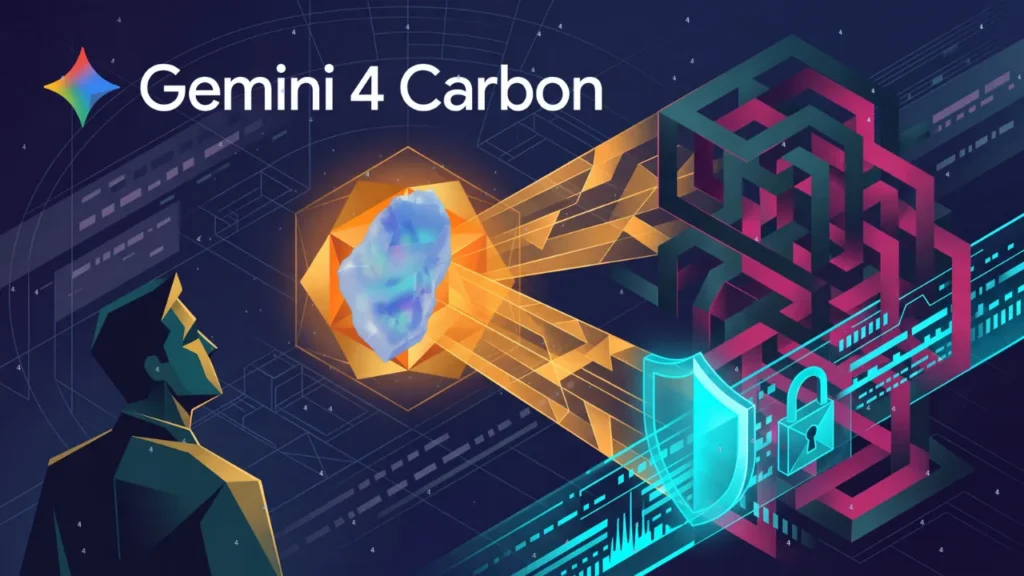
Google has made Gemini 4 Carbon available worldwide as of 10 November 2026, positioning the flagship system as its most capable reasoning model to date for long-horizon engineering and multi-step tasks. The release introduces extended verification capabilities and a unified 1,048,576-token context window that pools input, deliberate reasoning tokens, and final model output into a single shared capacity. Initial pricing has been set at $2.00 per million input tokens and $10.00 per million output tokens through a promotional window ending on 30 November 2026.
Gemini 4 Carbon is now available.It’s our strongest model, built to dig deeper, handle long-horizon tasks, and multi-step reasoning.If Argon is great for complex tasks, Carbon is the model you bring in for your hardest problems.
— Google (@Google) November 10, 2026
The rollout follows Google DeepMind’s release of the Argon foundation model, which remains the general-purpose choice for everyday agentic workflows. While Argon handles standard interactive queries and quick automated routines, DeepMind configured Gemini 4 Carbon specifically for multi-day engineering, security patching, and complex scientific hypothesis testing. Google framed the new deployment around problem-solving endurance, allowing automated software agents to persist through execution errors rather than abandoning tasks mid-cycle.
SUMMARY
- Release Date: 10 November 2026 via Google AI Studio and DeepMind infrastructure.
- Core Architecture: 1M-token unified context window with extended verification loops.
- Benchmarks: Scored 88.2% on SEC-bench Pro and 65.2% on Terminal-Bench 4.0.
- Pricing: Introductory rate of $2.00 per million input tokens through 30 November 2026.
- Primary Use Cases: Long-horizon software engineering, scientific research, and defensive security.
What is Gemini 4 Carbon built to do?
Google designed Gemini 4 Carbon to handle sustained engineering workflows where an automated agent cannot resolve an assignment in a single reasoning pass. In software engineering benchmarks, the model reached 65.2% on Terminal-Bench 4.0, climbing from Argon’s 57.1% baseline. DeepMind specifically tuned the model’s reasoning loops to carry out root-cause analysis across enterprise repositories, handle low-level debugging, and review compile logs independently.

Developers can govern the computational budget of the model by setting deliberate reasoning tiers within the API. The system uses low, medium, and high thinking levels, allowing teams to determine how many internal tokens the model consumes prior to generating an answer. For large jobs that exceed standard interaction boundaries, Google added background execution support. This mechanism allows outputs to stretch beyond the default 65,536-token ceiling by chaining consecutive 64K continuation stages across the entire available buffer.
Comparing Argon and Carbon performance
The division between Google’s two current frontier models hinges on operational speed versus reasoning depth. Argon functions as the default engine for interactive software work and responsive conversational assistants. In contrast, Google recommends assigning Carbon to difficult system crashes, formal scientific proofs, and multi-file code refactoring. Earlier technical milestones, including Google’s initial AI model updates
, set the trajectory for this specialised dual-tier design.
| Specification / Benchmark | Gemini 4 Argon | Gemini 4 Carbon | Source Date |
| Context Buffer | 1,048,576 tokens | 1,048,576 tokens | 10 November 2026 |
| Terminal-Bench 4.0 | 57.1% | 65.2% | October 2026 |
| SWE-sweep | 4.3% | 9.6% | October 2026 |
| GraphWalks BFS F1 (256K–1M) | 84.2% | 96.2% | October 2026 |
| SEC-bench Pro | Not Published | 88.2% | October 2026 |
| Introductory Input Rate | $2.00 / 1M tokens | $2.00 / 1M tokens | 10 November 2026 |
Competitive benchmarks also indicate key product trade-offs. While Carbon scored 59 points on the AA Intelligence Index v5.0—beating Claude Opus 5.5 at 58 points and GPT-6 Astra at 57 points—it finished behind GPT-6 Astra on the FrontierSWE 2 coding evaluation (61.2% versus 65.5%). It also trailed Claude Opus 5.5 on the OSWorld offline benchmark (81.5% versus 87.2%).
Defensive cybersecurity and enterprise utility
Google highlighted enterprise security as a central application for the model. Gemini 4 Carbon scored 88.2% on SEC-bench Pro and 71.0% on CWE-bench, pointing to reliable identification of common weakness enumerations across unfamiliar code repositories. DeepMind confirmed that verified security engineers can access specialised vulnerability research and patching toolchains directly via the Fairwind Program.

These security capabilities operate alongside expanded multimodal recognition. Google verified that the system accepts interleaved text, high-resolution imagery, audio, and video inputs. The broader data window allows an engineering team to upload complex architecture diagrams and full dependency lockfiles into a single debugging context.
What independent testing says about Carbon
Google’s own benchmarks tell one side of the story. The independent check comes from Artificial Analysis, which runs both models on the same tasks at several reasoning settings and publishes cost and time per task alongside the scores. On its Intelligence Index v5.0.1, read on 15 November 2026, Carbon at its high setting leads OpenAI’s GPT-6 Astra at max on six of nine component evaluations.
| Artificial Analysis evaluation | Gemini 4 Carbon (high) | GPT-6 Astra (max) |
|---|---|---|
| Intelligence Index v5.0.1 | 60 | 57 |
| Terminal-Bench 4.0 | 65.2% | 59.1% |
| AutomationBench-AA | 77.8% | 68.5% |
| FrontierCode-AA 2.0 | 40.6% | 42.4% |
The lead is not one-sided. Astra wins FrontierCode-AA 2.0, and it also leads on GDP.pdf and CritPt v2 (Hard). Carbon’s domain scores are ahead too: 63 in finance and accounting, 62 in legal and 65 in engineering, against Astra’s 57, 56 and 62.
The price story changes when you measure per completed task instead of per token. Artificial Analysis records $5.48 per task for Carbon at high thinking, against $3.24 for Astra at high effort, because Carbon spends far more tokens on the same work, and its runs take 33.8 minutes per task against 9.2 minutes for Astra. That makes Carbon the better buy for long, input-heavy jobs such as reading large codebases or document sets, where its flat price across the whole 1M-token window counts most, and a weaker choice for interactive agent work where elapsed time and a predictable bill per task matter.
Two caveats matter. First, the setting changes the result: Astra’s score rises from 43 at low to 57 at max, so a comparison that does not name the setting can move by more than ten points. Second, Google notes that its cybersecurity figures reflect access through the Fairwind Program, so the public model’s classifiers and refusal behaviour may not match those test runs.
Deployment timeline and what comes next
Google has launched the model within the Google AI Studio documentation
and opened API endpoints for production testing. The model has also been integrated into Google’s Managed Agents system to support autonomous task execution. Google AI Ultra subscribers can also use Carbon in Google Antigravity, the Gemini app and AI Mode in select countries.
The current introductory pricing will stay in place through 30 November 2026. Beginning on 1 December 2026, standard rates will double to $4.00 per million input tokens and $20.00 per million output tokens, which includes internal thinking steps. However, prompt caching will cut cached input token costs by 95%, bringing them to $0.10 per million tokens in November and $0.20 starting in December. Developers moving to Carbon will need to track reasoning token volumes carefully, as extended deliberate thought loops can rapidly reach output caps if left unmonitored.
Verification Note: All listed benchmark numbers and token rates were verified against official Google DeepMind model documentation and AI Studio technical documentation released on 10 November 2026. Complete architectural training data splits and exact hardware infrastructure details were not disclosed in the model card and remain unconfirmed.
FAQ
How can developers access Gemini 4 Carbon?
Developers can access Gemini 4 Carbon through the Google AI Studio playground, dedicated API endpoints under the gemini-4-carbon model name, and the Gemini Managed Agents platform. Standard API credentials provide immediate access to testing environments, while specialized cybersecurity toolsets require verification under Google’s Fairwind Program.
What is the difference between Gemini 4 Argon and Carbon?
Argon is Google’s faster, general-purpose system configured for daily agent automation and rapid responses. Carbon acts as the high-intensity reasoning alternative, consuming additional thinking tokens to resolve complicated software engineering bugs, multi-tier data workflows, and complex scientific tasks.
How much does Gemini 4 Carbon cost to run?
Through 30 November 2026, introductory rates sit at $2.00 per million input tokens and $10.00 per million output tokens. On 1 December 2026, rates rise to $4.00 per million input tokens and $20.00 per million output tokens, with cached input discounted by 95%.
Does Gemini 4 Carbon support long decode operations?
Yes, the model supports long decode operations that let responses run past the standard 65,536-token boundary. When configured for background execution, the model continues generating output across 64K-token steps up to the full 1,048,576-token unified buffer limit.