
Why Is Crypto Down? What’s Behind the Crash and Will It Recover
Why is crypto down? Bitcoin is near $76,500 after the Binance hack, ETF outflows and oil jitters. See what moved markets today and whether crypto will recover.

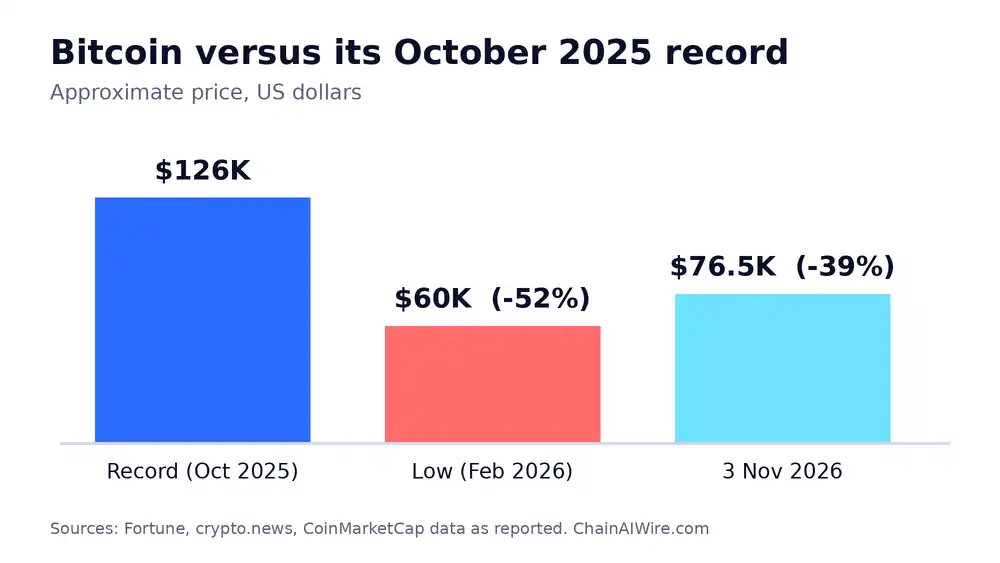
Why is crypto down? In short, several pressures hit the market at once: the record $6.3 billion Binance hack, heavy outflows from spot bitcoin ETFs, a wave of liquidations in leveraged trades, and nervousness about interest rates, oil prices and today’s US midterm elections. On 3 November 2026, bitcoin traded around $76,500, roughly 39% below its October 2025 record of about $126,000, and the whole crypto market was worth about $2.6 trillion.
This guide answers the questions people are searching for right now: why crypto is crashing, what moved crypto markets today, why crypto is down so much, whether crypto is dead, and whether crypto will recover. Figures are from 3 November 2026 and change quickly. This is general information, not financial advice.
Why is crypto down? The short answer
- A confidence shock: Binance, the world’s largest exchange, lost about $6.3 billion in a hack on 29 October, the biggest crypto theft on record.
- Money leaving ETFs: US spot bitcoin ETFs saw about $643 million of net outflows on 30 October and roughly $399 million on 2 November.
- Forced selling: falling prices triggered liquidations of leveraged long positions, which pushed prices down further.
- A tough macro backdrop: the Federal Reserve is holding rates with a firm tone on inflation, and oil prices jumped on Middle East tensions.
- Event risk: traders are cautious ahead of today’s US midterm elections and Friday’s jobs report.
- Weak momentum: bitcoin is trading below the average purchase price of recent buyers, so rallies keep meeting selling.
What moved crypto markets today?
Here is a snapshot of the market on 3 November 2026, based on news reports and data trackers:
- Bitcoin: about $76,400 to $77,000, down roughly 2% in 24 hours and about 4% over the week. It is more than 10% lower than four weeks ago.
- Total market value: around $2.6 trillion, down about 3.7% on the day, according to total crypto market capitalization trackers.
- Ether: roughly $2,250.
- ETF flows: about $399 million of net outflows on Monday’s report for 2 November, following $643 million on 30 October.
- Liquidations: estimates for the past 24 hours range from about $90 million to $380 million, depending on the tracker. On 30 October, liquidations across crypto futures were reported at over $1 billion.
- Biggest movers: Zcash fell about 11%, while TRON gained roughly 2%.
- Oil and geopolitics: reports of military action around Iran’s Qeshm Island pushed oil higher and weighed on risk assets.
- Key levels: traders are watching support near $76,400 to $76,700, and resistance near $78,000 and $79,500.
Liquidation and flow figures differ between data providers, so treat them as approximate.
Why is crypto crashing? Five forces behind the sell-off
1. The Binance hack shook confidence
The Binance hack on 29 October is more than four times larger than the previous record, the $1.5 billion Bybit theft in 2025. The FBI has since blamed North Korea’s TraderTraitor group. Binance froze withdrawals for roughly 45 hours and reopened them on 1 November, when customers withdrew a net $3.64 billion in the first 9.5 hours, equal to about 2.1% of its reported reserves. The exchange says user funds are safe and that it has covered about 95% of the stolen assets. Bitcoin did not collapse on the news, but the episode added to risk aversion across the market.
2. ETF outflows removed a key buyer
Spot bitcoin ETFs have become one of the market’s biggest sources of demand, so when they sell, price has fewer buyers to lean on. The $643 million outflow on 30 October was reportedly the largest since June. It reversed the streak we reported when Bitcoin ETFs turned October positive, and another $399 million left on 2 November.
3. Leverage turned a dip into a drop
Many traders borrow money to bet on rising prices. When the price falls far enough, exchanges automatically close those positions, which means selling into a falling market. This “liquidation” process can turn an ordinary decline into a sharp one, and it explains why crypto often falls faster than the news alone would suggest.
4. Rates, oil and liquidity
The Federal Reserve left interest rates unchanged last week, but its chair, Kevin Warsh, said inflation remains above the 2% target, which keeps hopes of cheaper money in check. Higher oil prices add to inflation worries. Some analysts, including BitMEX co-founder Arthur Hayes, argue that crypto weakness may last until central banks expand liquidity again.
5. Election and event risk
Traders often reduce risk before big events. Today’s US midterm elections and Friday’s jobs report are both on the calendar, and analysts disagree about what different outcomes could mean for crypto. Historical patterns around elections depend heavily on the time window measured, so they are a weak guide.
Why is crypto down so much from its high?
Bitcoin hit a record of about $126,000 in early October 2025. It then fell about 52% to a low near $60,000 on 5 to 6 February 2026, when the Crypto Fear and Greed Index reached an all-time low of 5. It has recovered since, but at about $76,500 it is still roughly 39% below its peak.
Altcoins have fared much worse. One analysis from BTCC found that many altcoins lost 70% to 95% of their value from their peaks. There are three reasons why smaller coins fall further than bitcoin:
- They are thinner markets, so a few large sellers can move the price a lot.
- They attract more speculation and leverage, which magnifies both rallies and crashes.
- They lack bitcoin’s institutional demand from ETFs and company treasuries.
It also helps to compare this fall with earlier ones. According to CryptoJobsList, bitcoin’s previous bear markets saw peak-to-trough drops of roughly 77% to 93%. By that measure, the current decline is smaller, although that is no proof that the bottom is in.
Is crypto dead?
No. Crypto is in a bear phase, which is not the same as being dead. Several things point the other way:
- The market is still huge: about $2.6 trillion in total value, even after the fall.
- Users did not flee en masse: Binance’s founder says 98% of customers chose to stay after withdrawals reopened. That is the exchange’s side of the story, but the net outflow was 2.1% of reserves.
- Building continues: stablecoins and tokenized assets keep advancing, and the Swiss industry group CMTA recently recognized Cardano’s token standard for tokenized shares.
- Institutions are involved: Coinbase Institutional estimated that corporate treasury companies bought about $14.5 billion of bitcoin in the first half of 2026, even as ETFs saw net selling.
There are real problems too: record hacks, reversing ETF flows, thinner retail participation, and a stronger link between crypto and stock-market swings. “Dead” is too strong, but “risky and volatile” is accurate.
Will crypto recover?
Nobody can promise a recovery or a date, and analysts disagree. Here are three broad scenarios:
- Recovery: this would need ETF inflows to return, expectations of easier money, and fewer shocks such as hacks. A move back above $78,000 to $79,500 would be an early sign.
- Sideways trading: the market could stay in a range while it digests the Binance aftermath and waits for clearer signals on rates.
- More downside: if bitcoin breaks below the $76,400 to $76,700 support area, more liquidations could follow.
History offers some perspective. After earlier deep declines, bitcoin eventually set new highs, though the wait varied from months to years. Past patterns are not a promise, and a recovery for bitcoin does not guarantee one for every altcoin. Because crypto is volatile, never put in money you cannot afford to lose.
What to watch this week
- US midterm election results and the market’s reaction.
- Friday’s jobs report, which can shift expectations for interest rates.
- Binance’s proof-of-reserves update and the pace of its withdrawals.
- Daily ETF flows, to see whether outflows slow or reverse.
- Oil prices and Middle East news, which are driving risk appetite.
Why is crypto down? FAQ
Why is crypto down?
Several pressures hit at once: the record $6.3 billion Binance hack, heavy ETF outflows, liquidations of leveraged trades, a firm Federal Reserve, higher oil prices and caution before the US midterm elections. Bitcoin is near $76,500, about 39% below its record.
Is crypto dead?
No. The market is still worth about $2.6 trillion, institutions remain involved, and development continues, but it is in a bear phase with real risks such as hacks and falling fund inflows.
What moved crypto markets today?
On 3 November 2026, ETF outflows, liquidations, oil prices rising on Middle East tensions and caution before the US midterm elections weighed on prices. Bitcoin slipped to roughly $76,500, and total market value fell about 3.7% to around $2.6 trillion.
Will crypto recover?
Nobody knows. A recovery would need returning ETF inflows, easier liquidity and fewer shocks. Bitcoin has set new highs after earlier deep declines, but the timing varied widely and there is no guarantee.
Why is crypto crashing?
Falling prices are being amplified by forced liquidations of leveraged trades, money leaving ETFs, worries about exchange security after the Binance hack, and a cautious macro backdrop.
Why is crypto down so much?
Bitcoin is about 39% below its October 2025 record of roughly $126,000, and many altcoins have fallen 70% to 95% from their peaks. Smaller coins fall further because their markets are thinner and more speculative.
Sources