
Indonesia Logs 350,600 Cyber Threats in 24 Hours, but No Bank Breach Confirmed
FortiGuard Labs logged about 350,600 cyber threats in Indonesia on Nov 7, 214,000 aimed at finance. No bank breach is confirmed. Here are the facts.

FortiGuard Labs’ live threat dashboard logged about 350,600 cyber threat detections in Indonesia in the 24 hours to November 7, and roughly 214,000 of them were aimed at banks, insurers and other financial firms. No breach of an Indonesian bank has been confirmed, and security experts say the figure counts detections, not successful attacks.
Summary
- FortiGuard Labs’ dashboard recorded about 350,600 threat detections in Indonesia over 24 hours to November 7, an average of roughly four per second.
- About 214,000 detections, or 61%, targeted banking, financial and insurance firms. Government and critical infrastructure came second with about 79,000.
- Some viral posts say more than 250,000 detections hit financial institutions. Press reports put the figure at about 214,000, and 250,000 would be about 71% of the total, not 61%.
- No bank breach, data theft or money theft has been confirmed. The Financial Services Authority (OJK) says it has stepped up coordination with banks.
- Indonesia ranked among the top four in Asia-Pacific on the dashboard, behind New Zealand, Australia and Malaysia in one later snapshot. That is not a global ranking.
What did FortiGuard Labs record in Indonesia?
The Indonesia cyber threats figure comes from FortiGuard Labs’ public threat dashboard, which reported about 350,600 detections for Saturday, November 7. Indonesian daily Kompas, citing the dashboard, said about 214,000 of those targeted the banking, financial and insurance sectors. Coin Bureau’s post on X, which spread the numbers, put the financial share at 61% and said the data showed no confirmed bank breach.
🚨Indonesia’s banking and government institutions are UNDER ATTACKCybersecurity firm FortiGuard Labs recorded 350,000 cyber threats in Indonesia within 24 hours on November 7.That’s 4 threats in every second, mostly aimed at financial and government institutions.Over 250,000 hit financial institutions, accounting for 61% of the total, more than all other sectors combined.No major data or money theft has been confirmed yet.Reports say Indonesia was among the 4 most-attacked countries in the last 24 hours.
— Bull Theory (@BullTheoryio) November 8, 2026
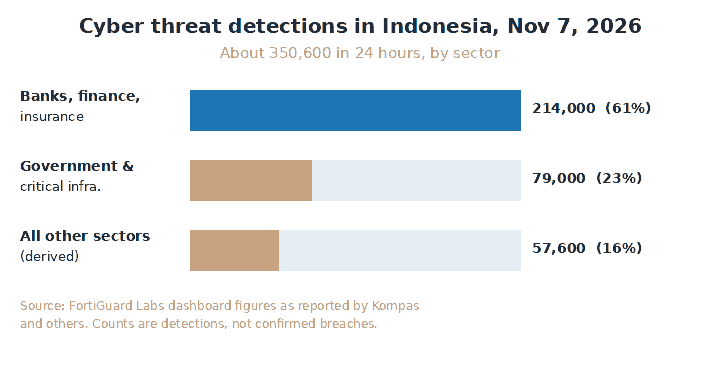
The arithmetic holds together. Spread over 86,400 seconds, 350,600 detections is about 4.06 per second. A 61% share of 350,600 is about 214,000. Government agencies and critical infrastructure came second with about 79,000 detections, according to CoinCentral’s summary. Together, finance and government account for roughly 84% of the total.
| Sector | Detections (approx.) | Share of total |
|---|---|---|
| Banking, financial services and insurance | 214,000 | 61% |
| Government and critical infrastructure | 79,000 | 23% |
| All other sectors (derived by subtraction) | 57,600 | 16% |
| Total | 350,600 | 100% |
The dashboard is live, so the numbers move. Warta Ekonomi noted that a morning snapshot showed far smaller sector counts and different leading sectors. Any single screenshot is a moment in time rather than a fixed record.
Why do some posts say more than 250,000?
One widely shared post claimed that over 250,000 detections hit financial institutions, which it described as 61% of the total. Those two figures cannot both be right. A quarter of a million out of 350,600 is about 71%. Every press report reviewed here, including Kompas, gives the financial-sector figure as about 214,000, which matches the 61% share. This article uses the 214,000 figure.
Were Indonesian banks hacked?
No breach has been confirmed. Dian Ediana Rae, OJK’s head of banking supervision, told Kompas on November 8 that OJK’s IT supervisors have been coordinating with the IT staff of all banks since the previous Friday to raise vigilance. As of November 8, Batavia Pos reported that Indonesia’s cyber agency BSSN, OJK and Bank Indonesia had not announced a banking system disruption or customer data leak tied to the dashboard figure.
Alfons Tanujaya, vice chair for cyber security at the industry group APTIKNAS, told Tirto that the number does not mean 350,600 systems were broken into. In his reading, it counts attempts that Fortinet’s sensors detected and blocked. Such counts can include automated scanning by botnets that probe for weaknesses around the clock. He also said roughly 350,000 attempts a day is not an unusual spike and urged readers to compare it with historical averages.
Is Indonesia really among the most-attacked countries?
Only in a narrow sense. Warta Ekonomi reported that Indonesia was among the four countries with the most activity in Asia-Pacific over the period. In its snapshot, Indonesia logged about 189,000 detections, behind New Zealand with about 993,000, Australia with about 558,000 and Malaysia with about 496,000. Tanujaya made a similar point, saying Malaysia, Australia and New Zealand showed higher counts than Indonesia on the same dashboard.
That context matters because viral posts described Indonesia as one of the four most-attacked countries without naming the region. The sources reviewed here support a regional ranking only. A separate report from Free Malaysia Today said Malaysia’s National Security Council warned the public against claims built on screenshots of the same kind of map, and kept the national cyber threat level at moderate.
How do the Bank Rakyat and French incidents fit in?
Several posts linked the Indonesian numbers to an incident at a bank called Bank Rakyat. That bank is Malaysian, not Indonesia’s Bank Rakyat Indonesia (BRI). According to Lowyat.NET, Bank Rakyat said the disruption affected its corporate website through a third-party service provider and did not touch its core banking systems. Malaysian Communications Minister Fahmi Fadzil described the attack as web defacement of a third-party-managed site.
CoinCentral’s summary said there was no evidence linking the Malaysian website incident to the threat activity detected in Indonesia. Indonesian outlets have also set the dashboard figures beside other bank incidents abroad, such as the cyberattack that French lender Crédit Mutuel Arkéa confirmed. That case involved fraudulent transfers, which is exactly the kind of confirmed loss that a detection count does not show.
Why raw threat counts say little about risk
A detection is a record that a sensor saw suspicious traffic. It is not a record that someone got in. An illustrative example shows the gap. A bot might send ten thousand login attempts at a bank’s website in an hour, and a security system might block all of them. The dashboard would log a large number, while no account was opened and no money moved.
Kompas quoted an analyst making the same point: the number of threats does not measure loss, and economic risk depends on whether attackers succeed in getting in, whether funds are lost, whether payments are disrupted and how customers react. That is a different picture from a confirmed compromise, such as the $6.3 billion Binance hack that the FBI linked to North Korea, where stolen funds were identified and traced.
Different counters also measure different things. The Indonesian cyber agency BSSN has reported an average of 1.25 billion internet traffic anomalies a year from 2020 to July 2025, according to AFU.ID. That figure uses a different method from FortiGuard’s dashboard, so the two cannot be compared directly.
What regulators stress is response speed. Under OJK Regulation 22 of 2023, as Kompas described it, the most important factors are how fast banks detect attacks and stop illicit fund flows, and how well they restore services while keeping customer data and balances accurate. Banks have also faced scrutiny elsewhere. Binance founder CZ has argued that banks are in a worse position than crypto exchanges when it comes to cyber defence.
What should bank customers do?
Nothing in the reports reviewed suggests that Indonesian customers have lost money because of the dashboard activity. General precautions still apply during a news cycle like this. Use the bank’s official app and website, and treat unexpected messages, links or calls that mention a “cyberattack” as suspect. Never share a one-time password or PIN, and rely on official statements from your bank or OJK. These are general safety steps, not guidance tied to a confirmed incident.
What to watch
- Official statements: any comment from BSSN, OJK or Bank Indonesia on whether a bank was compromised.
- Service disruptions: any bank reporting outages, delayed payments or customer notifications.
- Baseline comparison: whether later dashboard readings, set against historical daily averages, show a real rise.
- The Malaysian case: findings on how the Bank Rakyat website was defaced and whether any link to Indonesia emerges.
FAQs
How many cyber threats did FortiGuard record in Indonesia?
FortiGuard Labs’ dashboard recorded about 350,600 threat detections in Indonesia in the 24 hours to November 7, an average of about four per second.
Were Indonesian banks hacked?
No bank breach, data theft or money theft has been confirmed. As of November 8, authorities had not announced a banking system disruption or customer data leak linked to the figure.
Did 250,000 or 214,000 threats hit financial institutions?
Press reports give about 214,000, which is 61% of 350,600. Posts citing more than 250,000 do not match that percentage, which would be about 71%.
Is Indonesia the most-attacked country?
No. Warta Ekonomi placed Indonesia among the top four in Asia-Pacific, behind New Zealand, Australia and Malaysia in its snapshot. The sources reviewed do not support a global top-four ranking.
Is the Bank Rakyat incident an Indonesian bank?
No. The incident involved Malaysia’s Bank Rakyat, whose corporate website was defaced through a third-party provider. It is separate from Bank Rakyat Indonesia (BRI).
What is FortiGuard Labs?
FortiGuard Labs is the threat research arm of cybersecurity company Fortinet. Its public dashboard shows suspicious activity detected by Fortinet’s sensors, not confirmed breaches.
What has OJK said?
OJK’s banking supervision chief said its IT supervisors have been coordinating with all banks’ IT staff since the previous Friday to raise vigilance.
Disclaimer: This article is for information and educational purposes only and does not constitute financial, investment or legal advice. Figures are based on sources available at the time of writing, come from a live dashboard and may change. Detection counts are not confirmed breaches or losses. Always rely on official statements from your bank and regulators. Information is current as of November 8, 2026.