
XRP Ledger Native Lending Clears Validator Vote, Eyes Dec 11 Launch
The XRP Ledger's native lending amendments cleared the validator vote on 27 November. If support holds, vaults go live on 9 December and the first loans on 11 December — the first native lending in the ledger's history.

At a glance: The XRP Ledger is about to offer native lending for the first time since it launched in 2012. The amendments that switch it on cleared the validator vote on 27 November, and if support holds, the vaults go live on 9 December and the first loans follow on 11 December. The margin is thin: two validators changing their votes would restart the two-week clock.
XRP has spent 14 years as a payments ledger. It has never had lending built into the ledger itself. That changes next month, if the validators hold their nerve.
What just happened?
Three amendments reached the majority validators need to activate. The two lending amendments, LendingProtocol and LendingProtocolV1_1, crossed the line on 27 November at 14:22 UTC, in flag ledger 108607678. SingleAssetVault, the vault standard the loans are built on, got there first, on 25 November at 19:38 UTC.
Each amendment needs the backing of more than 80% of trusted validators (28 of the 34 voting) held for 14 straight days. A live check on XRPScan on the morning of 28 November showed all three at 30 of 34 voters, or 88.24% consensus, with the status “Activating”. The earliest activation dates are 9 December at 19:38 UTC for the vaults and 11 December at 14:22 UTC for lending.
The count climbed fast. On 23 November, both lending amendments had 24 votes. By Friday they had 29, and 30 by Saturday morning. The lending amendment has been open for voting since February, and its V1_1 update since September: this was a slow climb, not a sudden one.
- LendingProtocol and LendingProtocolV1_1: 30 of 34 validators in favour, majority since 27 November.
- SingleAssetVault: 30 of 34 validators in favour, majority since 25 November.
- Vaults could activate 9 December; lending 11 December, if support stays above 80%.
How does lending on the XRP Ledger work?
It is simpler than lending on most other chains, because there is no smart contract and no collateral. Three roles, one flow.
Depositors put one asset (XRP, a token such as RLUSD, or another supported token) into a Single Asset Vault, defined by the XLS-65 standard, and receive shares that record their part of the pool. A loan broker creates the vault, checks borrowers off-chain, and writes the loans. The broker and the borrower co-sign a LoanSet transaction, and the principal moves from the vault to the borrower. The borrower then repays principal plus interest and fees on a fixed schedule.
The specification, XLS-66, was written by Vytautas Vito Tumas and Aanchal Malhotra, both associated with Ripple. Its V1_1 update adds a timetable: new loan brokers must use closed-ended vaults, with separate phases for taking deposits, investing the funds, and returning money to depositors.
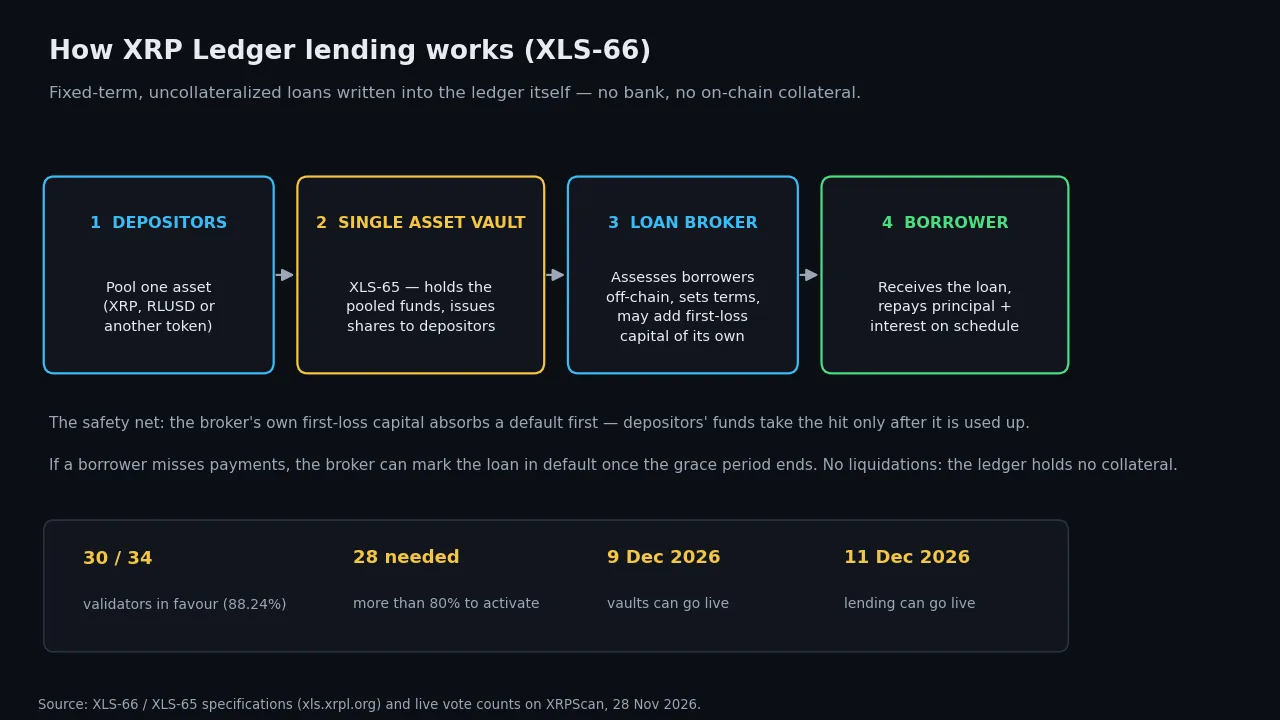
- Loans are fixed-term and uncollateralized: no collateral is locked on the ledger.
- Credit checks happen off-chain; the ledger records the loan, the payments and any default.
- New brokers must use closed-ended vaults, with separate deposit, investment and redemption phases.
What is first-loss capital?
That is the obvious question. If a borrower posts no collateral, who pays when a loan goes bad? The answer is the broker’s own money.
A broker can deposit first-loss capital into the lending setup alongside the depositors’ funds. If a borrower defaults, that money absorbs the loss first. Only the uncovered remainder reduces what backs depositors’ vault shares. The cover is optional, and where it is configured, its size is tied to a percentage of the debt owed.
That makes the broker the key risk in the whole design. Depositors are trusting the broker’s underwriting, not the ledger’s code. The ledger can enforce the loan terms. It cannot tell a good borrower from a bad one.
- First-loss capital is optional, and its size is set as a percentage of the debt owed.
- A default hits the broker’s money before depositors’ money.
- The vault also respects the issuer’s clawback and freeze controls on tokenized assets.
What could go wrong?
Three things. First, the vote is not the activation. Support has to stay above 80% for the full 14 days, and if it falls to 28 votes or below, the countdown restarts from scratch.
Second, the loans are uncollateralized by design. A bad loan is a real loss, not a liquidation. There are no price oracles and no automatic sell-off, because there is nothing to sell.
Third, nothing is live yet. The specification is still labeled a draft, and the V1_2 update (which would add private brokers and domain IDs) is not supported in the current code at all. The XRP Ledger Foundation and VS1 Finance opened a lending app for testing on the Devnet on 19 November, so developers can already try the full cycle, from setting up a lending market to repayment, before real money is involved.
- Support must stay above 80% for the full 14 days, or the countdown restarts.
- Borrowers post no collateral, so a bad loan is a real loss, not a liquidation.
- The feature is not live yet: lending transactions stay disabled until activation.
What does it mean for XRP holders?
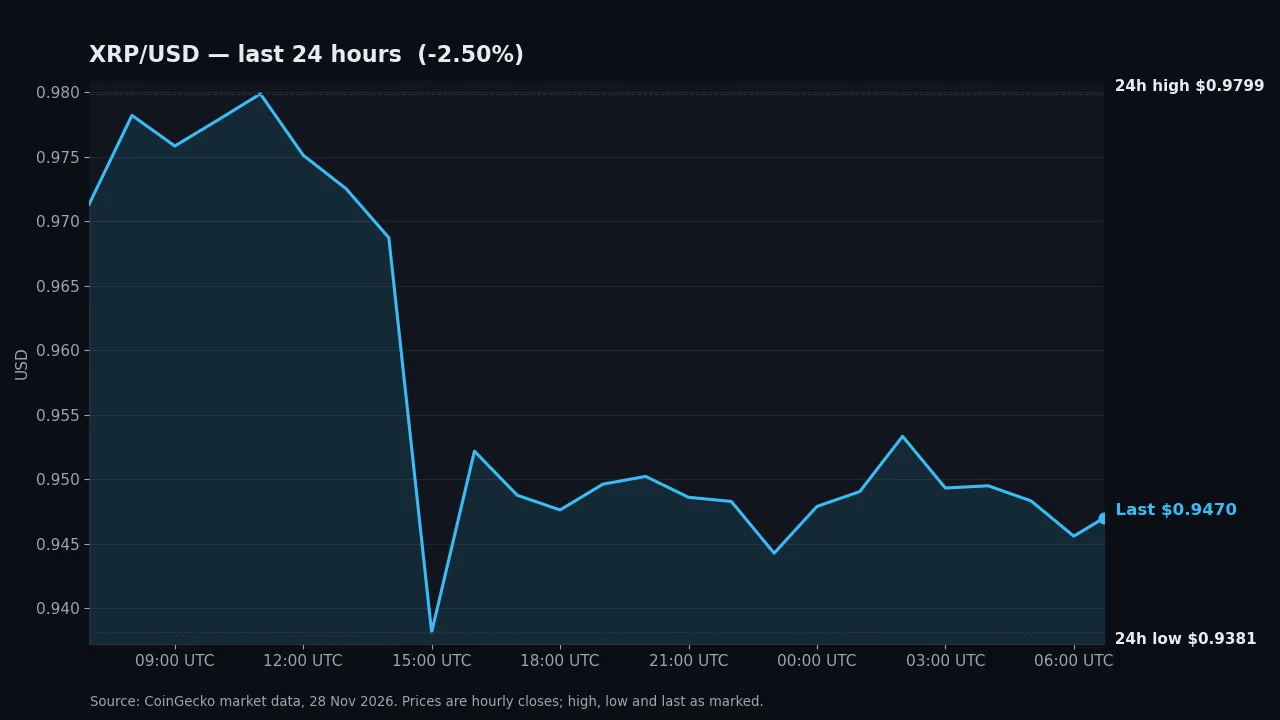
For now, not much changes in a holder’s wallet. XRP itself did not rally on the news. It traded at $0.9471 on the morning of 28 November, -2.5% in 24 hours, in a market where Bitcoin slipped back below $60,000 and the Fear & Greed Index sat at 10, extreme fear.
The bigger number is RLUSD. Ripple’s dollar stablecoin makes up $748.13 million of the XRP Ledger’s $836.92 million stablecoin market, 89.4%, according to DefiLlama on 27 November. A vault that accepts RLUSD would let holders earn yield on the ledger’s dominant stablecoin without leaving the network. That is the use case to watch, and it is also why the stablecoin rails other institutions are building matter: Brazil’s biggest banks are building a shared stablecoin of their own, and the same logic (one shared pool, many participants) runs through both stories.
The contrast with the rest of DeFi is the point. Aave App sells onchain lending to ordinary savers through an app; the XRP Ledger is putting lending into the ledger’s own rules, where a loan is a transaction like a payment. And the vote itself ran on the network’s trusted validator list, the same 35-key set that the XRP Ledger Foundation refreshed in October.
Key numbers
- 30 / 34: validators backing each amendment (88.24%)
- 28: votes needed to hold the majority
- 14 days: the activation countdown
- 9 Dec 2026: earliest vault activation
- 11 Dec 2026: earliest lending activation
- $836.92M: stablecoins on the XRP Ledger; RLUSD is $748.13M of it (89.4%)
- $0.9471: XRP price on 28 Nov, -2.5% in 24 hours (CoinGecko)
The XRP Ledger is two weeks from its first native loans, if the validators hold the line.
When will XRP Ledger lending go live?
The earliest dates are 9 December 2026 for Single Asset Vaults and 11 December 2026 for the lending amendments, and only if validator support stays above 80% for the full 14-day countdown. If support falls to 28 votes or below, the countdown restarts from scratch.
Do borrowers need to post collateral for an XRP Ledger loan?
No. XLS-66 loans are fixed-term and uncollateralized. The loan broker assesses the borrower off-chain before the loan is made, and the ledger records the loan, the repayments and any default. There is no collateral to liquidate.
What is a Single Asset Vault?
A vault defined by the XLS-65 standard that holds one asset: XRP, a token such as RLUSD, or another supported token. Depositors add the asset and receive shares that record their part of the pool, and the loan broker then lends from the pooled funds.
What happens to depositors if a borrower defaults?
The broker’s first-loss capital, where deposited, absorbs the loss first. Any uncovered amount reduces the assets backing depositors’ vault shares. First-loss cover is optional, so depositors should check whether a vault’s broker has posted it.
Can I use XRP Ledger lending today?
Not yet. Lending transactions stay disabled on mainnet until the amendments activate. A test version runs on the Devnet through an app from the XRP Ledger Foundation and VS1 Finance, opened on 19 November 2026.