
World Liberty Financial Sells Its Ether: Wallet Swaps $20 Million for Stablecoins
A wallet Arkham identifies as World Liberty Financial's Strategic Reserve sold about 12,000 ETH-related assets for $20.07 million in stablecoins on 27 November, reversing two years of accumulation — and WLFI's own token fell 17% in a day.

A wallet that Arkham identifies as World Liberty Financial’s Strategic Reserve sold its entire ether position on 27 November, swapping about 10,600 wrapped ether and 1,378 mETH for roughly $20.07 million in stablecoins in about half an hour. When the trades were done, the wallet held no ether at all — no ETH, no WETH, no mETH.
Note that the identification comes from Arkham, the on-chain analytics firm, not from World Liberty Financial itself. The project, backed by members of the Trump family, has said nothing about the sale so far, and a wallet being “linked to” a project is not the same as the project announcing a sale. What the chain shows is certain; who gave the order is not.
What the wallet sold
The wallet sold 10,600 WETH and 1,378 mETH through CoW Swap, receiving about $17.58 million in USDC and $2.49 million in USD1, World Liberty’s own dollar stablecoin, for a total of about $20.07 million. The Defiant reported the trades on 27 November, and the figures match the on-chain data.
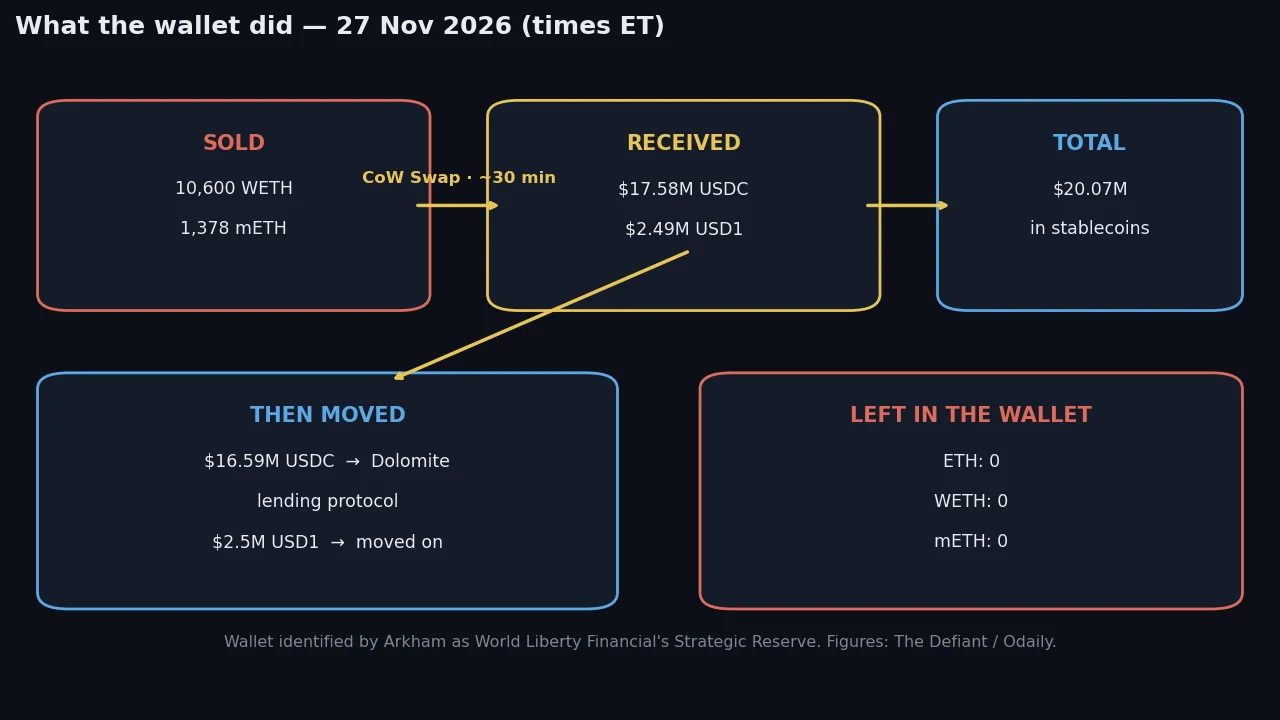
Most of the proceeds did not sit still. About $16.59 million of the USDC went straight to Dolomite, a lending protocol, and a further $2.5 million in USD1 was moved on after the final swap. The destination matters: Dolomite is the infrastructure behind World Liberty Markets, the project’s own lending platform, so the money moved from the project’s ether into the project’s own lending rails.
How we got here
The wallet had been a buyer, not a seller, for almost two years. In December 2024 it spent $10 million in USDC buying ether, and in January 2025 World Liberty said it had bought a further $47 million worth of ETH to mark Donald Trump’s inauguration. The accumulation was part of the project’s public story: a Trump-backed DeFi venture building a treasury around Ethereum.
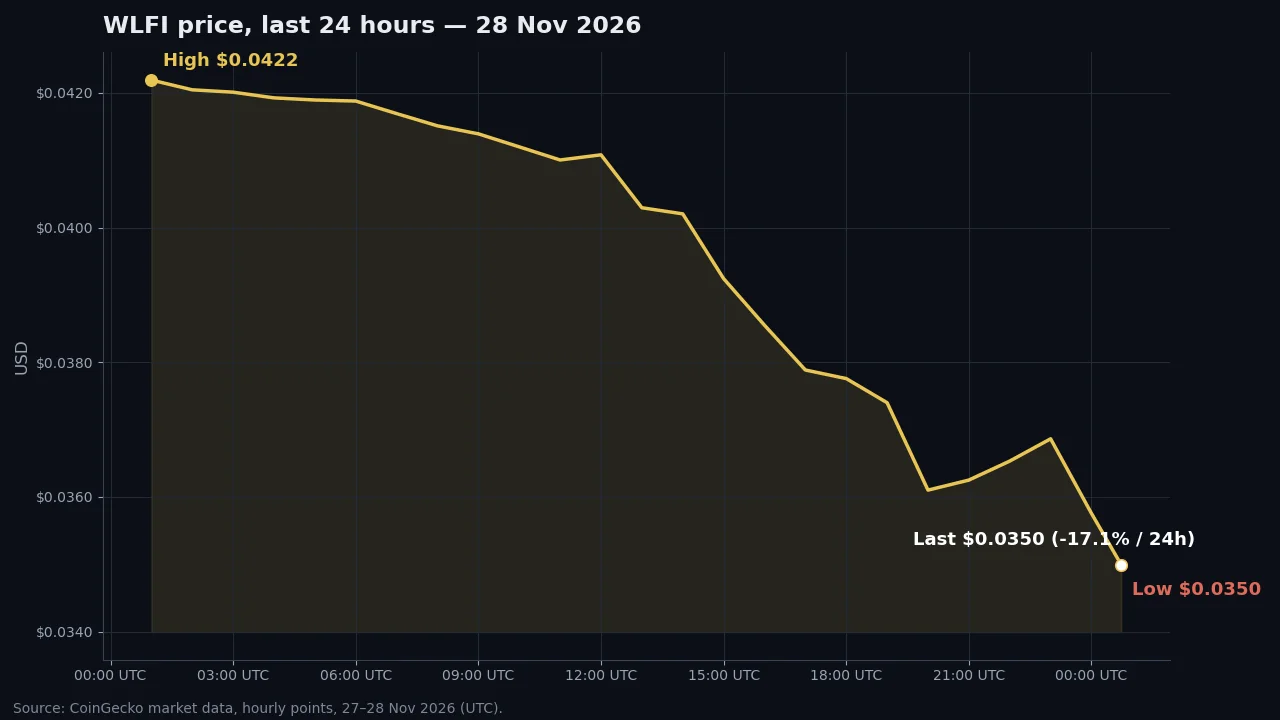
The sale landed on a bad day for the project’s own token. WLFI fell 17.1% in 24 hours to $0.0350, its low of the day, with hourly trading volume rising from about $15 million to $69 million as the price slid, according to CoinGecko market data. The token is down about 86% from its September high near $0.25. Ether itself barely moved on the news, trading around $1,664 after a 24-hour range of $1,654 to $1,740.
The contrast with two weeks ago is sharp. On 13 November, World Liberty said it had completed a $1 million buyback of WLFI — its first — funded from USD1 reserve earnings. Buying back its own token while its treasury wallet exits ether is not a contradiction, but it is a split screen: support for WLFI on one side, an exit from ETH on the other.
What it doesn’t mean
- It is not proof the project sold. The wallet is identified by Arkham as WLFI’s Strategic Reserve; no statement from World Liberty confirms it directed the trades.
- It is not a sale of WLFI tokens. The wallet sold ether and ether derivatives, not the project’s governance token.
- It is not evidence the project is in trouble. $20 million is small against a project whose USD1 stablecoin has a supply near $2.9 billion, and the proceeds went into lending, not out to an exchange.
- It did not move the ether market. ETH held around $1,660 through the trades; this is a WLFI story, not an ETH story.
Why it matters
What makes this sale worth more than its $20 million size is the direction of travel. World Liberty built part of its public image on buying ether — the $47 million inauguration purchase was a statement of intent. Exiting the position entirely, down to zero balances, is a louder statement than trimming it. A project that was accumulating ETH through 2024 and 2025 has now, on the visible evidence, decided it would rather hold dollars.
The shape of the exit matters too. Taking $2.49 million of the proceeds in USD1 keeps value inside the project’s own ecosystem, and parking $16.59 million on Dolomite puts it to work earning yield rather than sitting idle. In a market where sentiment is in extreme fear and US spot bitcoin ETFs have lost about $5.4 billion in November, caution is the theme of the month — and this wallet just acted on it. The move also lands in a Washington that is still working out what it wants crypto to be: the House has a bill that would write a strategic bitcoin reserve into law, as reported to the full House this week, while the project at the centre of this story is quietly swapping its ether for dollars.
What to watch
Three things. First, whether World Liberty says anything — a confirmation, a denial, or silence each mean something different, and the project has denied an ETH sale before, in April 2025. Second, whether the wallet buys back in, or whether the $16.59 million parked on Dolomite stays put and starts earning. Third, whether other Trump-linked wallets follow: this was one wallet, and the family’s crypto footprint is wider than a single address.
This article is for information only and is not financial advice.
How much ether did the World Liberty-linked wallet sell?
About 10,600 wrapped ether (WETH) and 1,378 mETH, worth roughly $20.07 million in stablecoins. The trades ran through CoW Swap over about 30 minutes on 27 November 2026, and the wallet was left holding no ETH, WETH or mETH.
Where did the money go?
The wallet received about $17.58 million in USDC and $2.49 million in USD1, World Liberty Financial’s own dollar stablecoin. About $16.59 million of the USDC was then moved to Dolomite, a lending protocol, and a further $2.5 million in USD1 was moved on after the final swap.
Is the wallet definitely World Liberty Financial’s?
Not confirmed by the project. Arkham, the on-chain analytics firm, identifies the wallet as World Liberty Financial’s Strategic Reserve. World Liberty Financial has not commented on the sale, so the attribution rests on Arkham’s labelling, not on a statement from the project.
What happened to the WLFI token after the sale?
WLFI fell 17.1% in 24 hours to $0.0350 on 28 November 2026, its low of the day, with hourly trading volume rising from about $15 million to $69 million as the price slid, according to CoinGecko market data. Ether itself barely moved, trading around $1,664.