Ethereum Foundation Doubles Security Team for Post-Quantum, Post-AI Overhaul Targeting December 2028
The Ethereum Foundation has doubled its protocol security team for PQAI, a rebuild of Ethereum's cryptography for a post-quantum, post-AI world, targeting December 2028. About 42 million ETH worth $72 billion sits in wallets with exposed public keys.
The Ethereum Foundation has doubled its protocol security team as it starts the hardest upgrade in the network’s history: a rebuild of Ethereum’s cryptography for a world in which AI finds software bugs faster than humans can review them and quantum computers threaten the maths that secures every wallet. The overhaul, called PQAI, carries a December 2028 target and a warning from the researcher leading it that the work is harder than the Merge, with less time to do it.
AI is now the more urgent threat
The announcement came in the foundation’s PQAI #0 blog post, published on 23 November by Ethereum Foundation researcher Kev Wedderburn. Ethereum has planned defences against quantum computers for years, but Wedderburn writes that AI has now overtaken quantum as the more immediate risk. Models are already finding bugs in production software faster than people can review them, including thousands in the Linux kernel, one of the most scrutinised codebases in the world. He also cites an AI-assisted proof of the 167-year-old Riemann hypothesis, announced days earlier, as a measure of how fast the field is moving.
That speed is the reason for the rebuild. Cryptography should use the most conservative assumptions available, Wedderburn argues, and core components need formal verification against a specification so whole classes of bugs are ruled out. After more than a year evaluating candidate signature schemes, the foundation is advocating hash-based cryptography to replace elliptic curves. The change adds no new assumption, because the Ethereum protocol already relies on hashes being secure.
The warning lands in a month when hardware wallet security has already taken its own hit, with tampered Ledger devices confirmed in Berlin and a Trezor shipping-partner breach exposing about 27,000 orders. The PQAI overhaul is a different kind of problem, at the protocol layer rather than the device layer, but the timing underlines why the foundation is treating security as its highest priority.
The $72 billion exposure
The scale of what is at stake was quantified days earlier by researchers at the University of Pittsburgh and the Chicago-based security firm SeQure. Their paper, published on arXiv on 19 November and reported by CoinDesk on 23 November, found that about 42 million ether, worth roughly $72 billion at a price near $1,726, sits in wallets whose public keys are already exposed on the blockchain. That is 54.6% of the ether held outside staking on Ethereum’s execution layer.
The exposure exists because a wallet reveals its public key the first time it sends a transaction, and the key stays visible afterwards. No publicly known quantum computer can derive a private key from an exposed public key today, and the researchers are clear that their finding is a measurement of exposure, not an ongoing breach. But a machine powerful enough to run Shor’s algorithm against those keys would not necessarily be announced before it was used, and the researchers also found that 61% of staked ether would move to wallets with exposed keys once it is withdrawn.
Their migration plan gives owners two routes to quantum-resistant keys, at a cost of about $1 per account under the study’s fee assumptions. With ordinary transactions competing for block space, the team estimates 4.45 million wallets holding at least 0.1 ether could register new keys in 29 days, or 235 days if every eligible owner waited. The researchers reviewed 25 exchanges and found no publicly documented backup compatible with their recovery method.
What changes, layer by layer
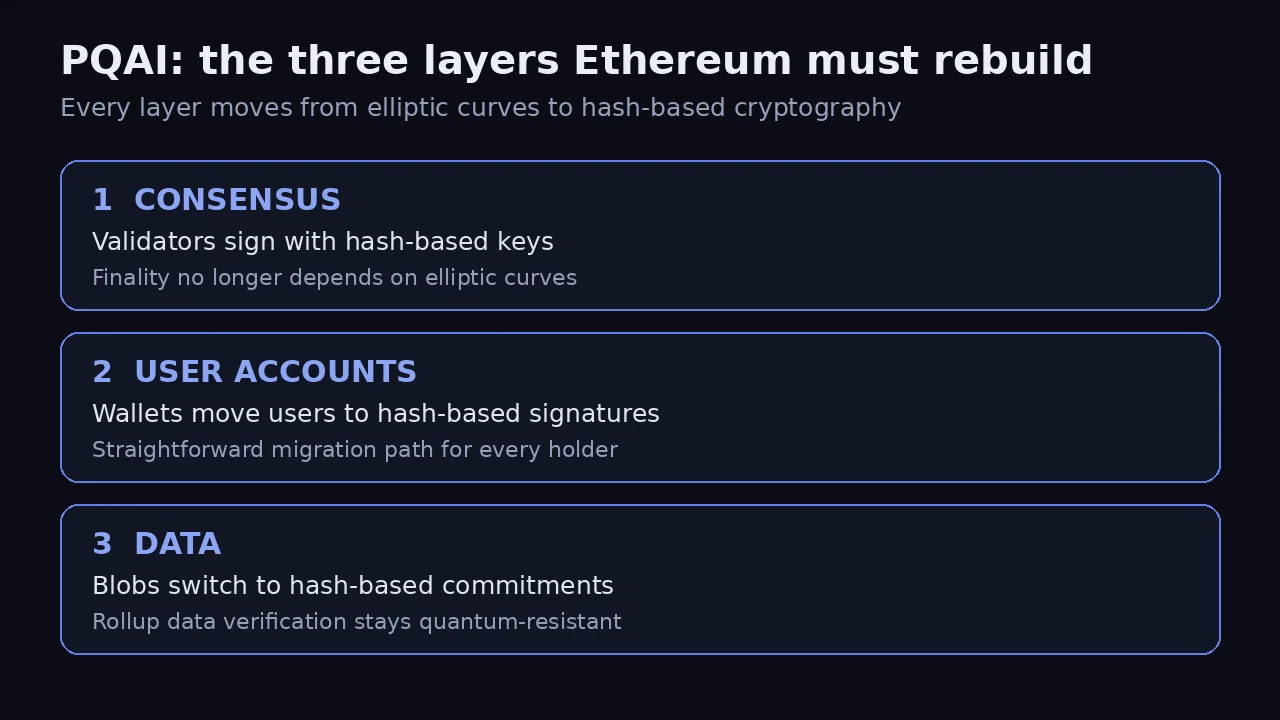
The overhaul touches three parts of the protocol at once. Validators will sign with hash-based keys, so finality no longer depends on elliptic curves. Wallets will give users a straightforward way to move to hash-based signatures, a migration that wallet teams, multisig providers and staking pools will all have to support. And blobs, the data layer rollups use, will switch to hash-based commitments.
| Layer | Today | Under PQAI |
|---|---|---|
| Consensus | Validators sign with BLS signatures on elliptic curves | Hash-based signing keys; finality no longer rests on elliptic curves |
| User accounts | Wallets use elliptic-curve key pairs | Hash-based signatures, with a guided migration for holders |
| Data | Blobs verified with KZG commitments | Hash-based commitments for rollup data |
The cost is real. Features people have spent years on will have to wait, tooling built around BLS signatures will need reworking, and contracts that assume pre-quantum cryptography will need updates. Much larger signatures mean monitoring hardware requirements closely, so people can still run nodes at home. Early specifications have started, the first post-quantum consensus devnet is already iterating, and the community group Ethlabs has published its own pqai27 proposal and pulled its Quick Slots proposal out of the Hegotá upgrade to free up engineering time.
A tighter deadline, a smaller team
At Devcon in Mumbai, Ethereum Foundation researcher Justin Drake put forward December 2028 as the target for completing the post-quantum and post-AI transition, a full year earlier than the quantum-resistance deadline the foundation had previously announced. The foundation still treats 2029 as its internal deadline, with a timeline review planned for January.
The doubled security team is the most concrete commitment in the announcement, and it comes after a restructuring that cut about a fifth of the foundation’s staff five months ago. The expansion is a reallocation rather than a hiring spree: a dedicated post-quantum team has been in place since January 2026, and the new headcount is meant to keep formal verification and security work in step with a development pace Wedderburn describes as faster than anything since the Merge. Ethereum Foundation researcher Ansgar Dietrichs put five options to developers on 19 November for how much quantum defence to build into the planned Hegotá upgrade, including one version devoted entirely to it.
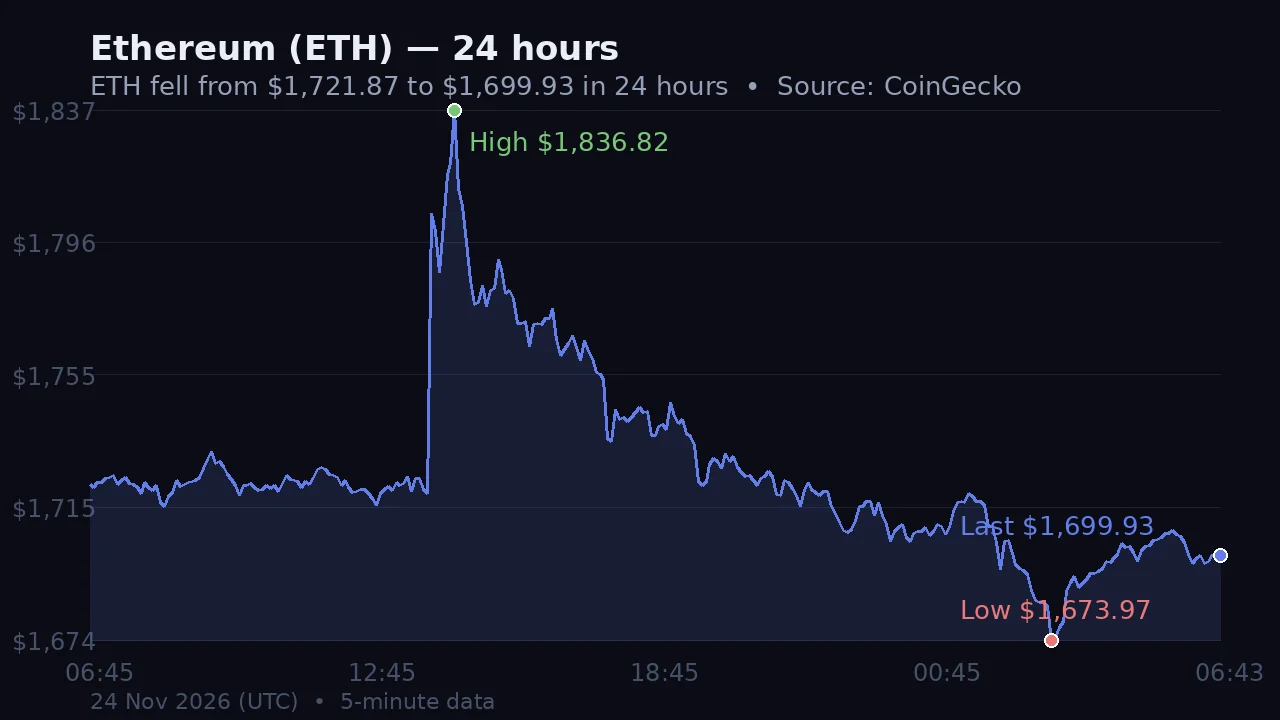
Ether itself traded at around $1,700 on 24 November, after touching $1,836.82 in the previous 24 hours and falling as low as $1,673.97. The price is a footnote to the announcement rather than the story: corporate Ether treasuries and Ethereum’s layer-2 ecosystem both depend on the same cryptography the overhaul is replacing, so the upgrade matters to holders whether or not they follow the cryptography.
What to watch
The January timeline review will show whether December 2028 holds or slips. The Hegotá upgrade decisions will show how much quantum defence ships first. And the first post-quantum devnet iterations will show whether the cryptography works in practice before wallets and staking pools are asked to migrate.
What is Ethereum PQAI?
PQAI is the Ethereum Foundation’s post-quantum, post-AI overhaul of Ethereum’s cryptography. Announced on 23 November 2026 in a blog post by researcher Kev Wedderburn, it rebuilds three layers of the protocol — consensus signing, user accounts and blob data commitments — on hash-based cryptography instead of elliptic curves.
Why does the Ethereum Foundation say AI is now a bigger risk than quantum computers?
The foundation has planned quantum defences for years, but Wedderburn writes that AI has become the more urgent risk because models are already finding bugs in production software faster than humans can review them, including thousands in the Linux kernel. Quantum computers remain a longer-term threat; AI is changing the security picture now.
How much ETH is exposed to a future quantum attack?
About 42 million ether, worth roughly $72 billion at a price near $1,726, sits in wallets whose public keys are already exposed on the blockchain, according to a paper from University of Pittsburgh and SeQure researchers published on 19 November 2026. That is 54.6% of the ether held outside staking on Ethereum’s execution layer. No publicly known quantum computer can exploit this today.
When will Ethereum finish the post-quantum transition?
Ethereum Foundation researcher Justin Drake has proposed December 2028 as the target for completing the post-quantum and post-AI transition, a year earlier than the previously announced quantum-resistance deadline. The foundation still treats 2029 as its internal deadline, with a timeline review planned for January.
Do Ethereum holders need to do anything now?
No. There is no action for holders today, and no publicly known quantum computer can break Ethereum’s cryptography. When the migration begins, wallets will give users a straightforward way to move to hash-based signatures, and the researchers’ plan estimates the switch would cost about $1 per account.