What Is Avalanche Blockchain? How It Works and AVAX
Learn what Avalanche blockchain is, how its multi-chain network works, what the AVAX token does, and how it is used in DeFi, tokenization and finance.
Avalanche blockchain is a high-performance network designed to make digital transactions faster, more scalable, and efficient. It supports smart contracts, decentralized applications, and financial services without relying on a single central authority. Unlike traditional blockchain networks, Avalanche uses a multi-chain architecture that allows different chains to handle specific tasks while remaining part of a connected ecosystem. Its technology aims to provide quick transaction finality, flexible development options, and support for custom blockchain networks. The Avalanche network also enables developers to build applications for decentralized finance, gaming, and digital asset tokenization. At the center of this ecosystem is the AVAX token, which supports transaction fees and network staking.
But what is Avalanche, how does it work, and what makes it different from platforms such as Ethereum and Solana? This guide explains its architecture, consensus mechanism, AVAX token, real-world applications, benefits and risks.
What Is Avalanche Blockchain?
Avalanche blockchain is a Layer 1 blockchain platform designed to support smart contracts, digital assets and application-specific blockchain networks. It uses a multi-chain architecture. This means different blockchains can perform different tasks instead of forcing every application to use one shared chain.
The Avalanche network includes a Primary Network made up of three built-in blockchains: the Avalanche C-Chain, Avalanche X-Chain and Avalanche P-Chain. Each has a different purpose. Developers can also create separate Avalanche L1s for applications that need their own rules, validators or operating models. These application-specific networks were previously known as Avalanche subnets. The newer L1 model gives each network more control over its design and operation. Avalanche documentation explains the role of the three Primary Network chains and their relationship to the wider ecosystem.
In simple terms, Avalanche provides the infrastructure for building and using blockchain applications. A developer can deploy a smart contract on the C-Chain or create a separate network for a game, financial service or business application. This flexibility is a major part of what makes Avalanche different from a blockchain where most activity takes place on one general-purpose chain.
The platform is also designed to support blockchain interoperability. Its networks can communicate through Avalanche’s cross-chain infrastructure, allowing applications to work across different chains. However, interoperability does not mean that every network automatically shares the same security, rules or validator set. Each Avalanche L1 can define important parts of its own operating model.
Who Created Avalanche?
Avalanche was developed by Ava Labs, a blockchain development company founded in 2019. Its co-founders include Emin Gün Sirer, Kevin Sekniqi and Maofan Ted Yin. Their work brought research into a new consensus design together with the development of a blockchain platform.
Emin Gün Sirer is a computer scientist and former Cornell University professor known for his work in distributed systems and cryptocurrency research. Kevin Sekniqi and Maofan Ted Yin also contributed to the technical research and development behind the platform.
The early research behind the Avalanche Consensus design was associated with a pseudonymous group known as Team Rocket. The research introduced a different way for network participants to reach agreement. Rather than relying on a central coordinator, the design uses repeated sampling of small groups of validators.
Avalanche launched its main network in September 2020. Since then, the platform has developed its smart contract capabilities, validator infrastructure and support for custom blockchain networks. Ava Labs continues to develop tools and infrastructure for businesses and developers building on Avalanche.
What Problem Was Avalanche Designed to Solve?
One of the main challenges in blockchain technology is balancing scalability, security and decentralization. This is often called the blockchain trilemma. A network needs to process transactions efficiently while remaining secure and allowing a broad group of independent participants to help operate it.
Some blockchains become congested when many users compete to process transactions. This can increase fees and make applications slower or more expensive to use. Other networks improve performance by relying on a more limited group of validators, which can raise questions about decentralization.
Avalanche approaches these challenges through its consensus design and multi-chain architecture. Its goal is to support fast transaction confirmation while allowing developers to create networks suited to specific applications. Instead of making every application compete for the same resources, separate chains can handle different workloads.
This does not mean Avalanche has solved every blockchain problem. Each network still faces trade-offs involving security, adoption, cost and decentralization. Its architecture offers developers more choices, but those choices also require careful network design.
How Does the Avalanche Blockchain Work?
The Avalanche blockchain technology combines a multi-chain structure with a family of consensus protocols. The Primary Network contains three built-in blockchains, each responsible for a different part of the system. The platform also supports independent Avalanche L1s that can be designed for specific applications.
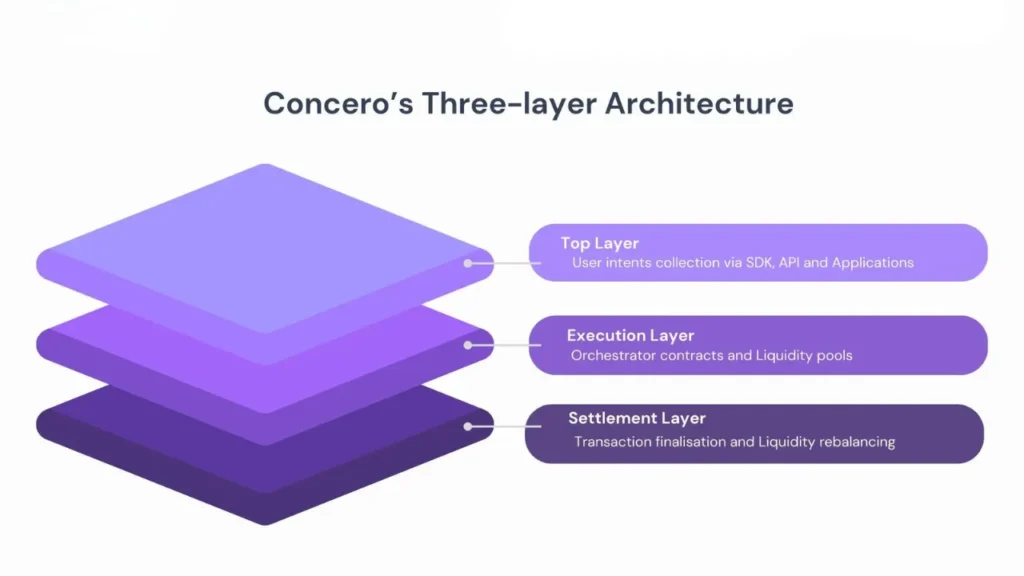
This structure helps separate asset transfers, smart contract activity and network coordination. It also gives developers the option to build on an existing chain or create a dedicated network. To understand how Avalanche works, it is important to look at its three chains and the consensus mechanisms that help validators agree on network activity.
Understanding Avalanche’s Multi-Chain Architecture
The Primary Network is the foundational network within Avalanche. It contains the X-Chain, C-Chain and P-Chain. These chains work together, but they do not all perform the same tasks.
The Avalanche X-Chain focuses on creating and transferring digital assets. The Avalanche C-Chain supports smart contracts and Ethereum-compatible applications. The Avalanche P-Chain manages validators, staking operations and the creation of Avalanche L1s.
| Blockchain | Main purpose | Key function |
|---|---|---|
| X-Chain | Digital assets | Creates and transfers supported assets |
| C-Chain | Smart contracts | Runs EVM-compatible applications |
| P-Chain | Network coordination | Manages validators, staking and L1 operations |
This separation allows each chain to focus on its own responsibilities. It is important, however, not to confuse the Primary Network with the entire Avalanche ecosystem. The Primary Network is one part of Avalanche, while the wider ecosystem also includes additional L1 networks.
What Is the Exchange Chain (X-Chain)?
The Exchange Chain, also called the X-Chain, is designed for creating and transferring digital assets. It is part of Avalanche’s original multi-chain architecture and has a role in the network’s asset management system.
The X-Chain uses a directed acyclic graph, commonly called a Directed Acyclic Graph (DAG), as part of its transaction structure. A DAG allows transactions to be represented through a structure that is not limited to one simple sequence of blocks. This design is associated with the Avalanche consensus approach.
The X-Chain is different from the C-Chain. It is not the main environment for deploying Ethereum-compatible smart contracts. Developers who want to build applications using familiar Ethereum tools generally use the C-Chain instead.
What Is the Contract Chain (C-Chain)?
The Contract Chain, or C-Chain, is the main smart contract environment on the Avalanche Primary Network. It supports the Ethereum Virtual Machine (EVM), which allows developers to deploy many applications written for Ethereum with limited changes.
The C-Chain supports Solidity, the programming language widely used for Ethereum smart contracts. This makes the network familiar to developers who already work with Ethereum tools, wallets and decentralized applications.
For users, the C-Chain is important because many Avalanche applications operate through it. These include decentralized exchanges, lending platforms, NFT applications and other services. Its compatibility with Ethereum tools can make it easier for developers to move existing applications or create new ones.
The C-Chain uses Snowman-based consensus to order transactions into a linear sequence. This is useful for smart contracts because the order of operations can affect the final result. The official Avalanche documentation describes the C-Chain as an EVM implementation that supports smart contracts written in Solidity.
What Is the Platform Chain (P-Chain)?
The Platform Chain, or P-Chain, is responsible for important network coordination tasks. It manages validator-related operations, staking and the creation and tracking of Avalanche L1s.
A validator is a computer that participates in the network’s consensus process. Validators help confirm network activity and maintain the blockchain’s state. The P-Chain records information about these validators and supports the operations needed to manage the Primary Network and other Avalanche L1s.
The P-Chain is also important for developers who want to create custom networks. It supports the registration and management of Avalanche L1s, making it a key part of the platform’s multi-chain design.
How Does the Avalanche Consensus Mechanism Work?
A blockchain consensus mechanism allows network participants to agree on which transactions are valid and what the correct state of the network should be. Without consensus, different computers could maintain conflicting versions of the same blockchain.
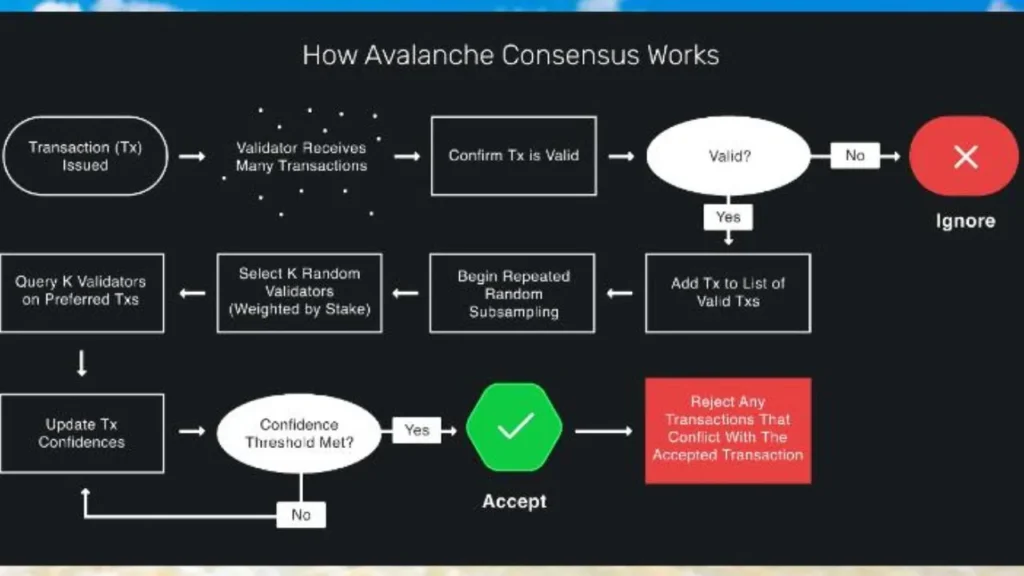
The Avalanche consensus mechanism uses repeated random sampling. Instead of requiring every validator to communicate directly with every other validator for every decision, a validator asks a small, randomly selected group of other validators about their preferences. It then uses their responses to update its own preference.
This process repeats. When enough sampling rounds produce consistent results, the network becomes highly confident in the decision. The approach is designed to help validators reach agreement quickly without depending on one central leader.
Avalanche uses a family of related protocols often called the Snow protocols. Two important names are Avalanche Consensus and Snowman Consensus. They use related ideas but are suited to different transaction structures.
What Is Avalanche Consensus?
Avalanche Consensus uses repeated random subsampling to help validators agree on transaction decisions. A validator checks the preferences of a small group of other validators. If the responses show a strong preference for one valid outcome, the validator may adopt that preference.
The process continues across multiple rounds. As more validators reach the same preference, agreement becomes increasingly likely. This approach can support fast confirmation and a large validator set without requiring every participant to exchange messages with every other participant in every round.
The original Avalanche consensus design is associated with DAG-based transaction processing. This structure can allow transactions to be handled in parallel in the relevant protocol design. It is one reason Avalanche is often discussed in relation to high throughput and fast finality.
What Is Snowman Consensus?
Snowman Consensus uses the same general idea of repeated validator sampling, but it orders transactions into a linear sequence of blocks. This is useful for applications where the order of operations matters.
For example, a smart contract may need to process one transaction before another. If the order changes, the result could also change. A linear chain makes it possible to maintain a clear order for these operations.
Snowman is used by the C-Chain and P-Chain in the Primary Network. The two consensus approaches serve different purposes within Avalanche’s architecture. The official documentation explains the Snow family as a set of protocols based on repeated random sampling and probabilistic safety guarantees.
What Are Avalanche Subnets and Avalanche L1s?
Avalanche subnets were introduced as a way for developers to create application-specific blockchain networks. The terminology has since evolved. Newer documentation and development use the term Avalanche L1s to describe these sovereign networks.
An Avalanche L1 can define its own rules, validator membership, token economics and execution environment. A gaming company, for example, might want a network designed for frequent in-game transactions. A financial institution might need a network with permissioned access and specific compliance controls.
The Etna upgrade, activated in December 2024, changed how Avalanche L1s operate. Under the newer model, L1 validators do not have to validate the Primary Network itself. They must still sync the P-Chain to support the ecosystem’s interoperability features. This gives L1 operators more independence than the earlier subnet model. Avalanche’s L1 documentation explains this structure.
This distinction is important. Not every Avalanche L1 automatically receives the same security as the Primary Network. Each L1 has its own validator set and design. Its security depends on how that network is configured and operated.
What Was the Avalanche9000 Upgrade?
Avalanche9000 was a major upgrade associated with the Etna hard fork, which activated on the Avalanche mainnet on December 16, 2024. It was designed to make it easier and less expensive to launch application-specific networks.
Before Etna, validators operating a subnet had to meet Primary Network validation requirements, including a significant AVAX stake. The upgrade introduced a different model for Avalanche L1 validators. Instead of requiring them to stake 2,000 AVAX on the Primary Network simply to validate an L1, the new system introduced a recurring fee model.
Etna also reduced the minimum C-Chain base fee at the time of activation and introduced changes to validator management and cross-chain communication. Later upgrades have changed some fee parameters again, so older descriptions of Avalanche gas fees should not be treated as current figures.
The wider importance of Avalanche9000 is that it made independent L1 deployment more practical for developers and organizations. It strengthened Avalanche’s focus on customizable networks rather than relying only on one shared blockchain.
What Makes Avalanche Different From Other Blockchains?
Avalanche stands out because of its combination of a multi-chain architecture, fast consensus design and support for application-specific networks. It gives developers the choice to use the existing C-Chain or build a separate L1 with its own operating rules.
These features can be useful for applications that need more control over performance, fees or network membership. However, Avalanche is not automatically better than every competing blockchain. Its advantages depend on the application, the quality of its ecosystem and the way each network is operated.
Transaction Speed and Finality
Transaction speed and transaction finality are related, but they do not mean exactly the same thing. Speed usually describes how quickly a network processes activity. Finality describes when a transaction is considered confirmed and no longer expected to be reversed under the protocol’s assumptions.
Avalanche is designed for fast transaction finality. Its consensus protocols use repeated validator sampling to reach agreement without relying on a single block proposer to make every decision. This can make the network useful for applications where users need quick confirmation.
The term sub-second finality is often used when describing Avalanche’s performance. It is important to understand that actual performance can depend on the specific chain, network conditions, application and transaction type. A dedicated Avalanche L1 may have different performance characteristics from the C-Chain.
Scalability and Network Flexibility
Avalanche scalability is based partly on the ability to create separate networks for different applications. If a game, financial service or business application needs its own environment, developers can build an Avalanche L1 rather than placing every transaction on the same general-purpose chain.
This approach is sometimes described as horizontal scaling. Instead of relying only on one blockchain to handle growing demand, the ecosystem can support more networks as new applications are launched.
However, adding more chains also creates responsibilities. Each L1 needs suitable validators, reliable infrastructure and a secure design. Developers must also consider how users and assets will move between networks. Scalability is therefore not just about creating more chains; it is about making sure those chains work reliably.
Transaction Fees and Network Costs
Avalanche gas fees are payments users make to process transactions and execute smart contracts. On the C-Chain, fees are paid in AVAX. The exact cost depends on network conditions, transaction complexity and the fee rules active at the time.
Avalanche’s upgrades have changed fee settings over time. The Etna upgrade reduced the minimum C-Chain base fee in December 2024. Later changes, including the Helicon upgrade in September 2026, altered how the minimum gas price is determined. This is why it is better to avoid quoting an old minimum fee as though it were still the current network-wide rate.
Custom Avalanche L1s can also configure their own fee models. This gives developers more control over how users pay for transactions. A business network might choose a fee structure that fits its application, while a public network may use a different approach.
Security and Decentralization
Avalanche uses Proof of Stake (PoS) for validator participation on the Primary Network. Validators stake AVAX and operate nodes that help maintain the network. Staking creates an economic commitment and gives validators a role in the consensus process.
The level of decentralization depends on factors such as the number of validators, how stake is distributed, the cost of operating nodes and the rules for joining the network. A large validator count alone does not prove that control is evenly distributed.
Custom Avalanche L1s introduce another consideration. They can choose their own validator arrangements. This can be useful for businesses that need permissioned networks, but it also means the security model may differ from the Primary Network. Readers should evaluate each L1 separately rather than assuming all chains have identical security.
Avalanche vs. Ethereum
Avalanche vs Ethereum is a common comparison because both platforms support smart contracts and decentralized applications. They also share an important developer feature: Avalanche’s C-Chain is compatible with the Ethereum Virtual Machine.
This compatibility allows developers to use familiar tools and deploy many Solidity-based applications on Avalanche. Ethereum, meanwhile, has a large developer community, an established application ecosystem and a broad network of infrastructure providers.
The main difference is not simply speed or fees. The platforms have different architecture and scaling strategies. Avalanche emphasizes a Primary Network combined with customizable L1s. Ethereum relies on its main network and a wider ecosystem of scaling solutions, including rollups.
| Feature | Avalanche | Ethereum |
|---|---|---|
| Main design | Multi-chain ecosystem with customizable L1s | General-purpose Layer 1 with a rollup ecosystem |
| Smart contracts | EVM-compatible C-Chain | Native EVM environment |
| Developer language | Solidity supported | Solidity widely used |
| Scaling approach | Separate application-specific L1s and network upgrades | Mainnet improvements and Layer 2 rollups |
| Native asset | AVAX | ETH |
| Network fees | AVAX on C-Chain; L1 fees depend on configuration | ETH on Ethereum mainnet |
Neither platform is the best choice for every project. A developer may prefer Avalanche for a dedicated network with custom rules. Another may choose Ethereum because of its liquidity, established applications or user base.
Avalanche vs. Solana
Solana is another major Layer 1 blockchain designed for high-performance applications. It uses a different architecture and execution environment from Avalanche. Solana focuses on a high-throughput shared network, while Avalanche allows applications to operate on separate L1s.
Both platforms support decentralized finance, payments, gaming and other blockchain applications. Their ecosystems also compete for developers, users and liquidity.
The right choice depends on the application’s requirements. A project that benefits from a shared network may prefer Solana. A project that needs a dedicated chain with its own validators and operating rules may find Avalanche’s L1 model useful.
Avalanche vs. Polkadot and Cosmos
Polkadot and Cosmos also focus on connecting multiple blockchain networks. Polkadot uses a system built around its Relay Chain and parachains. Cosmos provides tools and standards that allow independent blockchains to communicate through its Inter-Blockchain Communication protocol.
Avalanche takes a different approach through its Primary Network and sovereign L1s. Each platform makes different choices about security, validator participation, interoperability and network independence.
There is no single winner across all these ecosystems. Developers should compare the technical requirements, operating costs, available tools and security model of each platform before choosing one.
NEAR Protocol is another blockchain platform that competes for developers and applications. Its architecture and scaling approach differ from Avalanche, but it addresses similar goals around usability and application performance.
What Is AVAX and How Does It Work?
AVAX is the native cryptocurrency of the Avalanche network. It is used to pay transaction fees on the Primary Network, support staking and serve as a common unit of account across the ecosystem. It is important to separate the AVAX token from Avalanche itself. Avalanche is the blockchain platform, while AVAX is the digital asset used within parts of that platform.
The AVAX token is also connected to the network’s economic design. Users can stake AVAX to participate in Primary Network validation or delegate their tokens to an existing validator. Transaction fees paid in AVAX are burned, meaning they are permanently removed from circulation. At the same time, the protocol creates new AVAX as staking rewards.
What Is the AVAX Token Used For?
One of the main uses of AVAX is paying transaction fees. When someone sends an asset or interacts with a smart contract on the C-Chain, the transaction requires a fee. That fee is paid in AVAX and is burned by the protocol.
AVAX also supports staking. Validators commit tokens to participate in the Primary Network’s consensus process. This helps secure the network and gives participants the opportunity to earn rewards if they meet the protocol’s requirements.
The token also acts as a common unit of account across Avalanche L1s. However, individual L1s can have their own gas tokens and economic rules. Therefore, AVAX is important to the wider ecosystem, but it is not necessarily the transaction currency for every application-specific chain.
How Does AVAX Staking Work?
Avalanche staking allows AVAX holders to support network security by participating as validators or delegators. A validator operates a node and takes part in the consensus process. A delegator assigns their stake to an existing validator rather than running their own validator node.
On the Primary Network, becoming a validator requires a minimum stake of 2,000 AVAX under the current documented rules. Delegation has separate requirements and is subject to the protocol’s minimum amount and staking period. These requirements can change through network upgrades, so users should check the official documentation before committing funds.
Staking rewards are not guaranteed investment returns. They depend on protocol rules and the successful completion of a validation period. Validators also need reliable hardware, a stable internet connection and an understanding of the technical responsibilities involved.
Avalanche’s Primary Network does not use the same slashing model as some other Proof of Stake networks. A validator that fails to meet the required uptime can lose its reward for that period. This does not mean staking is risk-free. Users still face price volatility, operational risks and the possibility of choosing an unreliable validator.
What Is Avalanche Tokenomics?
Avalanche tokenomics describes how AVAX is issued, used and removed from circulation. The token has a maximum supply cap of 720 million AVAX. A portion was created at the network’s launch, while additional tokens can be issued as rewards for successful validation.
Transaction fees are burned. This reduces the amount of AVAX that would otherwise remain in circulation. Staking rewards, on the other hand, introduce new tokens. The relationship between newly issued rewards and burned fees affects the token’s supply over time.
It is important not to describe AVAX as automatically deflationary. Even though transaction fees are burned, staking rewards can increase the circulating supply. The net effect depends on the amount of AVAX issued and the amount burned.
| Token feature | Explanation |
|---|---|
| Native token | AVAX |
| Maximum supply | 720 million AVAX |
| Transaction fees | Paid in AVAX on the Primary Network and burned |
| Staking | Supports Primary Network validation |
| Validator rewards | New AVAX can be issued under protocol rules |
| Ecosystem role | Common unit of account across Avalanche L1s |
These token mechanics explain how AVAX supports the network. They do not predict its market price. Demand for the token depends on many factors, including network activity, market conditions, investor expectations and competition.
What Is the Avalanche Ecosystem Used For?
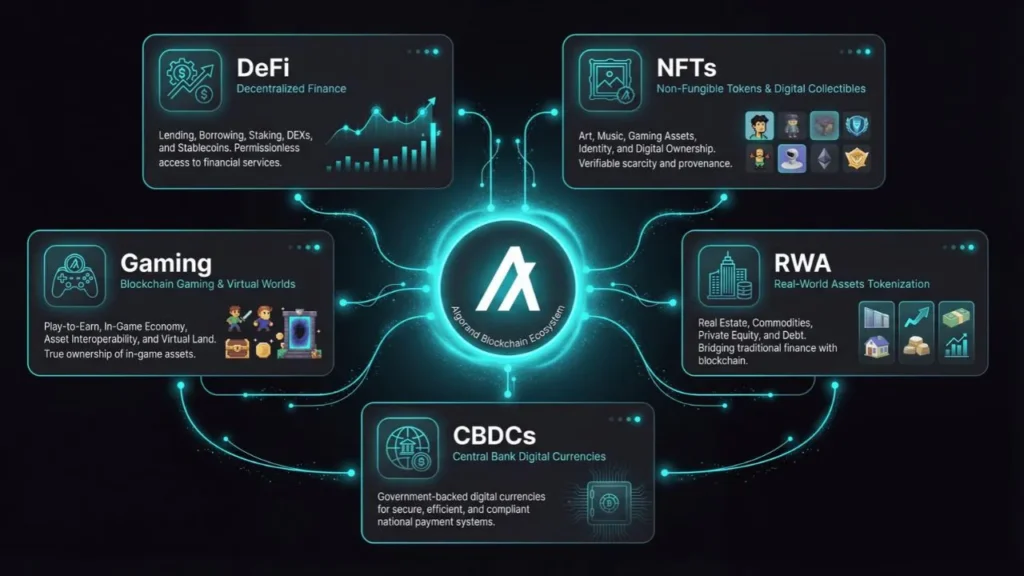
The Avalanche ecosystem supports a wide range of blockchain applications. These include decentralized finance, gaming, digital assets, payments and enterprise services. Developers can use the C-Chain for EVM-compatible applications or create separate L1s when they need a more specialized environment.
The flexibility of Avalanche is important because different applications have different needs. A decentralized exchange may need smart contract functionality and liquidity. A game may need fast and frequent transactions. A financial institution may require controlled access and specific compliance rules. Avalanche’s architecture allows developers to choose an approach that fits their project.
Decentralized Finance (DeFi)
Decentralized Finance (DeFi) refers to financial services that operate through blockchain-based smart contracts instead of relying entirely on traditional intermediaries. These services can include lending, borrowing, trading and liquidity provision.
The Avalanche DeFi ecosystem includes applications that allow users to exchange tokens, provide liquidity and interact with lending protocols. Many of these applications operate on the C-Chain because it supports the EVM and Solidity smart contracts.
DeFi can make financial services accessible through a digital wallet, but it also carries risks. Smart contract errors, price changes, low liquidity and malicious applications can lead to losses. Users should research a platform before connecting a wallet or depositing assets.
Gaming and Web3 Applications
Blockchain gaming is another use case for Avalanche. Games may use blockchain networks to represent in-game items, digital ownership or token-based rewards. A dedicated L1 can give a game developer more control over transaction fees, network rules and application performance.
For example, a game with many players may need to process frequent transactions. A custom network can be designed around the game’s needs rather than competing for resources with unrelated applications. This does not guarantee that the game will succeed, but it gives developers another way to manage its infrastructure.
Web3 applications can also use Avalanche for digital identity, community services and other blockchain-based features. Their success depends on whether users find them useful, secure and easy to operate.
NFTs and Digital Assets
Non-fungible tokens, commonly known as NFTs, are blockchain tokens that represent distinct digital items or records. They can be used for digital collectibles, artwork, gaming items, tickets and other forms of digital ownership.
Avalanche supports NFT-related applications through its smart contract infrastructure. Developers can create tokens and applications that allow users to issue, transfer and manage digital assets.
An NFT does not automatically prove ownership of the real-world item or intellectual property it represents. The rights attached to a token depend on the issuer, the platform’s terms and applicable law. Buyers should understand what they are receiving before purchasing an NFT.
Tokenization and Real-World Assets
Real-world asset tokenization means creating blockchain-based tokens that represent rights or interests in assets outside the blockchain. These assets may include funds, government securities, real estate, commodities or credit products.
Tokenization can make it easier to record ownership, transfer assets and automate certain administrative processes. Smart contracts can also help manage rules around transfers and distributions. However, a token is only as reliable as the legal structure and records supporting it.
Avalanche has positioned its infrastructure for tokenized financial products and enterprise applications. Its ability to support dedicated networks may be useful when an issuer needs specific access rules or operating requirements. But tokenization does not remove the need for legal compliance, custody arrangements and investor protections.
Stablecoins and Payment Applications
Stablecoins are digital tokens designed to maintain a stable value, often by tracking a currency such as the US dollar. They are used in cryptocurrency trading, digital payments and transfers between blockchain applications.
Avalanche can support stablecoin transfers and payment applications through its smart contract infrastructure. A business may use blockchain settlement to move digital assets between supported wallets or applications. A dedicated network may also be designed for a particular payment service.
However, stablecoin users still need to consider the issuer, reserve arrangements, redemption terms and regulatory status. A token’s price stability depends on the system that supports it, not simply on the blockchain where it operates.
Enterprise and Institutional Blockchain Solutions
Businesses may have different requirements from public cryptocurrency users. A financial institution, for example, may need to control who can access a network, which validators can participate and how transactions are recorded.
Avalanche L1s can be configured for these requirements. A business can create a network with its own validator rules and operating model. Ava Labs also offers managed infrastructure through services such as AvaCloud, which is designed to help organizations deploy and manage blockchain networks.
This is one reason Avalanche is relevant to enterprise blockchain discussions. However, a company’s use of Avalanche infrastructure does not necessarily mean it uses AVAX as its main business asset or that its application is fully public.
Why Are Financial Institutions Showing Interest in Avalanche?
Financial institutions are exploring blockchain technology because it may change how assets are issued, transferred and settled. Traditional financial systems often involve several organizations, databases and reconciliation processes. Blockchain infrastructure can provide a shared digital record that approved participants can access according to defined rules.
Avalanche is one of the platforms being considered for these uses. Its customizable L1 architecture can support networks with controlled access and specific validator requirements. This may appeal to institutions that want some benefits of blockchain technology without placing every business process on a fully open public network.
Why Are Financial Institutions Exploring Blockchain Technology?
Banks, asset managers and market infrastructure providers are interested in tokenization because it can represent financial assets as digital tokens. In some models, smart contracts can automate parts of the transfer, settlement or recordkeeping process.
For example, a tokenized fund may represent an investor’s interest in a financial product. The blockchain can help record transfers and support certain administrative processes. The legal rights still depend on the fund’s documents, issuer and applicable securities laws.
In the United States, tokenized securities remain subject to securities regulation. The US Securities and Exchange Commission has discussed how federal securities laws apply to tokenized securities and has issued conditional relief for certain tokenized securities venues. This shows that regulation remains central to the development of on-chain financial markets.
Avalanche’s Role in Tokenized Securities
Avalanche can provide infrastructure for issuing and managing tokenized assets. Its L1 model allows an organization to configure a network around its own requirements. This may include validator permissions, transaction rules and access controls.
The platform’s institutional materials identify financial firms and asset managers working with or using Avalanche infrastructure. Examples named by Avalanche include BlackRock, Franklin Templeton, Citi and other organizations. The exact nature of each relationship differs, so it is important to distinguish between a pilot, a product available on the network and a broader production deployment.
Tokenization also requires more than a blockchain. Institutions need reliable custody, identity checks, legal ownership records, transfer restrictions and compliance processes. A blockchain can support parts of this system, but it cannot replace the full legal and operational framework.
The NYSE-Related Tokenization Development
A significant development reported on November 9, 2026, involved the New York Stock Exchange’s planned tokenized-securities platform. According to reporting by The Wall Street Journal and The Block, the NYSE selected Avalanche to support ledger functions for clearing and settlement on the planned platform.
The proposed service is intended to support around-the-clock trading and settlement of tokenized securities. The NYSE’s technology would handle trade matching, while Avalanche would provide the blockchain infrastructure used for recording and settling transactions. The platform is planned subject to regulatory approval, so it should not be described as an already operating public stock-trading service. The Block’s report provides details of the announcement.
This development is relevant because it shows how a major traditional financial market operator may use blockchain infrastructure for a specific part of its operations. It does not mean that all NYSE-listed stocks are now traded on Avalanche, nor does it mean that ordinary investors can already trade every tokenized stock through the platform.
What Could Institutional Adoption Mean for Avalanche?
If more institutions use Avalanche for real financial products, it could increase activity across its infrastructure. It may also encourage developers to build services for asset managers, banks and regulated businesses.
However, institutional announcements should be judged by what actually launches. A pilot project is not the same as a widely used production service. A partnership does not automatically create demand for AVAX. The effect on the token depends on the network design and how the institution’s application uses Avalanche.
The long-term opportunity depends on reliability, regulatory clarity, security and real customer demand. Institutions will need to show that blockchain systems can work at scale and meet their operational obligations.
How to Use the Avalanche Blockchain
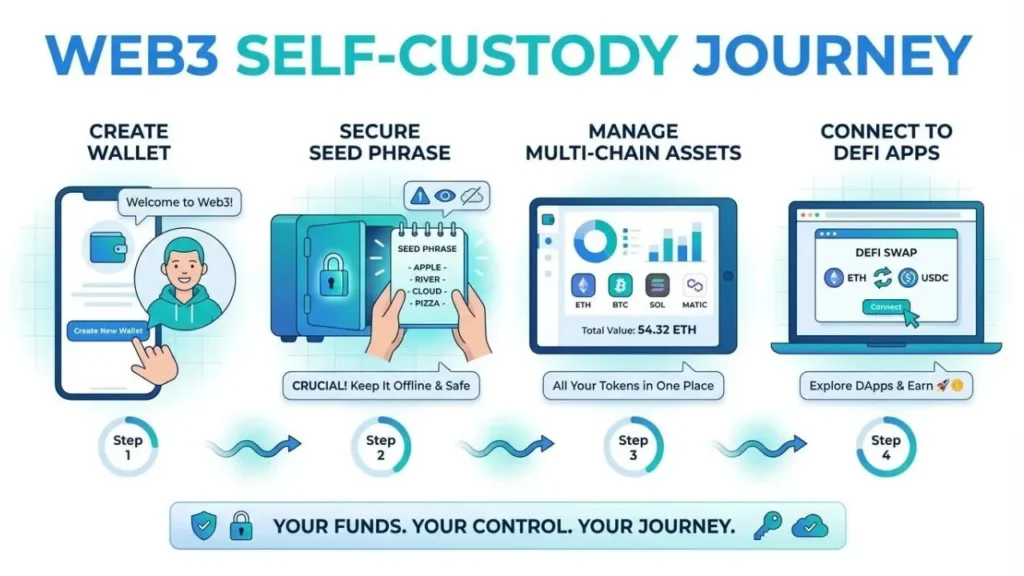
People can use Avalanche through compatible cryptocurrency wallets and applications. The exact steps depend on what they want to do. Someone who wants to hold AVAX has different needs from a user who wants to trade tokens, use a DeFi application or develop a smart contract.
Before using the network, it is important to understand which Avalanche chain an application supports. The C-Chain is commonly used for EVM-compatible applications, while custom Avalanche L1s may have their own wallet and network requirements.
What Do You Need Before Using Avalanche?
Most users need a compatible wallet and the correct network settings. They may also need AVAX to pay transaction fees on the C-Chain. If they are using a custom L1, they should check which wallet, token and fee arrangements that network requires.
A wallet gives users control over their blockchain addresses and signing keys. It does not hold cryptocurrency in the same way a physical wallet holds cash. The assets remain recorded on the blockchain, while the wallet manages the keys used to access them.
How to Set Up an Avalanche-Compatible Wallet
A user should choose a wallet that supports the Avalanche network and the specific chain they plan to use. After installing the wallet, they can create a new wallet or import an existing one. The wallet will provide a recovery phrase that can restore access if the device is lost.
The recovery phrase must be kept private. Anyone who obtains it may be able to control the wallet’s assets. Users should never share it with a website, support agent or person claiming to offer help. It is also wise to verify wallet addresses before sending funds because blockchain transactions are generally difficult or impossible to reverse.
How to Buy and Store AVAX
US users can check cryptocurrency exchanges and other regulated providers that support AVAX in their state. Availability, identity checks, fees and withdrawal options vary by provider. Before purchasing, users should review the platform’s terms and understand the costs involved.
After buying AVAX, a user may leave it with the exchange or transfer it to a self-custody wallet. Exchange custody means the provider controls the private keys. Self-custody gives the user direct control, but it also makes the user responsible for protecting the recovery phrase and signing transactions safely.
How to Connect a Wallet to Avalanche Applications
To use a decentralized application, a user normally visits its official website and selects the wallet connection option. The wallet may ask the user to approve a connection or sign a transaction.
A wallet connection does not always mean funds are being transferred. However, users should read each approval carefully. Some smart contract permissions can allow an application to interact with specific tokens. Connecting to a fake website or approving a malicious transaction can lead to financial loss.
How Developers Can Build on Avalanche
Developers can build EVM-compatible applications on the C-Chain using familiar tools and Solidity. They can also explore the option of creating an Avalanche L1 if their application needs a dedicated blockchain with custom rules.
The choice depends on the project. A small decentralized application may be suitable for the C-Chain. A game, enterprise service or financial application with special requirements may benefit from a custom L1.
Developers should begin with official documentation, test networks and security reviews. Smart contracts can contain errors that lead to lost funds or unexpected behavior. Testing and independent audits are important parts of responsible development.
What Are the Risks and Limitations of Avalanche?
Avalanche offers useful technical features, but it also has risks and limitations. A blockchain’s design does not guarantee that its applications will succeed, that its token will increase in value or that every network built on it will be secure.
Users and developers should consider the wider market, technical risks and operating requirements before relying on the platform. A balanced view is important because the long-term success of Avalanche depends on more than transaction speed.
Competition From Other Layer 1 Blockchains
Avalanche competes with established platforms such as Ethereum and Solana, as well as ecosystems such as Polkadot and Cosmos. These networks are also working to attract developers, users and businesses.
Competition can affect the number of applications built on Avalanche and the amount of activity taking place on its chains. Developers may choose another platform if it offers better tools, stronger liquidity or a larger user base for their particular project.
Adoption and Ecosystem Challenges
A blockchain can have strong technology but still struggle to attract regular users. Applications need useful products, reliable services and a good user experience. Developers also need access to funding, tools, liquidity and customers.
Avalanche must continue to attract applications that people actually use. A growing number of L1s does not automatically mean that every network will have meaningful activity. Some custom chains may remain small or fail to attract enough users to support their long-term operation.
Decentralization and Validator Considerations
The security of a blockchain depends partly on its validator structure. The Primary Network has its own staking and validator requirements. Custom Avalanche L1s can choose different validator arrangements.
This flexibility can be useful for businesses, but it creates different levels of decentralization across the ecosystem. A permissioned L1 operated by a small group of approved validators has a different trust model from a public network with broad validator participation.
Users should understand who operates a network, how validators are selected and what happens if a validator fails. They should not assume that every Avalanche L1 has the same security properties as the Primary Network.
Smart Contract, Wallet and Bridge Risks
Avalanche smart contracts can automate financial and application functions, but they can also contain programming errors. A vulnerability may allow an attacker to steal funds, change contract behavior or disrupt an application.
Wallet security is another important risk. Phishing websites, fake applications and malicious transaction approvals can expose users to losses. Cross-chain bridges also introduce additional technical and operational risks because they move assets or messages between different networks.
Users should verify application websites, review transaction details and avoid sharing recovery phrases. Developers should use testing, code reviews and security audits before launching contracts that handle valuable assets.
AVAX Price Volatility and Investment Risks
Avalanche crypto is part of the wider cryptocurrency market, which can experience large price movements. AVAX may rise or fall because of market sentiment, economic conditions, regulation, network activity or changes in investor demand.
The growth of Avalanche’s technology does not guarantee that AVAX will increase in price. A network can attract applications while its token faces market pressure. Likewise, a rising token price does not prove that the underlying technology is being widely adopted.
Anyone considering AVAX should understand that cryptocurrency investments can lose value. Staking rewards do not remove price risk, and users should never treat projected returns as guaranteed income. This article is for educational purposes and is not financial advice.
What Is the Future of Avalanche Blockchain?
The future of Avalanche blockchain will depend on whether developers, businesses and users continue to find value in its multi-chain design. Its ability to support custom L1s gives it a clear direction: providing infrastructure for applications that need more control over their own networks.
Institutional finance and real-world asset tokenization may also create opportunities. However, these areas are still developing. Their long-term impact will depend on regulation, customer demand, technical reliability and the success of products that move beyond pilot stages.
The Growth of Avalanche L1s
Avalanche L1s are a major part of the platform’s development strategy. They allow projects to create networks with their own validators, rules and economic models. This may be useful for gaming companies, financial institutions and businesses that need dedicated infrastructure.
The challenge is making these networks useful and sustainable. Each L1 needs reliable validators, developers and users. It also needs a clear reason to exist instead of simply using an established public blockchain.
The Future of Real-World Asset Tokenization
Tokenization could change how some financial assets are issued, recorded and transferred. Funds, securities and other assets may be represented through blockchain-based systems. This could improve certain processes and create new ways to distribute financial products.
Avalanche may benefit if institutions choose its infrastructure for these applications. But the opportunity depends on legal rights, investor protections, custody, compliance and market demand. The blockchain itself cannot solve every challenge involved in bringing traditional assets on-chain.
Institutional Adoption and Enterprise Use
The reported NYSE selection of Avalanche for a planned tokenized-securities settlement platform is an important example of institutional interest. Other financial organizations have also explored or used Avalanche infrastructure for tokenization and settlement projects.
The next test is whether these projects become widely used services. Real adoption means more than announcements. It requires reliable operation, clear regulatory treatment and customers who continue using the products.
Challenges That Could Affect Avalanche’s Growth
Avalanche will continue to face competition from other blockchain platforms. It must also address security, decentralization, user experience and the difficulty of maintaining many independent networks.
Regulation in the United States will be especially important for financial applications. Clear rules may help responsible projects develop, while uncertainty can make institutions cautious. The platform’s future will depend on how well it responds to these challenges.
Is Avalanche Blockchain Worth Understanding?
Yes, Avalanche is worth understanding if you are interested in blockchain infrastructure, decentralized applications or the future of digital finance. Its multi-chain architecture gives developers more flexibility than a system that relies on one general-purpose chain. Its C-Chain also provides compatibility with Ethereum development tools, while Avalanche L1s allow applications to operate with their own rules.
For businesses, the platform offers options for building dedicated networks. For users, it provides access to DeFi, digital assets and other blockchain applications. However, its technology and token should be evaluated separately. Avalanche has real capabilities, but its long-term success will depend on adoption, security, competition and the quality of the applications built on it.
FAQ
What Is Avalanche Blockchain in Simple Terms?
Avalanche is a Layer 1 blockchain platform that supports smart contracts, digital assets and application-specific blockchain networks. It uses several connected chains for different tasks and allows developers to create their own L1 networks. Its native cryptocurrency is AVAX.
Is Avalanche a Layer 1 Blockchain?
Yes. The Avalanche Primary Network is a Layer 1 network. The wider Avalanche ecosystem also supports additional Avalanche L1s. These networks can have their own validators, rules and token economics.
Is Avalanche the Same as AVAX?
No. Avalanche is the blockchain platform and ecosystem. AVAX is its native cryptocurrency. AVAX is used for Primary Network transaction fees, staking and as a common unit of account across the ecosystem.
How Fast Are Avalanche Transactions?
Avalanche is designed for fast transaction finality, and its consensus protocols can support sub-second finality under suitable conditions. Actual performance depends on the chain, network conditions and application. It is better to distinguish finality from a simple transactions-per-second measurement.
How Does the Avalanche Consensus Mechanism Work?
Avalanche uses repeated random sampling. Validators ask small groups of other validators about their preferences and update their decisions based on the responses. Repeating this process helps the network reach agreement. The Snowman protocol uses a related approach to order transactions linearly into blocks.
What Are Avalanche Subnets and L1s?
Subnets were the earlier name for application-specific networks in Avalanche. The newer term is Avalanche L1s. These networks can define their own validator membership, token economics and operating rules. The Etna upgrade made them more independent from Primary Network validation requirements.
Is Avalanche Better Than Ethereum?
Neither platform is automatically better for every use. Avalanche offers customizable L1s and an EVM-compatible C-Chain. Ethereum has a large developer ecosystem and a broad Layer 2 network. The right choice depends on the application’s technical needs, users and security requirements.
Can Anyone Build on Avalanche?
Developers can build EVM-compatible applications on the C-Chain and can explore creating custom Avalanche L1s. The tools and requirements depend on the type of project. Developers should use official documentation and test networks before deploying applications with real funds.
Does Avalanche Have Its Own Cryptocurrency?
Yes. AVAX is the native cryptocurrency of Avalanche. It is used for transaction fees on the Primary Network, staking and other network functions. Some custom Avalanche L1s may also use their own gas tokens.
Is Avalanche Suitable for Institutional Finance?
Avalanche offers features that may suit some institutional applications, including customizable networks and controlled validator arrangements. Financial firms may use blockchain infrastructure for tokenization or settlement. Suitability depends on legal, regulatory, security and operational requirements, and an announcement or pilot does not guarantee broad adoption.