Pi Coin: Price, Open Network and the November Summit
Pi Network's first Ecosystem Summit promised a DEX, a Launchpad and an automated market maker for early 2027. The same week, PI fell to a record low of $0.0473. Here is what the project is, where the coin trades, and what the numbers say.
Pi Network just held the biggest event in its seven-year history. The first Ecosystem Summit, streamed over three days from November 17 to 19, laid out a decentralized exchange, a token launchpad and an automated market maker for Mainnet in the first quarter of 2027. The market answered with a record low.
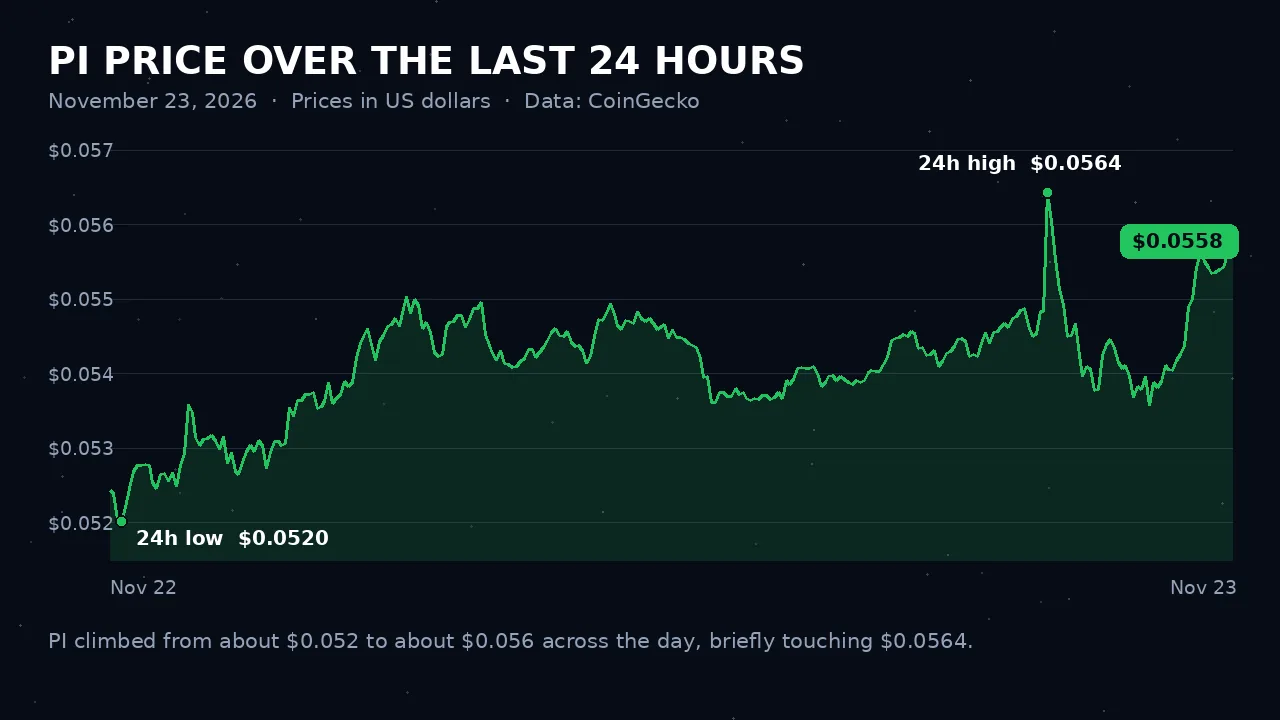
Note that the low came first. PI slipped below $0.06 on November 17, the day the summit opened, and touched $0.0473 on November 20, the lowest price in its history. The token has since bounced to about $0.057. The summit did not cause the fall, and the bounce does not undo it. Both facts matter, and this article keeps them separate.
What the summit actually announced
The headline from day one was decentralized finance. Pi Launchpad, a decentralized exchange and an automated market maker will move from Testnet to Mainnet in the first quarter of 2027. The tools have been on Testnet and through several rounds of changes, according to Pi Network’s own summit blog, but no exact date was given. The Launchpad would let projects issue tokens inside the Pi ecosystem, and the exchange and market maker would give PI holders native ways to trade without leaving the network.
The summit closed on November 19 with the launch of Pi Next, a new developer hackathon with a 200,000 USDT prize pool. The Pi Foundation is also funding an App Growth Initiative with a marketing budget of up to 20 million PI, aimed at helping developers reach Pi’s identity-verified users. Token launches are a crowded market elsewhere: tokenized stocks on Base alone recently crossed $1 billion in weekly volume, so Pi’s Launchpad arrives into competition rather than an empty field.
Artificial intelligence was the other theme. Pi DataLab, demonstrated on the second day, is a platform that connects businesses needing human-generated data with Pi’s identity-verified users. Companies would post work such as data labeling, ranking and evaluation, and Pioneers would be paid in PI or in tokens launched on Pi. Pi says its identity checks have already coordinated more than 526 million validation tasks completed by over one million human validators, which is the experience DataLab is built on. The platform is still at the demonstration stage, with no launch date and no published payout terms.
Developers also got a new browser-based Developer Web Console with Model Context Protocol tools, so AI coding agents can register applications and wire up Pi’s authentication and payments with human approval where required. The Pi App Directory was redesigned with new sections for rising apps and discovery, and Pi App Studio, the AI-assisted app builder, will offer subsidized pricing for creators whose apps show real use. On-chain subscription smart contracts, first introduced on Testnet in April 2026, now have their supporting wallet and platform infrastructure in place. Protocol 28, which gives developers better smart contract tools, went live on Mainnet on October 16, 2026. Pi has also explored how stablecoins could work inside its ecosystem, a question larger institutions are now testing with stablecoin payments of their own.
How we got here
Pi Network began in 2019, founded by Stanford graduates Nicolas Kokkalis and Chengdiao Fan. The idea was simple enough to sound implausible: let ordinary people mine a cryptocurrency on their phones by tapping a button once a day, with no expensive hardware and no battery drain. Instead of proof of work, Pi runs on the Stellar Consensus Protocol, a federated agreement system in which users vouch for each other through security circles of people they trust. Members take on roles as pioneers, contributors, ambassadors or node operators, and the network rewards steady participation rather than computing power.
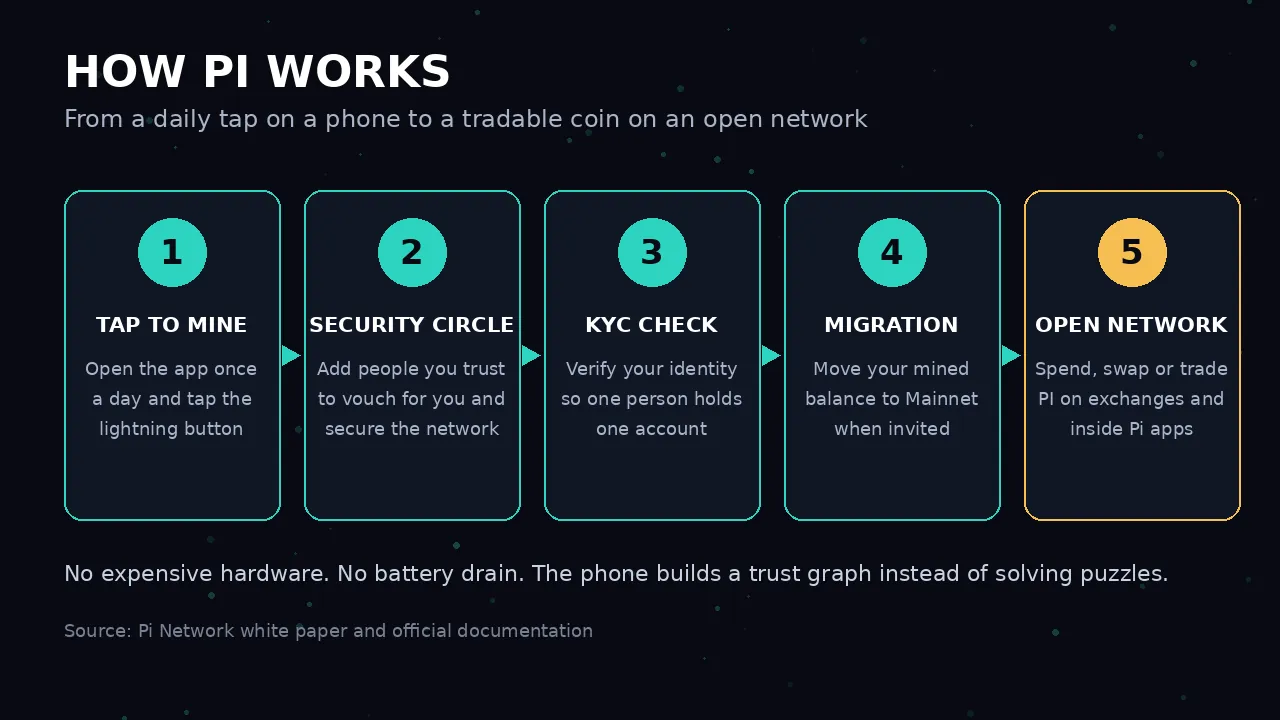
For six years the project stayed enclosed. Mined balances lived inside the app and could not be traded anywhere. That changed on February 20, 2025, when Pi opened its network to the outside world. External connectivity went live, exchanges began listing PI, and the token finally had a market price. At launch Pi said about 19 million Pioneers had passed its identity checks and roughly 10 million accounts had migrated their balances to Mainnet. The opening was chaotic: the price swung violently on the first day, fake Pi tokens flooded decentralized exchanges, and the Core Team warned users to stick to named venues.
The year since has been about turning a mining app into an ecosystem. On Pi Day, March 14, 2025, Pi opened an auction for .pi domain names, with bidding in PI and a minimum bid of 10 PI. The auction drew more than 123,000 active bids from 57,000 unique bidders across 69,000 domains, with 3 million PI in total bids. The same week brought the first PiFest since the network opened, a shopping event in which more than 125,000 sellers registered and 58,000 were active, while 1.8 million shoppers used the community-built Map of Pi. Kraken listed PI in March 2026, and the token rallied more than 30% on the announcement.
Where PI trades, and where it does not
PI trades on a defined set of exchanges. OKX carries the largest volume, followed by Gate, Bitget and MEXC, with Kraken, BTCC, LBank, XT.COM, DigiFinex, CoinW and CEX.IO also listing the token. CoinGecko tracks 23 PI trading pairs across those venues. That is a respectable list for a coin that spent six years untradable, and it is also a narrow one. Daily volume across all of them runs just over $5 million, which is thin for a token with a market value above $600 million. Thin volume means prices can move fast on small orders, in both directions.
Two names are missing, and both matter. Binance, the largest exchange by trading volume, does not list PI. Coinbase does not list it either. Bybit has also refused: its chief executive said publicly in February 2025 that the exchange would not list the token, a position that became part of a wider public argument covered later in this article. A listing on Kraken is a real credential, but it is not the same as acceptance across the industry, and the gap between the two is one of the honest measures of where Pi stands.
The price and supply in numbers
PI traded at about $0.057 on November 24, 2026, according to CoinGecko data checked that morning. The token is up 4.3 percent over 24 hours, down 8.0 percent over seven days, down 27.0 percent over 30 days and down 76.7 percent over the past year. Its market value stands near $645 million, which puts it 87th among cryptocurrencies, and its fully diluted valuation is about $992 million. Around $6.0 million of PI changed hands in the previous 24 hours.
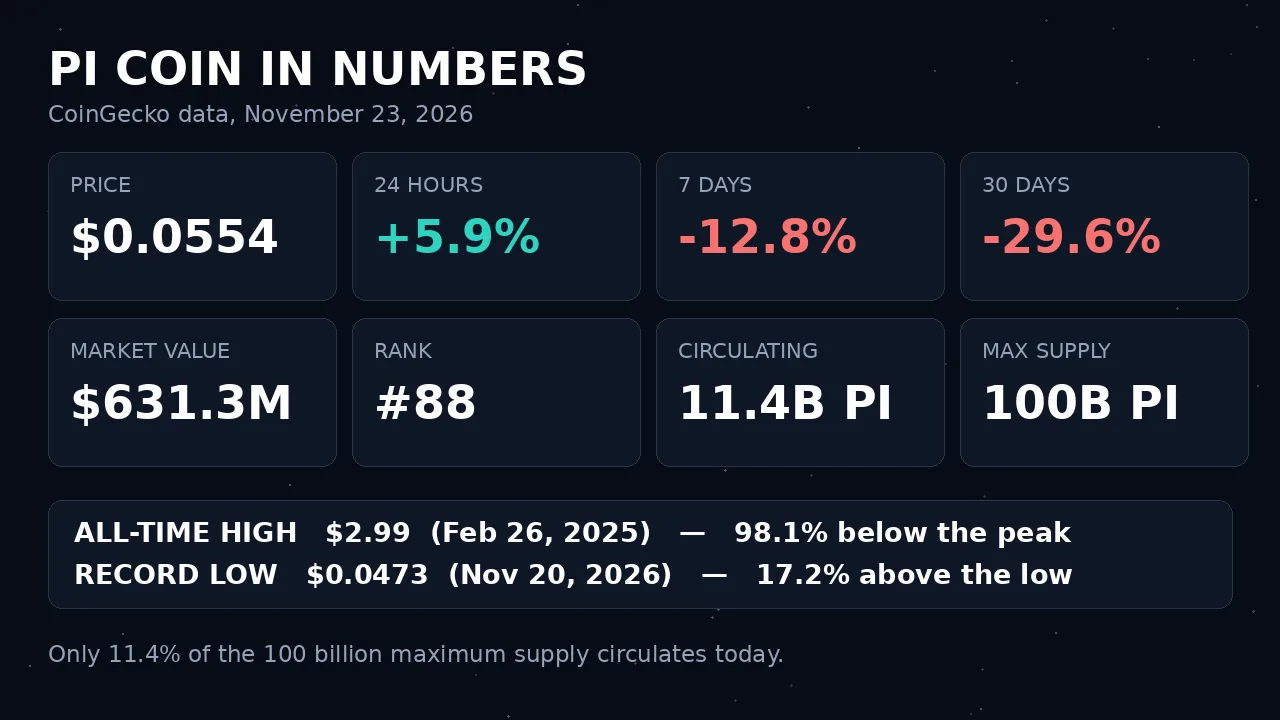
The supply figures are the part of the story that does not move with sentiment. About 11.4 billion PI circulate today, out of a maximum supply of 100 billion. That is 11.4 percent of the eventual total. Total supply, including coins that exist but are locked or unmigrated, is about 17.5 billion. The all-time high was $2.99 on February 26, 2025, days after the Open Network launch. PI now trades 98.1 percent below that peak. The record low of $0.0473 was set on November 20, 2026, and the current price sits about 20 percent above it.
The supply problem in numbers
Almost nine-tenths of Pi’s maximum supply has yet to reach the market, and it arrives steadily rather than all at once. PiScan data cited in industry coverage puts total unlocks across 2026 at roughly 1.2 billion PI, running at about 6.5 million coins a day in early November. A separate PiScan-based estimate put about 775.8 million PI on course to unlock by the end of 2026, with roughly 6.17 billion PI still locked at the time that estimate was published. Pi publishes no official monthly unlock calendar, so these are outside estimates drawn from on-chain data, not the team’s own schedule, and the exact monthly totals vary between sources.
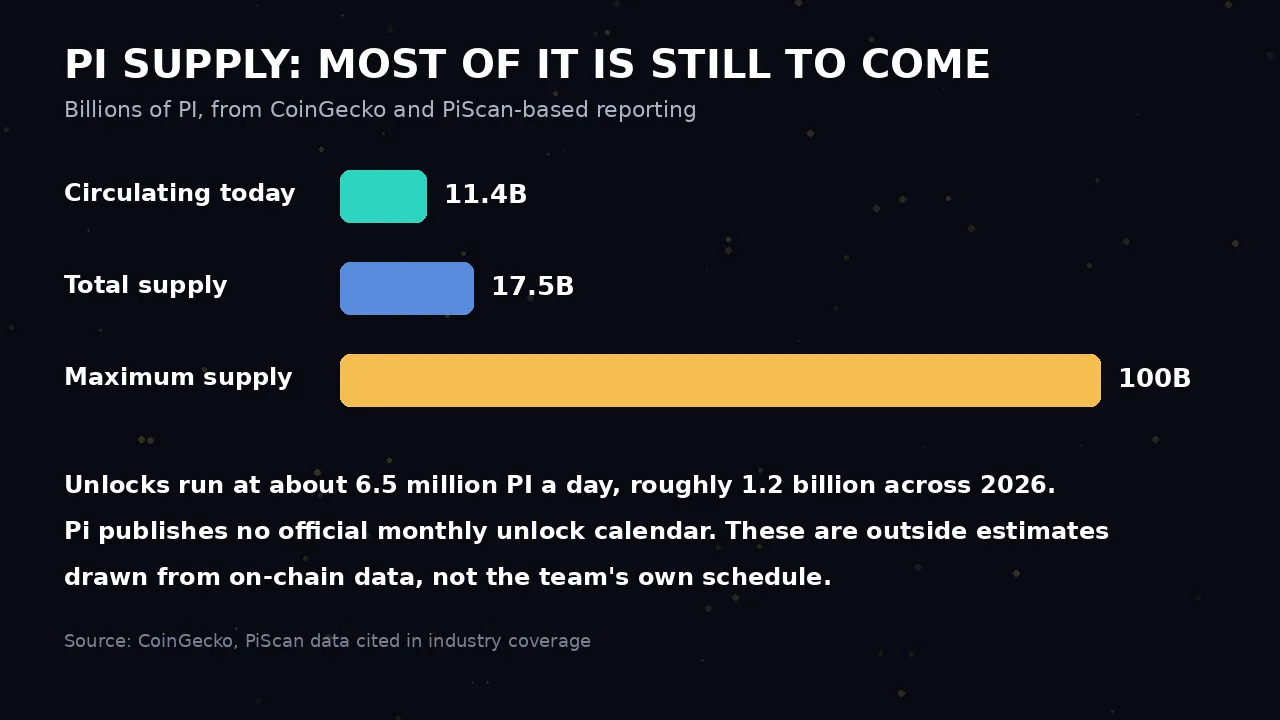
The mechanics matter more than any single month. Most mined PI was earned for free, by tapping an app. Every unlock puts fresh supply into the hands of people who paid nothing for it, and a large share of them sell. That is not a flaw in the design; it is the design. Pi’s supply was built to unlock gradually as balances migrate and lockups expire, and the flow has run all year. Any rally in PI has to absorb several million new coins a day before it can hold.
Migration is the other half of the supply story. Figures reported from the summit put migrated accounts at about 16.6 million, up from roughly 10 million at the Open Network launch. More than 18 million Pioneers have passed identity verification, according to the same reporting. Around 497,000 Fast-Track wallets were still waiting on a fix for a gas-fee problem at the time of the summit, and a second migration round for referral-linked balances began after Pi Day 2026. Each cleared migration adds coins that can reach the market, so the backlog is both a technical queue and a supply event waiting to happen.
The criticism, and what is verifiable
No account of Pi is complete without the argument that has followed it since launch day. On February 20, 2025, the day the Open Network went live, Bybit chief executive Ben Zhou called the project a scam on social media and said his exchange would not list it. He pointed to a 2023 warning from Chinese police that described a project targeting elderly people, collecting personal data and causing pension losses. Zhou also said Bybit had never submitted a listing request to Pi Network, and he challenged the project to address the reports questioning it. PI fell from a high of $1.84 to a low of $0.61 that day. His words, as reported by Cointelegraph, were blunt: “Yes, I still think you are a scam, and no, Bybit will not list scam.”
Pi Network answered the next day. A spokesperson told Cointelegraph that the company has no relationship with Bybit and that Bybit had not asked for the Know Your Business verification Pi requires of external businesses. The spokesperson said Zhou appeared to be responding to posts from an individual unaffiliated with Pi Network. On the police warning, Pi’s position was direct: “Pi Network is not affiliated with, did not authorize, and did not engage in any activity that is related to the police warning, and Pi Network has not been contacted by any police department in China regarding this incident.” The company also said the 60 million engaged Pioneers it advertises are application users, a smaller figure than total registered users, and pointed to more than 100 million downloads of its app on Google Play.
What can be checked is narrower than either side’s rhetoric. The 2023 warning was real, and Pi’s denial is on the record. Bybit has not listed PI, and neither have Binance or Coinbase. The price, the supply, the listings and the summit announcements in this article are all checkable against public data, and they are the fairest basis for judging the project. The rest is a dispute between a chief executive and a team, and readers should weigh it as that. Other networks have used their own mainnet launches to open new markets, including lending, so Pi is not the first project to face the gap between a large community and a small market. What sets Pi apart is the scale of that gap: tens of millions of users, and just over $5 million of daily trading.
What it doesn’t mean
A summit is not a launch. The decentralized exchange, market maker and Launchpad are promised for the first quarter of 2027, with no exact date. Tools running on Testnet do not equal Mainnet usage, and a roadmap quarter is not a release.
A bounce is not a recovery. PI is 17.2 percent above its record low and still 98.1 percent below its peak. A 4.3 percent day does not change a 77 percent year.
A big community is not a big market. Sixty million engaged Pioneers is an application number. Daily trading volume is just over $5 million. The two figures describe different things, and only one of them sets the price.
A listing on one exchange is not acceptance everywhere. Kraken lists PI. Binance and Coinbase do not, and Bybit has refused. That split is the market’s verdict so far, not a conspiracy and not an endorsement.
Unlocks are not a cliff. Supply arrives steadily, several million coins a day, not in a single event. That makes the pressure constant rather than sudden, and it means there is no single date to watch for the selling to end.
What to watch
The first quarter of 2027 is the real test. If the decentralized exchange, market maker and Launchpad reach Mainnet on schedule, the question becomes whether applications use them and whether PI holders trade on them. If they slip, the summit will read as another promise in a project that has made many. The Pi Next hackathon, which opened on November 19 with 200,000 USDT in prizes, is the nearer checkpoint: what gets built, and whether any of it finds users beyond the existing community.
Closer in, watch whether PI holds above the $0.0473 low as the December unlock flow arrives, and whether the migration backlog clears without a wave of selling. Watch whether Pi DataLab moves from a demonstration to paying work, since that is the first summit announcement with a direct revenue idea behind it. And watch whether Binance or Coinbase change their stance, because a listing on either would do more for PI’s liquidity than any single product launch. Until then, Pi remains what it has been since February: a very large community, a working network, and a token still searching for a price the market believes in.
This article is for information only and is not financial advice.
What is Pi Coin?
Pi Coin is the cryptocurrency of Pi Network, a project founded in 2019 by Stanford graduates Nicolas Kokkalis and Chengdiao Fan. Users mine it on their phones by tapping an app once a day, with no special hardware, and the network secures itself through trust circles under the Stellar Consensus Protocol. PI became tradable on exchanges when Pi opened its network on February 20, 2025.
How much is Pi Coin worth today?
PI traded at about $0.057 on November 24, 2026, according to CoinGecko data checked that morning, with a market value near $645 million. That is 98.1 percent below its all-time high of $2.99 on February 26, 2025, and 17.2 percent above its record low of $0.0473 set on November 20, 2026.
Where can I buy Pi Coin?
PI is listed on OKX, Gate, Bitget, MEXC and Kraken, along with smaller exchanges such as BTCC, LBank, XT.COM, DigiFinex, CoinW and CEX.IO. Binance and Coinbase do not list PI, and Bybit has refused to list it. Daily trading volume across all venues runs just over $5 million.
Is Pi Network a scam?
Bybit chief executive Ben Zhou called Pi Network a scam in February 2025, citing a 2023 Chinese police warning. Pi Network said the warning concerned impersonators, that no Chinese police department has contacted it, and that it has no relationship with Bybit. Bybit has not listed PI. The checkable facts are the price, the supply, the exchange listings and Pi’s own announcements, and readers should weigh the claims against those.
What is Pi Network planning next?
Pi Network plans to bring its decentralized exchange, automated market maker and Launchpad to Mainnet in the first quarter of 2027, with no exact date given. Its Pi Next hackathon opened on November 19, 2026 with a 200,000 USDT prize pool, and its Pi DataLab platform aims to connect identity-verified users with paid AI data work. Delivery on the first-quarter 2027 dates is the main thing to watch.