CFTC Lets Regulated Exchanges Count Bitcoin and Ether Toward Operating Reserves
CFTC Staff Letter 26-31 lets regulated US derivatives venues count Bitcoin and Ether toward their 12-month operating reserves at a 20% haircut, and payment stablecoins at 2%. Crypto still cannot meet the separate liquidity requirement.

Can a regulated US derivatives exchange now hold Bitcoin instead of cash to meet its reserve requirements? In part, yes. Staff at the Commodity Futures Trading Commission said on Monday that Bitcoin and Ether may count toward the financial cushion derivatives venues are required to hold, and payment stablecoins may count too.
Note that this is staff guidance, not a rule change. It creates no new legal obligation, it was not voted on by the Commission, and a future Commission could change it. The headline is bigger than the legal weight behind it, and that distinction is the story as much as the announcement itself.
What the letter says
CFTC Staff Letter 26-31, issued on 23 November 2026 by the Division of Market Oversight and the Division of Clearing and Risk, answers a narrow question that has been open for years: can a regulated venue point to its crypto holdings when it has to prove it can keep the lights on for a year?
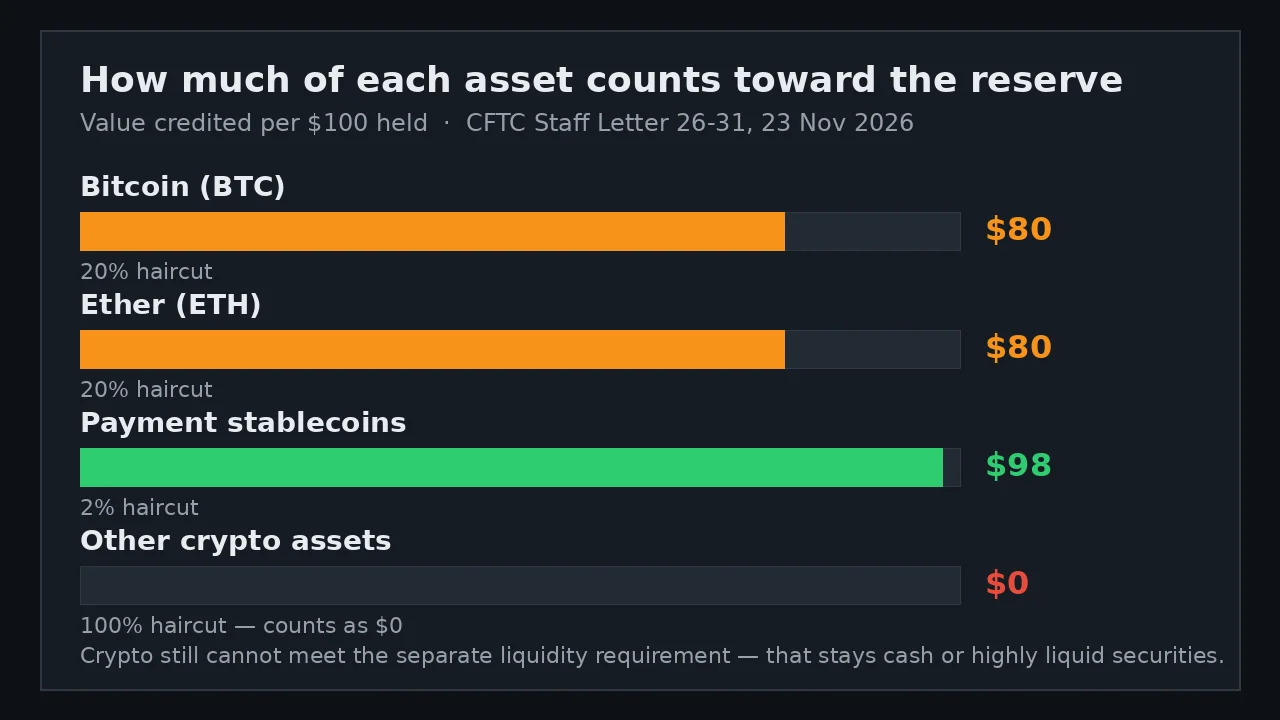
Under CFTC rules, designated contract markets, swap execution facilities and derivatives clearing organizations must hold enough financial resources to cover at least 12 months of projected operating costs. Staff now say Bitcoin, Ether and qualifying payment stablecoins may count toward that requirement, subject to haircuts: a minimum 20% discount for Bitcoin and Ether, 2% for payment stablecoins, and 100% for any other crypto asset that is neither readily marketable nor a qualifying stablecoin. In plain terms, $100 of Bitcoin counts as $80 toward the reserve, $100 of stablecoins as $98, and $100 of anything else as nothing.
As the letter puts it, the Division of Market Oversight “is of the view that crypto assets such as bitcoin, ether, and payment stablecoins may serve as acceptable financial resources under Commission Regulation 37.1301, subject to appropriate haircuts and to the liquidity limitation discussed in Sections I.B and I.C of this advisory, respectively.”
The venues covered are the places where America’s regulated crypto trading actually happens: Coinbase Derivatives, Crypto.com’s North American Derivatives Exchange and Bitnomial, along with prediction markets Kalshi and Polymarket US. For a Bitcoin-native venue already holding BTC on its balance sheet, the practical effect is straightforward: that position can now count toward the mandatory reserve instead of sitting alongside a parallel pile of cash.
How we got here
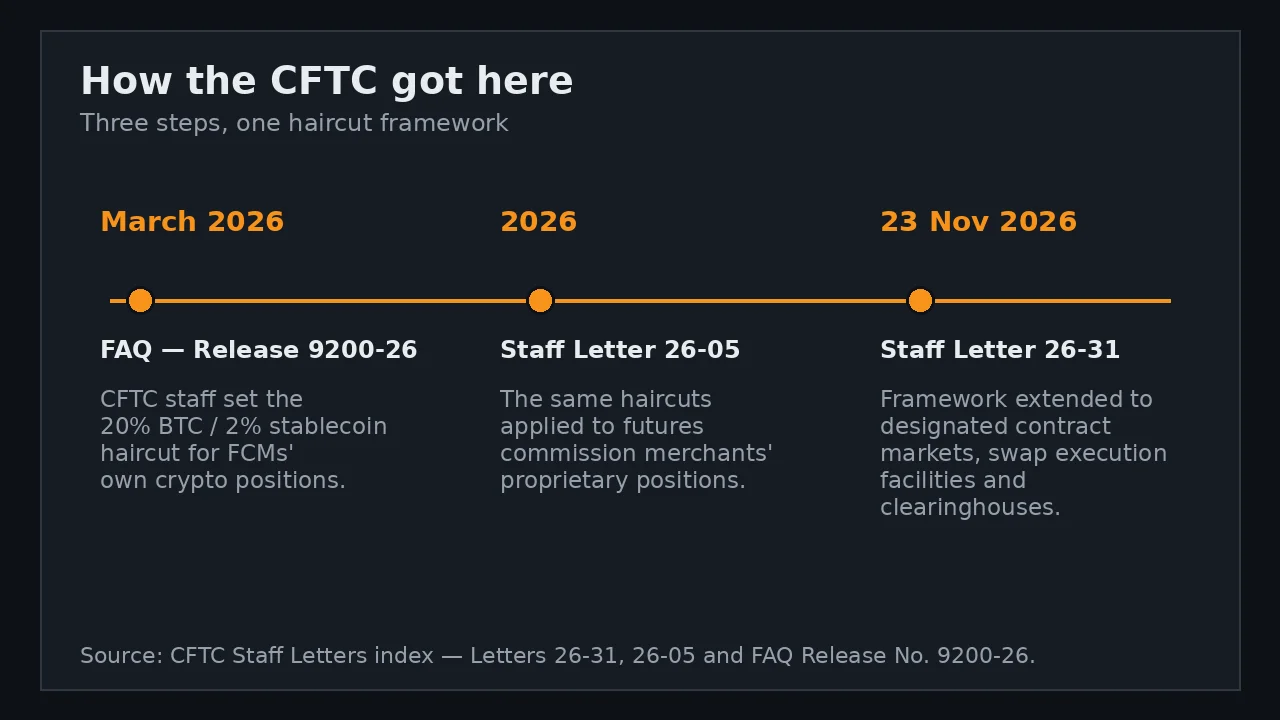
The 20% figure is not new math. The CFTC set it out in a March 2026 FAQ, Release No. 9200-26, and then applied it to futures commission merchants’ proprietary crypto positions through Staff Letter 26-05. Letter 26-31 extends the same framework to a broader set of entity types, and it follows the CFTC’s December 2025 decision to let Bitcoin, Ether and USDC serve as collateral for derivatives transactions.
CFTC Chair Michael Selig welcomed the advisory on X, writing that he was “pleased to see @CFTC staff continue to provide important clarity around crypto assets in US derivatives markets through today’s staff advisory.” The same day, the Commission also published a final rule creating a reporting framework for certain event contracts, a separate piece of the agency’s effort to formalise rules for prediction markets.
What it doesn’t mean
- Not a rule. The letter is the view of staff in two divisions, not a Commission vote. It states plainly that it creates no enforceable right and does not necessarily represent the views of the Commission itself.
- Not cash. Crypto of any kind, including payment stablecoins, does not qualify as cash or a highly liquid security under generally accepted accounting principles. It cannot satisfy the separate liquidity requirement, which still has to be met with cash or highly liquid securities: at least three months of operating costs for swap execution facilities, and six months for exchanges and clearinghouses.
- Not every token. Only Bitcoin, Ether and qualifying payment stablecoins are named. Everything else in crypto faces a 100% haircut, which means it counts for zero.
- Not a reserve-asset designation. The letter does not make Bitcoin an official reserve asset under US law. It lets a specific set of regulated entities count it toward one specific requirement, at a discount.
- Not the whole balance sheet. The advisory covers the operating-cost financial-resources requirement only. It does not address whether crypto can satisfy a clearinghouse’s default-resource requirements under a separate rule, Commission Regulation 39.11(a)(1).
Why it matters for crypto venues
For the venues themselves, the change frees up capital. Money that was parked in cash or liquid securities purely to satisfy the reserve requirement can now be the Bitcoin the venue already holds, discounted by a fifth. In a week when Bitcoin has slid toward $60,000 — it was trading near $60,300 early on Tuesday, with Ether near $1,693 — that discount is doing real work: the regulator is saying the asset counts, but only after a buffer against its volatility.
The timing also fits a wider pattern. Washington has been moving crypto further inside the regulated perimeter all year, from the SEC’s work on exchange-traded products to the CLARITY Act debate in the Senate, even as that bill itself has stalled. Stablecoins are the other half of the story: the World Bank’s exploration of USDC payments with Citi and Circle showed institutions treating dollar tokens as settlement rails, and a 2% haircut is the regulator’s way of saying the same thing — a dollar-pegged instrument is near-cash, Bitcoin is not. The same logic is visible in the ETF market, where Bitwise’s filing for a spot Zcash ETF and the growth of tokenized stocks on Base keep pushing crypto assets into familiar, regulated wrappers.
What to watch
Whether the full Commission, or Congress through market-structure legislation, codifies the 20% figure into a formal rule. Whether regulated venues actually start counting Bitcoin and Ether in their reserves and say so publicly. And whether the same haircut framework turns up in the next round of guidance for brokers and custodians, where the same question — how much is a crypto holding really worth to a regulator — is still being answered one letter at a time.
This article is for information only and is not financial advice.
What did the CFTC announce on 23 November 2026?
CFTC staff issued Staff Letter 26-31, an advisory saying regulated derivatives exchanges, swap execution facilities and clearinghouses may count Bitcoin, Ether and qualifying payment stablecoins toward the financial resources they must hold to cover at least 12 months of operating costs.
How much does $100 of Bitcoin count toward an exchange’s reserves?
$80. Bitcoin and Ether carry a minimum 20% haircut under CFTC Staff Letter 26-31, so $100 of Bitcoin counts as $80 toward the reserve requirement. Payment stablecoins carry a 2% haircut and count as $98, while other crypto assets face a 100% haircut and count as $0.
Can crypto replace cash in a venue’s reserves?
No. Crypto assets, including payment stablecoins, do not qualify as cash or highly liquid securities under generally accepted accounting principles, so they cannot satisfy the separate liquidity requirement. Swap execution facilities must hold at least three months of operating costs in cash or highly liquid securities, and exchanges and clearinghouses at least six months.
Which venues does the CFTC advisory cover?
Designated contract markets, swap execution facilities and derivatives clearing organizations regulated by the CFTC. In practice that includes Coinbase Derivatives, Crypto.com’s North American Derivatives Exchange, Bitnomial, and the prediction markets Kalshi and Polymarket US.
Is Staff Letter 26-31 a formal rule change?
No. It is a staff advisory from the CFTC’s Division of Market Oversight and Division of Clearing and Risk. It was not voted on by the Commission, creates no enforceable rights, and does not necessarily represent the Commission’s views. A future Commission could modify or rescind it.