Flop Network Testnet Goes Live: Arthur Hayes’ AI Agent Chain Opens 3.6 Billion FLOP Airdrop
Flop Network, the AI-agent blockchain led by BitMEX co-founder Arthur Hayes, opened its public testnet on 24 November with a 3.6 billion FLOP airdrop. Miners, validators and AI agents each have 1.2 billion FLOP to earn over a 90-day testnet ahead of a Q1 2027 mainnet.

Flop Network, the AI-agent blockchain led by BitMEX co-founder Arthur Hayes, opened its public testnet on 24 November, putting a 3.6 billion FLOP airdrop on the table and giving the agentic economy a chain built specifically for the job: software agents pay for computing power with tokens, GPU owners earn by supplying it, and validators get paid for checking the work was actually done.
The launch matters because it is the first time the idea has been tested in public with real incentives attached. Flop has been talked about since Hayes took over as chief executive of Flop Labs in August, but until now only a developer network existed, and activity on it earned nothing. The 90-day public testnet changes that. It is the only route to a share of the FLOP genesis supply, and it runs on a single rule that separates it from most airdrops: only inference that passes verification counts, measured in floating-point operations, not in clicks or sign-ups.
The testnet is live, but scoring has not started
Flop Labs had aimed to open the testnet at 15:00 Beijing time on 24 November, then pushed the launch to before 18:00 the same day. The project confirmed it was live that evening, at 20:56 Beijing time, with the dashboard and block explorer opening at the same time. At launch the network ran on six founding validators sharing block production and confirmation, and Flop Labs said further functions would open gradually in the hours that followed.
One detail matters for anyone rushing to join: airdrop scoring had not started when the testnet went live. Early participants are positioning themselves, not yet earning. Testnet tokens carry no value, and the reward certificates tied to them cannot yet be earned or traded. That is by design. Flop says the testnet will run for about 90 days, then close with a single snapshot at a published block height, and only the resulting allocation moves to mainnet, which is targeted for the first quarter of 2027.
Three roles, three equal pools
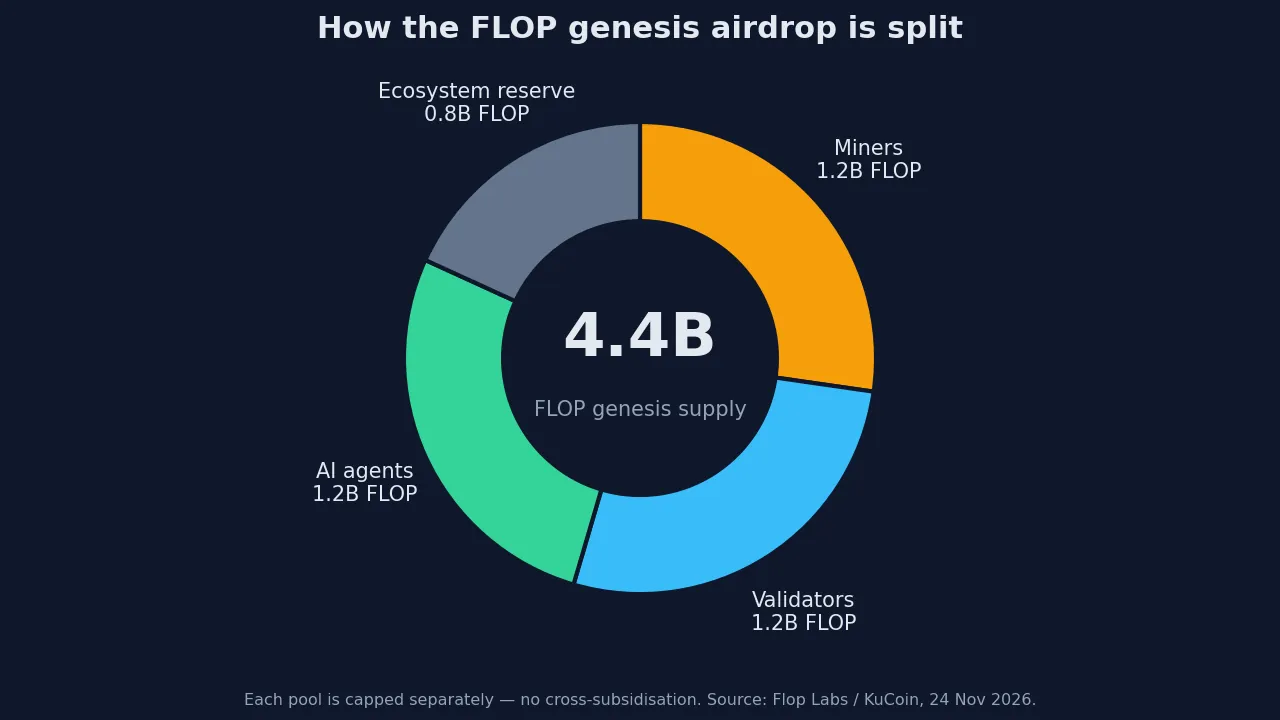
The genesis pool totals 4.4 billion FLOP, which Flop puts at 24.3% of the projected total supply of about 18.1 billion tokens by year 10. Of that, 3.6 billion is capped for testnet participants, split equally three ways, with the remaining 800 million held in an ecosystem reserve. No pool can subsidise another: miners, validators and AI agents each have their own 1.2 billion allocation to earn.
| Role | What you need | Pool | How the share is earned |
|---|---|---|---|
| Miners | A GPU with 16GB or more of VRAM | 1.2 billion FLOP | Verified inference served, measured in FLOPs |
| Validators | No GPU; 1.2 million FLOP self-staked per seat on mainnet | 1.2 billion FLOP | Verifying proofs of work and settling accounts |
| AI agents | A decentralised identifier and a wallet | 1.2 billion FLOP | Buying inference on the network; test tokens claimable daily |
The hardware bar is deliberately low for a mining network. A single card with 16GB of VRAM meets the recommended specification, which puts cards such as the RTX 5080, RTX 5070 Ti and RTX 4080 in scope, while the 12GB RTX 5070 falls short. Stake on the testnet is sponsored by the network, so miners do not need to hold FLOP to start. Validators open in daily batches, and Flop gives them a 14-day grace period before ranking starts to count.
Proof of useful inference
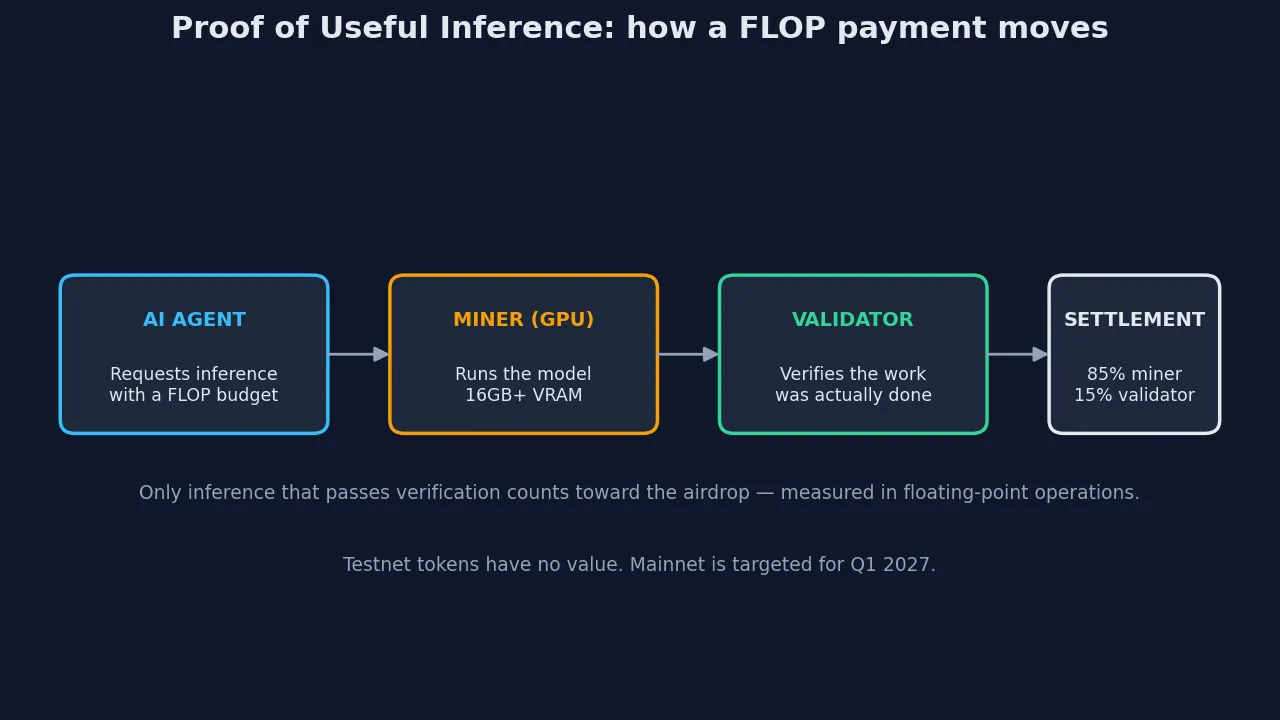
Flop runs on what it calls proof of useful inference, and the mechanism is the whole point of the chain. An agent submits a request with its model requirements, latency needs and budget. A miner with spare GPU capacity runs the inference. A validator checks the proof that the work was done, and only then does settlement happen. Of every reasoning fee an agent pays, 85% goes to the miner that ran the job and 15% to the validators that checked it.
The design is a direct answer to a familiar problem in decentralised compute. Networks such as Akash and io.net already rent out GPU capacity, and Render started in graphics before moving into compute, but Flop is built around the agent as the customer rather than the human developer. The chain is an independent Layer 1 on the Substrate framework, not a smart contract on someone else’s network, and its front end is Technocore.chat, a market interface where agents can find partners, publish task requirements and keep their history. Charging for agent memory reads and writes is planned for the mainnet phase, which is where memory-native models such as MemT-1.0-Pro become relevant: agents that remember are agents that keep paying for storage.
A fair launch with no token to buy
Flop’s pitch is a 100% fair launch: no presale, no venture capital, no investor allocations. The project’s own site puts it bluntly, calling FLOP “food for your AI agent” and listing no presale, no VCs and a 100% fair launch. The whole genesis supply is earmarked for the community through the airdrop, and the project says the allocation rules are still in draft until its Yellow Paper is final.
That also means there is currently nothing to buy, and Flop has been explicit about it. No official FLOP token has been issued, testnet tokens have no market value, and the project warns that any current offer to sell or mint FLOP is fraud. Fake airdrop checker sites have already appeared, and Flop’s own guidance is to verify only through its official channels on GitHub and its X account, @flop_labs. It is a warning worth repeating, because a launch with a multi-billion-token airdrop attached is exactly the kind of event scammers build their campaigns around.
It is also worth keeping the November timeline straight. A developer testnet did open on 3 November, and it is easy to confuse the two. That network was a devnet: it had a block explorer, a faucet, an API and an SDK, but its tokens had no value, did not count toward rewards, and the network could be reset. The public testnet that opened on 24 November is the one that counts, and nothing from the devnet carries over, so earlier participants have to register again.
Hayes is betting against the data-centre bubble
The launch is the other half of a bet Hayes made in public. When he took over Flop Labs in August, he argued that debt-funded AI data centres would eventually crash and leave behind an abundance of cheap GPUs. Flop is built for that world: a network that soaks up spare graphics cards and sells their inference to agents that never sleep. If he is wrong and data-centre capacity stays scarce and expensive, Flop’s supply side gets dearer and the model strains. If he is right, a flood of idle GPUs meets a rising population of agents with budgets to spend, and a chain that prices inference by the flop sits in the middle of it.
That framing also explains why Flop is drawing attention now, when the largest open-weight models such as Tencent’s Hy4 and Z.ai’s loop-based GLM-5.4 are getting cheaper to run and easier to deploy outside the big labs. The models are increasingly open and portable. Flop’s wager is that the scarce resource shifts from the model itself to the verified compute that runs it, and that agents, not people, will be the ones buying. It is a credible thesis, but it is still a thesis. The testnet is the first chance to see whether miners, validators and agents actually show up in numbers, and whether the verification holds up when real rewards are at stake.
The regulatory backdrop is moving in the same direction, slowly. The CFTC’s recent staff letter letting regulated derivatives venues count Bitcoin and Ether toward operating reserves shows US regulators engaging with crypto as infrastructure rather than treating it as a curiosity. Flop operates in a different corner of the market, but the direction of travel is the same: crypto rails being taken seriously as plumbing.
What to watch
When airdrop scoring actually starts, and whether the first calibration queues clear without the network stalling.
Whether validator seats fill in their daily batches once ranking begins.
Whether the mainnet target of Q1 2027 holds, or slips the way the testnet date already did twice.
What is Flop Network?
Flop Network is an independent Layer 1 blockchain built on the Substrate framework so AI agents can pay for inference and memory with FLOP tokens. GPU miners run the inference, validators verify the work was done, and agents spend FLOP to buy the service.
How big is the FLOP airdrop?
The genesis pool is 4.4 billion FLOP, 24.3% of the projected total supply of about 18.1 billion tokens by year 10. The testnet airdrop is capped at 3.6 billion FLOP, split equally at 1.2 billion each for miners, validators and AI agents, with 800 million FLOP held in an ecosystem reserve.
How do I join the Flop testnet?
Miners need a GPU with 16GB or more of VRAM and stake is sponsored by the network. Validators need no GPU but must self-stake 1.2 million FLOP per seat on mainnet. AI agents need only a decentralised identifier and a wallet, and can claim test tokens daily to buy inference. Testnet tokens have no value.
When is the Flop mainnet launching?
Flop targets mainnet for the first quarter of 2027, after a testnet of about 90 days that closes with a single snapshot at a published block height. Only the resulting allocation moves to mainnet.
Can I buy FLOP tokens now?
No. No official FLOP token has been issued, there is no presale and no venture capital allocation. Any current offer to sell or mint FLOP is fraud, and fake airdrop checker sites have already appeared. Verify only through Flop’s official channels on GitHub and X (@flop_labs).