
SBI Solana Global Launches: Japan’s $2.3 Trillion Banking Giants Put Stablecoins and Tokenized Assets on Solana
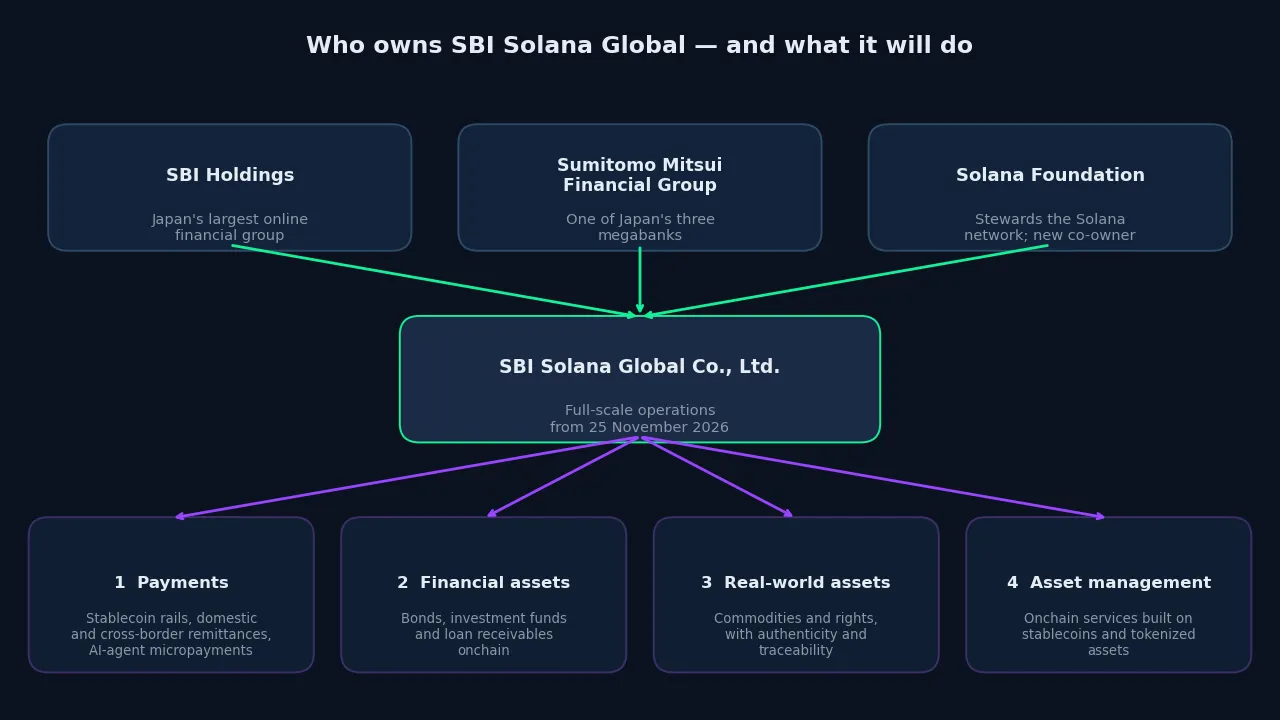
SBI Holdings, Sumitomo Mitsui Financial Group and the Solana Foundation have launched SBI Solana Global, a joint venture that will build stablecoin payments, tokenized bonds and funds, and onchain asset management on Solana, starting in Japan.

Two of Japan’s biggest financial groups have put their names behind Solana. SBI Holdings, Sumitomo Mitsui Financial Group (SMFG) and the Solana Foundation said on Tuesday that their joint venture, SBI Solana Global, has begun full-scale operations, with a mandate to build stablecoin payments, tokenized assets and onchain investment services out of Japan. It is one of the largest institutional endorsements a public blockchain has received in Asia, and it arrives in a week when the crypto market has been falling, not rising.
Note that the headline numbers need care. The $2.3 trillion in combined assets and 80 million customers the Solana Foundation cites belong to SBI and SMFG as groups, not to the venture, and nothing in the announcement says any of that money is moving onchain. What has actually happened is narrower and more concrete: an existing joint venture has been restructured, renamed and given a public blockchain to build on. The test now is whether it produces services, not statements.
What the announcement says
The three parties said they had completed the agreements to move SBI R3 Japan into its new structure, and that the company has begun full-scale operations as SBI Solana Global Co., Ltd., The Block reported on Tuesday. The venture will work across four areas: stablecoin-based payments and remittances, at home and across borders; the tokenization of financial assets such as bonds, investment funds and loan receivables; the tokenization of real-world assets, with the chain used to track authenticity and traceability; and onchain asset management built on stablecoins and tokenized assets.
“SBI Solana Global aims to create an onchain digital economy originating in Japan and expand its business across Asia and global markets,” the announcement said. The plan is Japan first: the companies say they will establish practical use cases and a solid business foundation at home before taking the work across Asia and into global onchain markets.
How we got here
This is not a cold start. SBI Holdings and the Solana Foundation announced their strategic partnership on 13 July, when the Foundation agreed to take an equity stake in SBI R3 Japan and the company took on the SBI Solana Global name. Tuesday’s announcement completes that restructuring and puts the business into operation.
The history matters because it shows what changed. SBI R3 Japan was built on R3’s Corda, a permissioned ledger where only approved participants can see and validate transactions. The new venture runs on Solana, a public chain. That is a deliberate move from a walled garden to open infrastructure, and the Solana Foundation joining as a co-owner, rather than a technology vendor, is the part that makes it hard to dismiss as a press-release partnership.
SBI also brings something live to the venture. Its yen-backed stablecoin, JPYSC, launched with the Startale Group in June, and its outstanding balance reached about ¥20.8 billion (around $136 million) by the end of October. JPYSC is the obvious first product for the venture’s payment rails, though the announcement does not say so directly.
The move fits a pattern. In South Korea, the Solana Foundation has partnered with Hanwha Asset Management, Shinhan Card, Shinhan Asset Management and Toss Bank on stablecoin payments, cross-border remittances and tokenization. And on 12 November, the Depository Trust & Clearing Corporation said it would connect its tokenization service to Solana from the second half of 2027. Solana is quietly becoming the settlement layer institutions reach for when they want tokenization done on a public chain.
What the market did
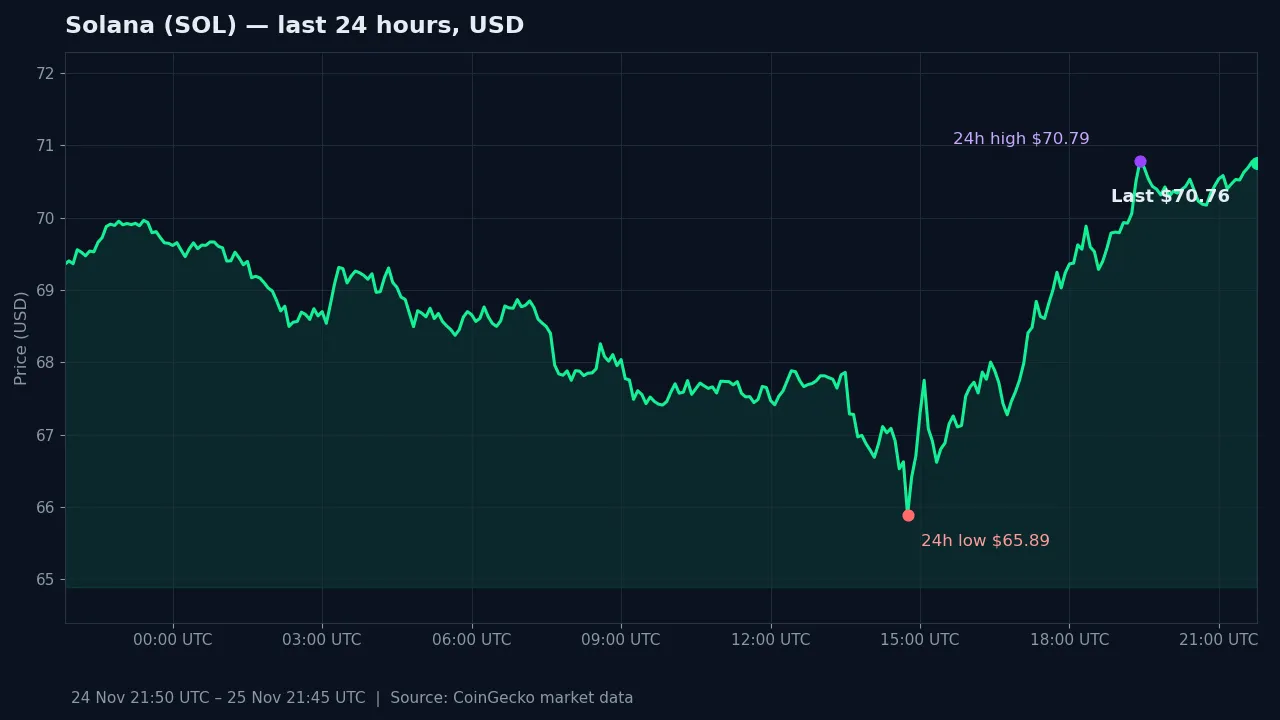
SOL, Solana’s token, traded at about $70.75 at the time of writing, up roughly 2% over 24 hours after dipping to $65.89 earlier in the day. The announcement did not set off a rally: the token was down about 3.4% on the day at midday before recovering. For a venture with no products and no launch dates yet, that is the honest reading. The market treated it as a corporate development, not a trading event.
What it doesn’t mean
- It is not $2.3 trillion coming to Solana. That figure describes the combined assets of SBI and SMFG as banking groups. The venture has disclosed no capital, no assets under management and no target for either.
- It is not a product launch. The announcement names four business areas and no products. It gives no launch dates, names no executives, and discloses neither the equity split between the three owners nor the financial terms.
- It does not require anyone to hold SOL. Nothing in the announcement says customers must buy or hold the token to use the venture’s services, and it promises no effect on SOL’s price.
- It is not the first step. The July partnership, the JPYSC launch in June and the Corda history all came first. Tuesday’s news is the moment the structure went live, not the moment the idea was born.
Why it matters for Japan
Strip away the announcement language and the signal is this: SBI, Japan’s largest online financial group, and SMFG, one of Japan’s three megabanks and a globally systemically important bank, have chosen to build on a public blockchain rather than the permissioned ledger they already owned. That is a bet that open infrastructure, not a private network, is where Japanese finance will be tokenized.
It also has a legal footing that did not exist a few years ago. The venture will build its payment rails under Japan’s revised Fund Settlement Act, the framework that governs yen stablecoins. Regulation is not the story here. The story is that the regulation now exists and institutions are using it.
The broader context helps too. Tokenized stocks on Base crossed $1 billion in weekly volume this month, and the World Bank is exploring USDC payments with Citi and Circle. Tokenization is moving from pilots to volume, and SBI Solana Global is Japan’s entry into that race. Whether Japan’s banks can move as fast as its crypto startups is the open question, and the CFTC’s decision to let US derivatives venues count Bitcoin and Ether toward operating reserves shows regulators elsewhere are moving in the same direction.
What to watch
Whether SBI Solana Global names a first product or a launch date. Whether JPYSC’s outstanding balance grows now that it has a dedicated vehicle behind it. And whether the Korea partnerships and the DTCC connection turn into live services in 2027, or stay as announcements.
What is SBI Solana Global?
SBI Solana Global is a joint venture of SBI Holdings, Sumitomo Mitsui Financial Group and the Solana Foundation. It is the renamed SBI R3 Japan, which began full-scale operations under the new name on 25 November 2026.
What will SBI Solana Global do?
It will work across four areas: stablecoin-based payments and remittances, the tokenization of financial assets such as bonds, investment funds and loan receivables, the tokenization of real-world assets, and onchain asset management built on stablecoins and tokenized assets.
What is JPYSC?
JPYSC is a yen-backed stablecoin SBI launched with the Startale Group in June 2026. Its outstanding balance reached about ¥20.8 billion (around $136 million) by the end of October 2026, and it is the venture’s most obvious first product for payment rails.
When will SBI Solana Global launch its first products?
No dates have been disclosed. The announcement names business areas only, and the companies say they will build practical use cases in Japan first, then expand across Asia and into global markets.
Do I need to hold SOL to use SBI Solana Global’s services?
Nothing in the announcement says so. SOL is the Solana network’s token, but the venture’s services are aimed at institutions and payment users, and the announcement makes no promise about SOL’s price.
This article is for information only and is not financial advice.