
Cisco and OpenAI Launch Shirudo to Shield Linux Systems
Cisco and OpenAI have launched Shirudo, an open-source runtime that shields running Linux systems from exploits while the real patch is still being built — no restart required.

Cisco and OpenAI have launched Shirudo, an open-source runtime that protects running Linux systems while teams prepare a permanent patch.
Note that Shirudo is not a patch. It is a temporary safeguard — a small, targeted block on the exact behaviour an exploit uses — that buys a security team time. The patch still has to be written, tested and rolled out. Shirudo only covers the gap in between, and that gap is where systems get hit.
What the launch covers
The two companies announced Shirudo on 23 November, from San Jose. Shirudo is Japanese for “shield”, and the name is the whole idea: a running system gets a shield put in front of it while the permanent fix is still being built.
Shirudo is built on eBPF, the Linux technology that lets small, checked programs run at specific points inside the operating system kernel without changing its source code or restarting anything. A guardian agent uses those hooks to watch a system, and when a vulnerability turns up, the agent builds a shield: a small piece of eBPF or application code that blocks the vulnerable path and lets legitimate requests through.
The project is open source from day one. The code is on GitHub under the shirudo-dev organisation, licensed under BSD 2-Clause, with the BPF programs dual-licensed under BSD and GPL. Cisco and OpenAI have also published documentation, a virtual-machine quickstart and a self-guided lab, and a technical deep-dive webinar is scheduled for 15 December.
How a shield is built
The workflow runs as a loop. An agent takes in the details of a new vulnerability, reproduces the exploit, and picks the exact point where the attack can be stopped. It then builds a shield, tests that the shield blocks the attack, and checks that normal work still gets through. Only then does the shield go to a human operator for approval.
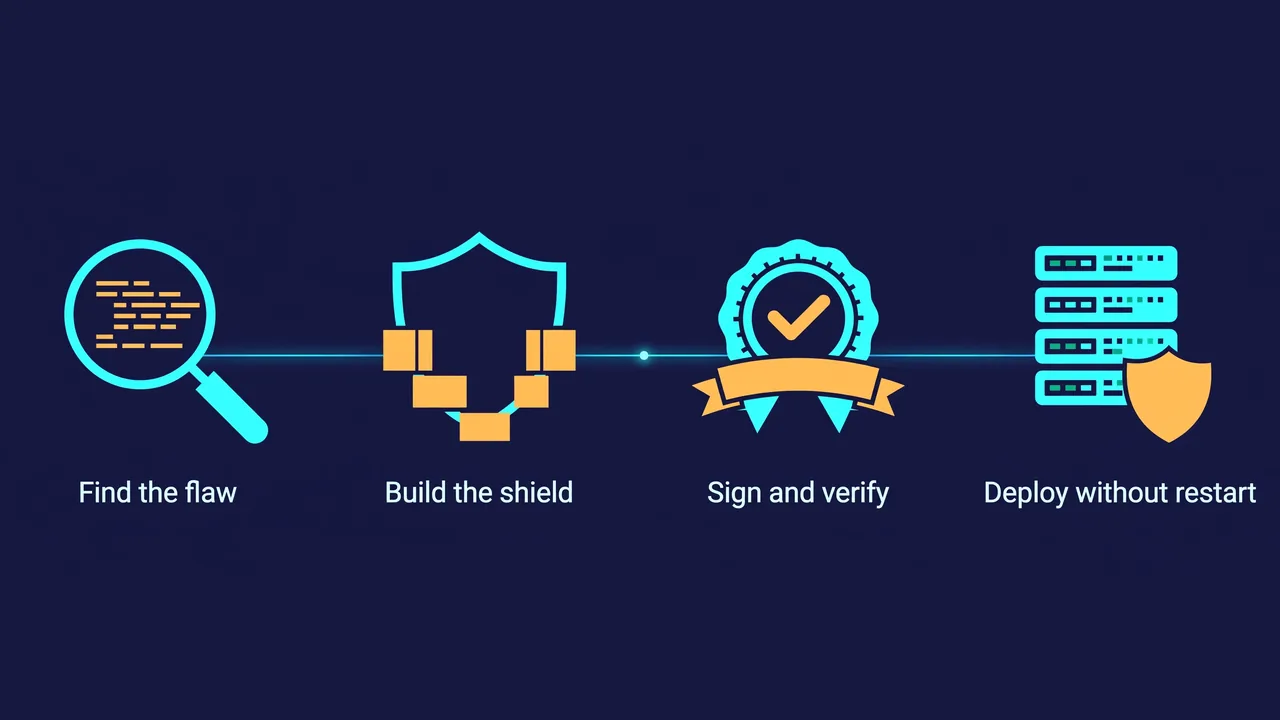
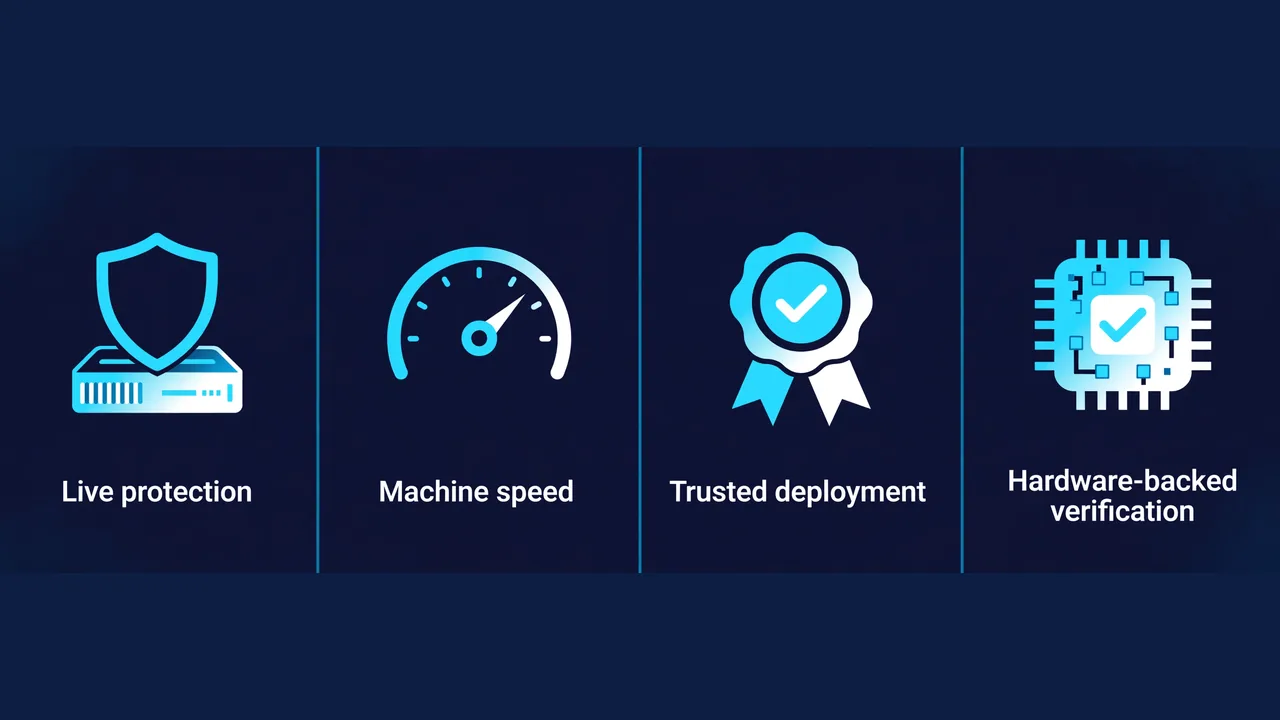
Once approved, the shield is delivered as a signed .bee package through a standard container registry. The target machine pulls the package and checks the signature against a hardware-backed record before anything loads, so a shield cannot run unless it was signed, even if an attacker has administrator access. A Trusted Platform Module, or TPM, keeps a verifiable record of which protections were loaded and when.
The idea was tested against real flaws. In a controlled demonstration, a shield generated by OpenAI’s Codex blocked a Java4Shell exploit attempt against a running Elasticsearch service, without a restart. The shield added an input check to Java’s Base64 decoder and rejected the malicious input while the service kept running. Cisco says Shirudo also detected and blocked attempts to exploit a PHP flaw in testing.
Shirudo grows out of Tetragon, the eBPF runtime-security platform that Isovalent — the Cisco-owned team behind the project — open-sourced in 2022. Isovalent describes Shirudo as a ground-up rewrite of Tetragon, rebuilt so that AI agents, not only human engineers, can drive it through code.
“There is nothing more important than giving security teams the tools they need to match the speed of the AI-driven threats they are facing. We need self-defending infrastructure that acts at the speed of code, learns in real time, and shields itself until patches are safely rolled out.”
Jeetu Patel, Cisco President and Chief Product Officer
What it doesn’t mean
- Not a patch. A shield blocks one exploit path. The underlying flaw is still there until the vendor’s fix lands, and the shield retires when it does.
- Not automatic. The agent proposes and tests, but a human operator approves every shield before it goes live. People keep the keys and set the boundaries.
- Not a cure-all. A shield stops the specific behaviour it was built for. It does not make a system invulnerable, and a badly aimed shield could block legitimate traffic — which is why teams test first.
- Not production-ready yet. Shirudo is pre-release, with no stable version so far. Running it on production systems needs a compatible kernel with Shirudo’s patches and a TPM 2.0 chip.
- Not a closed product. Its value depends on the community: researchers contributing shields and tests, and operators reporting where a shield breaks real traffic.
Why it matters now
Testing and deploying a patch can still take days or weeks, and the gap between a flaw being found and a fix being rolled out is exactly where attackers work. The problem is sharper than it used to be: an exploit and a legitimate request can rely on the same Linux operation, so blocking that operation outright takes the service offline. Teams have had to choose between staying exposed and going down.
AI has made the gap worse on the attacker’s side. Models now help find and weaponise vulnerabilities faster than most organisations can patch — in some cases exploitation starts before a flaw is even publicly disclosed. Shirudo is an attempt to turn the same capability around: the agent that finds the flaw builds the stopgap, at the same speed.
The launch also shows how fast OpenAI is moving beyond models. In the same week it launched OpenWorks for small businesses, it is now shipping security infrastructure with Cisco, while its GPT-6.2 models power the agents doing the work. On the open-model side, Z.ai’s GLM-5.4 arrived days earlier. And the same speed problem is showing up on the AI side itself: OpenRouter removed three providers this week after researchers found prompts being copied for months.
What to watch
The technical deep dive on 15 December will show how far the runtime has come since launch. The more important test is whether tested shields start shipping alongside vulnerability disclosures, as OpenAI and Cisco intend — that would turn Shirudo from a demo into a shared library defenders can actually use. Watch too for the first production deployments, and for what breaks in practice: a shield that blocks real traffic is worse than no shield at all.
This article is for information only and is not financial advice.
What is Shirudo?
Shirudo is an open-source runtime launched by Cisco and OpenAI on 23 November 2026. It uses eBPF shields to protect running Linux systems from exploits while teams prepare a permanent patch. Shirudo is Japanese for ‘shield’.
How does a Shirudo shield work?
An AI agent finds a vulnerability, reproduces the exploit and builds a small shield that blocks the exact behaviour the attack uses. The shield is tested against real workloads, cryptographically signed, and only deployed once a human operator approves it — all without restarting the system.
Does Shirudo replace patching?
No. A shield is a temporary safeguard that blocks one exploit path. The underlying flaw remains until the vendor’s patch is installed, and the shield retires when the real fix lands.
Is Shirudo ready for production use?
Not yet. Shirudo is pre-release, with no stable version so far. Production targets need a compatible Linux kernel with Shirudo’s patches and a TPM 2.0 chip for hardware-backed verification.