What is Blockchain in Simple Words? A Simple Guide to How It Works
What Is Blockchain? Confused about blockchain? This guide breaks down how it works, real-world uses, and common myths in plain, easy-to-understand language.

Blockchain is a digital ledger that records transactions across a network of computers instead of one central server. Each “block” of data links to the one before it, forming a chain that’s extremely hard to alter. It powers cryptocurrencies like Bitcoin but also supports supply chains, healthcare records, and digital identity systems.
You’ve probably heard the word “blockchain” tossed around in conversations about Bitcoin, NFTs, or the future of banking. But what does it actually mean?
At its core, blockchain is a way of recording information so that no single person or company controls it, and no one can quietly change the record without everyone else noticing. That might sound abstract, but the concept is simpler than it seems once you break it down.
Understanding blockchain matters because this technology already touches more of daily life than most people realize. It underpins how millions of people send money across borders, how companies track products from factory to shelf, and how some governments are experimenting with secure digital identity systems. As more industries explore these applications, knowing the basics helps you make sense of the news, the hype, and the real opportunities.
This guide walks through what blockchain is, how it works step by step, its defining characteristics, and where it’s being used in the real world today. You’ll also learn how blockchain compares to traditional systems, which common myths to ignore, and what limitations still hold the technology back.
What Is Blockchain? The Basics

Blockchain is a digital ledger that records transactions. Unlike a notebook or spreadsheet kept in one place, this ledger is copied across many computers at once, known as a distributed network. The National Institute of Standards and Technology (NIST) describes blockchains as tamper-evident, tamper-resistant digital ledgers implemented in a distributed fashion, usually without a central authority (NIST, 2018).
How Does Blockchain Differ From a Traditional Database?
Traditional databases, like the ones banks or retailers use, are typically controlled by a single organization. That organization can add, edit, or delete records as needed. Blockchain flips this model. Instead of one gatekeeper, copies of the ledger live on many computers, called nodes, that must agree before new information is added. Once that information is confirmed, changing it retroactively becomes extremely difficult.
Why Is It Called “Blockchain”?
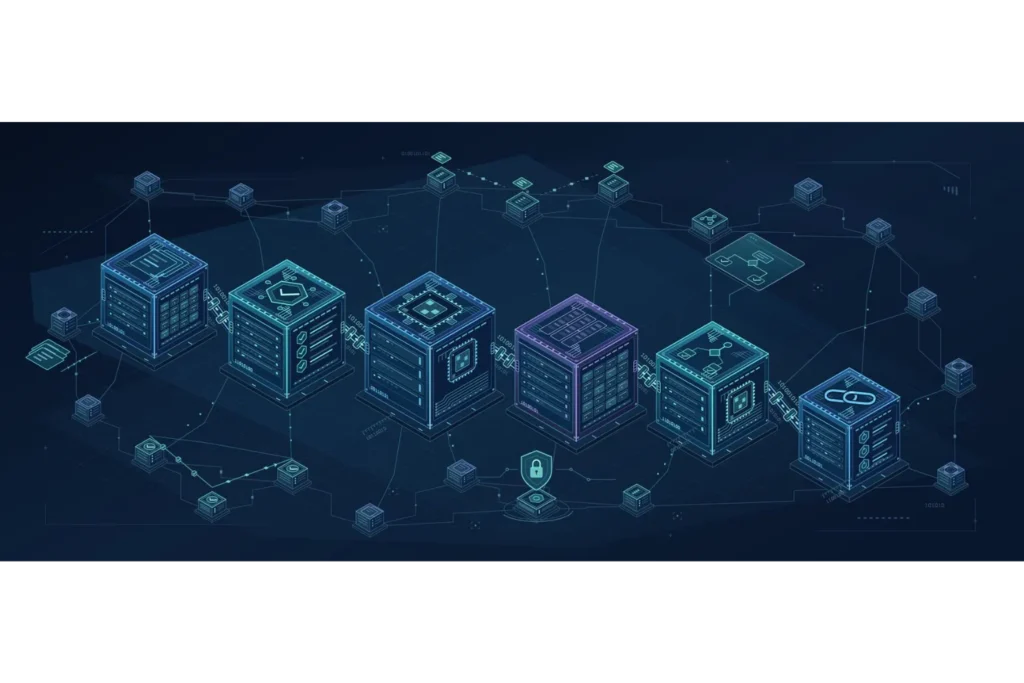
The name describes exactly what it is: a chain of blocks. Each block holds a batch of transaction data, a timestamp, and a cryptographic reference to the block before it. That reference links every block to its predecessor, forming an unbroken chain stretching back to the very first entry. This design is part of why blockchain records are so hard to tamper with: altering one block would require changing every block that came after it, across every copy of the ledger.
How Does Blockchain Work Step by Step?
Blockchain can feel complex, but the underlying process follows a predictable sequence.
What Happens When a Transaction Is Initiated?
Someone requests a transaction, like sending cryptocurrency, updating a supply chain record, or signing a digital document. That request gets broadcast to the network of computers participating in the blockchain.
How Are Blocks Created and Added to the Chain?
The network’s computers work together to verify the transaction is legitimate. Once verified, it gets grouped with other recent transactions into a new block. Depending on the blockchain, this verification happens through a consensus mechanism such as proof of work or proof of stake. Bitcoin, for example, uses proof of work and is designed to add a new block roughly every 10 minutes. Ethereum switched from proof of work to proof of stake during an upgrade known as the Merge in September 2022.
Once a block is validated, it’s added to the chain and distributed to every copy of the ledger across the network. From that point forward, the transaction is part of the permanent record.
What Role Does Cryptography Play in Securing Blockchain Data?
Cryptography is what makes blockchain tamper-resistant. Each block contains a unique digital fingerprint, called a hash, generated from its contents and the hash of the previous block. Change even a single character of data in a block, and its hash changes completely, immediately signaling that something’s off. Because each block’s hash depends on the one before it, this chain of hashes makes retroactive tampering easy to detect and hard to pull off undetected.
What Are the Key Characteristics of Blockchain?
Several features distinguish blockchain from conventional record-keeping systems.

Decentralization: Why No Single Authority Controls the Network
Instead of relying on one company or government to manage the ledger, blockchain distributes that responsibility across many independent participants. This reduces the risk of a single point of failure and limits any one party’s ability to unilaterally change the rules.
Transparency: Who Can See Blockchain Transactions?
On public blockchains, every participant can view the full history of transactions. This openness builds trust because anyone can independently verify what’s been recorded, without needing to rely on a central authority’s word.
Immutability: Can Blockchain Data Be Changed After It’s Recorded?
Once data is confirmed and added to the chain, altering it requires changing every subsequent block across a majority of the network’s copies, which is computationally impractical on most established blockchains. This near-permanence is one of blockchain’s most valued properties for record-keeping.
Security: How Does Blockchain Protect Data?
Blockchain security relies on multiple layers: cryptographic hashing, distributed consensus, and, on public networks, the sheer difficulty of controlling enough computing power to override the majority. That said, security isn’t absolute, a point worth remembering when evaluating any blockchain-based system.
What Are Real-World Examples and Applications of Blockchain?
Blockchain’s applications extend well beyond its original use case.

Cryptocurrency and Bitcoin
Bitcoin remains the most well-known blockchain application. Described in a 2008 whitepaper by the pseudonymous Satoshi Nakamoto, Bitcoin’s network launched in January 2009 with its genesis block. Bitcoin demonstrated that a decentralized digital currency could function without a central bank or payment processor.
Supply Chain Management and Product Tracking
Companies use blockchain to track goods as they move from manufacturer to retailer. Each step, like production, shipping, or customs clearance, can be logged on the blockchain, giving businesses and consumers a verifiable history of a product’s journey.
Healthcare Records and Patient Data Management
Blockchain is being explored as a way to securely store and share patient records across providers. In theory, this could reduce administrative friction while keeping sensitive data protected and auditable.
Smart Contracts and Automation
Smart contracts are self-executing agreements written in code and stored on a blockchain, most notably on Ethereum. When predetermined conditions are met, the contract executes automatically, no intermediary required. This has opened the door to decentralized finance platforms, automated insurance payouts, and more.
Voting Systems and Digital Identity Verification
Some governments and organizations are piloting blockchain-based voting and digital identity systems, aiming to create tamper-resistant records of votes cast or identities verified. These applications are still largely experimental, but they illustrate blockchain’s potential beyond finance.
How Does Blockchain Compare to Traditional Systems?
Speed and Efficiency
Traditional centralized databases can process transactions quickly because one authority makes the final call. Blockchain’s decentralized verification process, where multiple nodes must reach consensus, generally adds steps that a single-authority database doesn’t need. The tradeoff is reduced reliance on any one gatekeeper.
Cost and Scalability Differences
Centralized systems often scale more easily because one organization controls infrastructure and upgrades. Public blockchains, by contrast, need agreement across a distributed network, which can make certain upgrades or scaling efforts more involved. Many projects are actively developing solutions to improve blockchain scalability.
Security Advantages and Potential Vulnerabilities
Blockchain’s distributed design removes a single point of failure, but it doesn’t eliminate risk entirely. A “51% attack,” where one entity gains control of the majority of a network’s computing or staking power, could theoretically let them manipulate transaction records. Exchange hacks and smart contract bugs have also led to real losses, underscoring that blockchain security depends on far more than the underlying ledger design.
When Does Blockchain Make Sense, and When Doesn’t It?
Choose blockchain if your use case benefits from decentralization, transparency, and tamper-resistant records across multiple parties who don’t fully trust each other, like cross-border payments or multi-party supply chains. A traditional database may be the better fit if you need a single organization managing fast, simple, internal data with no need for distributed trust.
What Are Common Misconceptions About Blockchain?
Is Blockchain Only for Cryptocurrency?
No. While cryptocurrency is blockchain’s most famous application, the technology also supports supply chain tracking, healthcare data, digital identity, and smart contracts, among other uses.
Is Blockchain Completely Anonymous?
Not quite. Blockchain transactions are pseudonymous, not anonymous. Wallet addresses aren’t automatically tied to real names, but blockchain analytics firms can often trace transaction patterns back to real-world identities, especially when funds move through regulated exchanges.
Is Blockchain Unhackable?
No system is unhackable. While the blockchain ledger itself is difficult to alter retroactively, exchanges, wallets, and smart contracts built on top of blockchains have been hacked before. Vulnerabilities typically exist at these edges rather than in the core ledger.
Does Blockchain Solve Every Problem?
Blockchain isn’t a universal fix. It’s most useful when decentralization and tamper-resistance matter. For applications needing a fast, simple, centrally managed database, traditional systems often remain the more practical choice.
What Are the Benefits and Limitations of Blockchain?
Major Advantages for Businesses and Individuals
Blockchain offers verifiable, tamper-resistant records, reduced reliance on intermediaries, and greater transparency for participants across a network. These qualities make it attractive for industries where trust between multiple parties is essential.
Current Challenges and Scalability Issues
Despite its advantages, blockchain still faces scalability hurdles. Reaching consensus across many distributed nodes takes coordination, and developers continue working on solutions to help public blockchains handle higher transaction volumes.
What Are the Environmental Considerations of Blockchain?
Energy use varies significantly depending on a blockchain’s consensus mechanism. Proof-of-work blockchains like Bitcoin require substantial computing power. Proof-of-stake blockchains use dramatically less energy. Ethereum’s 2022 Merge, which shifted the network from proof of work to proof of stake, led to major reported energy savings, though estimates vary by source. The Ethereum Foundation has cited a 99.95% drop in energy use (reported by Forbes, Oct 2022), Digiconomist estimated a reduction of at least 99.84%, and a Stanford course analysis estimated a 25.7 terawatt-hour annual reduction. The differing figures reflect different methodologies, but all point to a substantial energy decrease.
Regulatory and Legal Uncertainties
Blockchain regulation is still catching up to the technology. In the US, the GENIUS Act, signed into law in July 2025, established a regulatory framework for USD-backed payment stablecoins and placed issuers under Bank Secrecy Act and anti-money laundering requirements. In the European Union, rules under the Markets in Crypto-Assets (MiCA) regulation covering e-money tokens and asset-referenced tokens have applied since June 30, 2024, with the broader MiCA framework taking effect December 30, 2024. These frameworks reflect a growing effort to bring clarity to how blockchain-based assets are issued and used.
Why Blockchain Technology Is Worth Understanding
Blockchain, at its heart, is a straightforward idea: a shared digital ledger that no single party fully controls, secured by cryptography and verified by a distributed network. From Bitcoin’s 2009 launch to today’s supply chain tracking, healthcare pilots, and smart contracts, blockchain’s applications have expanded far beyond its original purpose.
The technology still faces real challenges, including scalability limits, energy considerations on certain networks, and an evolving regulatory landscape. But understanding the fundamentals puts you in a better position to evaluate where blockchain genuinely adds value and where it doesn’t.
As regulation matures and new consensus models reduce energy demands, blockchain’s role in finance, healthcare, logistics, and identity verification is likely to keep growing. If you want to go deeper, consider exploring how specific blockchains like Ethereum implement smart contracts, or how your industry is piloting blockchain-based solutions.
FAQ
Is blockchain the same thing as Bitcoin?
No. Bitcoin is a cryptocurrency that runs on a blockchain, but blockchain is the underlying technology. Many other applications, from supply chain tracking to smart contracts, also use blockchain without involving Bitcoin at all.
How much does it cost to use blockchain?
Costs vary by blockchain and use case. Public blockchains like Bitcoin and Ethereum charge transaction fees that fluctuate based on network demand, while businesses building private or permissioned blockchain systems face development and infrastructure costs instead of per-transaction fees.
Is blockchain anonymous or private?
Blockchain is pseudonymous rather than anonymous. Transactions are tied to wallet addresses instead of real names, but blockchain analytics tools can often trace activity back to real-world identities, particularly when funds pass through regulated exchanges.
What are the main risks of using blockchain?
Risks include exchange hacks, smart contract bugs, and theoretical 51% attacks where one entity gains majority control of a network. Regulatory uncertainty in some regions also creates risk for businesses building blockchain-based products.
Who should consider using blockchain, and who shouldn’t?
Blockchain suits situations involving multiple parties that need transparent, tamper-resistant records without relying on one central authority, such as cross-border payments or multi-party supply chains. Organizations needing a fast, simple, centrally managed database may find traditional systems more practical.