
B3 and Six Brazilian Banks Build Open BRL, a Shared Real Stablecoin for Early 2027
B3 and six of Brazil's biggest banks are building Open BRL, a real-pegged stablecoin with shared settlement rails. Operations are expected in the first quarter of 2027 — but the notice leaves the chain, the reserves and the governance undecided.
Brazil’s stock exchange operator B3 and six of the country’s biggest financial institutions are building a shared real-pegged stablecoin, Open BRL, with operations expected in the first quarter of 2027. The announcement, made on 27 November, puts the exchange, the country’s largest banks and its biggest brokerages behind a single token and a common set of settlement rails — a bet that Brazil’s banks would rather share a stablecoin than each issue their own.
Seven institutions, one token
The partners are Bradesco, BTG Pactual, Itaú Unibanco, Safra, Santander and XP, alongside B3 itself. In the first phase, B3 runs the technology and Banco B3, the bank inside the exchange group, issues the token and holds the backing. The six partners build integrations and evaluate use cases for the infrastructure, which is meant to move value and settle digital-asset trades across institutions that today run on separate systems.
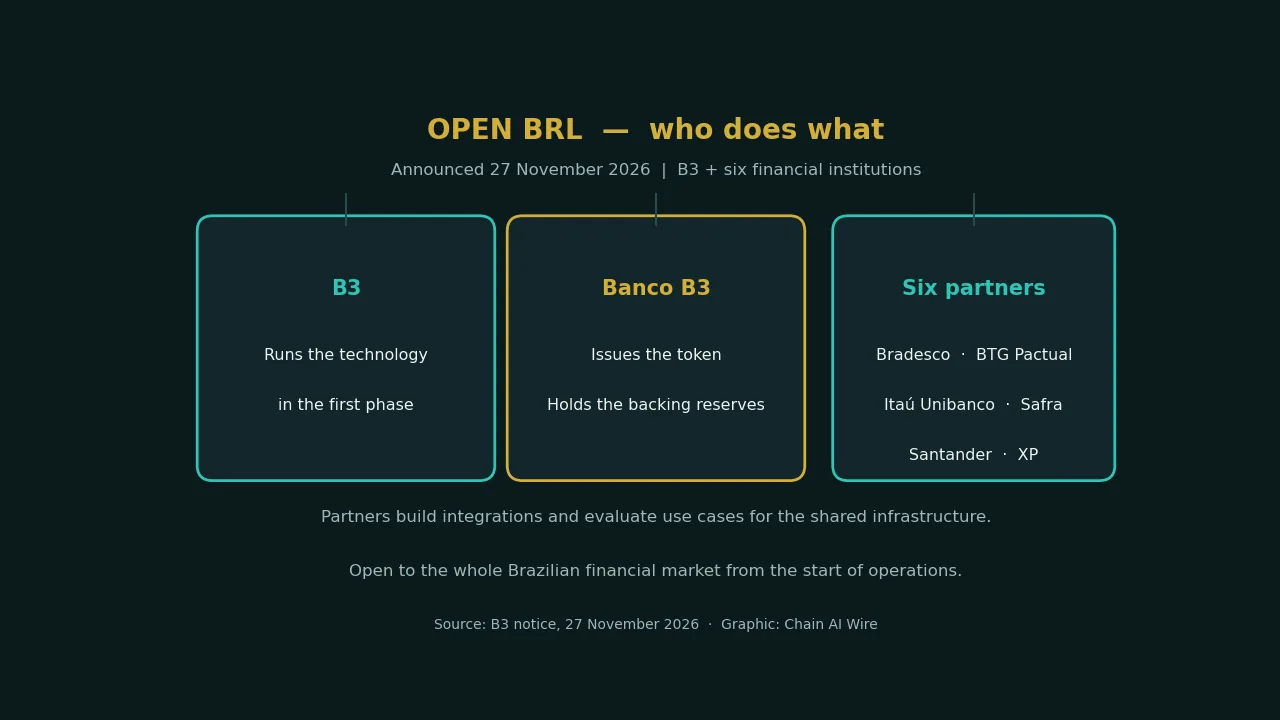
The division of labour is the point. Talks between the institutions began about three months ago, after the banks concluded it would be awkward to settle trades using a digital currency issued by a competitor, according to Valor Econômico, the Brazilian business daily that reported the plan hours before B3’s own release. A shared token issued by a neutral party — the exchange group’s bank — sidesteps that problem, and B3 says the initiative is open to the entire Brazilian financial market from the start of operations. “Our goal is for this initiative to be open to the entire Brazilian financial market,” Luiz Masagão, B3’s vice president of products and clients, told Valor.
From a solo coin to a shared one
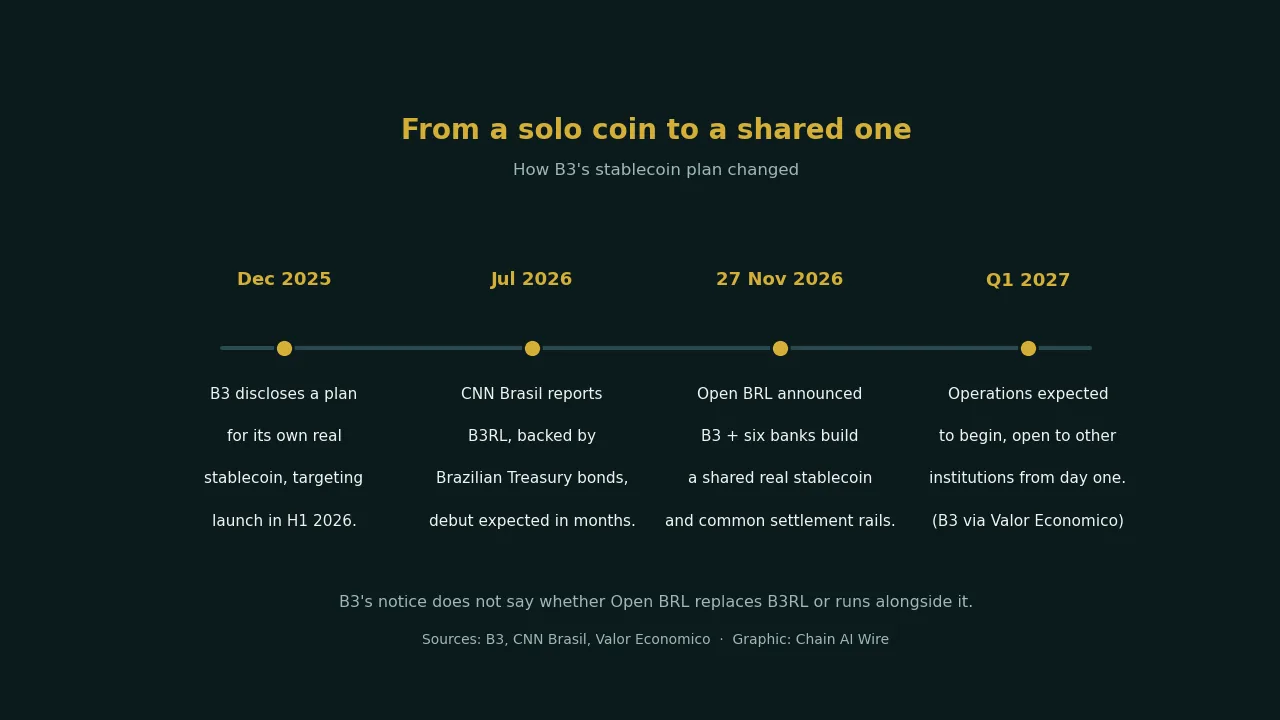
Open BRL is not B3’s first attempt at a real stablecoin. B3 first disclosed plans for its own token in December 2025, targeting a launch in the first half of 2026, and in July 2026 CNN Brasil reported it would be called B3RL, backed by Brazilian Treasury bonds, with a debut expected within months and blockchain trading of stocks and bonds to follow in 2027. That launch never happened. The Open BRL notice does not mention B3RL at all, and it is not yet clear whether the shared token replaces the solo plan or will run alongside it.
| B3RL (July 2026 plan) | Open BRL (27 Nov 2026) | |
|---|---|---|
| Who builds it | B3 alone | B3 plus six banks and brokerages |
| Issuer | B3 (planned) | Banco B3, in the first phase |
| Backing | Brazilian Treasury bonds | Reais held as backing; composition not published |
| Launch target | Within months of July 2026 | Operations expected Q1 2027 |
| Scope | Blockchain trading of stocks and bonds | Shared rails for payments and digital-asset settlement |
The change of shape matters more than the change of name. A token B3 issued alone would have been one more product from the exchange; a token seven institutions fund and build together is a standard, and standards are what let rivals settle with each other. The partners will fund the venture themselves, though none has disclosed how much it is putting in, and the founding firms plan to use the token in their own digital economy projects.
What the notice does not say
For all its detail on who does what, B3’s notice leaves the four questions that decide whether a stablecoin works unanswered. It names no blockchain, so it is unknown whether Open BRL will run on a public chain, a permissioned network operated by the exchange, or a hybrid. It describes the token as referenced in reais and promises continuous audit and backing mechanisms, but publishes no reserve composition, no custodian and no attestation schedule. Governance is still to be defined by a steering committee, and the notice itself carries no launch date — the first-quarter 2027 expectation comes from Masagão’s interview with Valor, not from B3’s release. What the notice does promise is compliance: the project is structured under applicable regulation with anti-money-laundering and counter-terrorism-financing controls, cybersecurity protocols and prudential standards drawn from major jurisdictions.
A crowded field, a new rulebook
Open BRL also enters a market that is already crowded. Brazil had more than a dozen real-pegged stablecoins by July, according to CNN Brasil’s count, so the new token’s advantage is not being first but being the one the country’s biggest banks have agreed to use together. The timing is regulatory as well as commercial: Brazil’s central bank is bringing crypto firms under a new licensing regime, and companies already active in the country had until 30 October to apply for authorisation. A token built by the exchange and the banks, under the regulator’s gaze, is a different proposition from the dozen that came before it. The pattern is regional, too. Days earlier, China, Japan, South Korea and the ASEAN states agreed in Kyoto to coordinate digital-asset regulation and cross-border payments, and in Japan, SBI, SMFG and the Solana Foundation launched a joint venture for stablecoin payments and tokenisation. Asia’s largest economies are converging on the same idea: shared rails, built by incumbents.
The contrast with the United States is instructive. There, payment stablecoins can now count toward regulated derivatives venues’ operating reserves, and the World Bank is exploring USDC payments with Citi and Circle, but no comparable consortium of the biggest American banks has rallied behind a single shared token. Brazil’s banks, by contrast, have chosen to build one together — and to let the exchange, rather than any one of them, hold the pen. For savers, the parallel is closer to home: Aave’s new savings app takes stablecoin deposits on eight networks, a reminder that the tokens themselves are becoming plumbing, and the question is who owns the pipes.
What to watch
Three things. First, the missing technical details: which chain Open BRL runs on, what exactly backs each token, and how often reserves are attested. Second, whether other Brazilian institutions join when operations begin in the first quarter of 2027, as B3 promises. Third, whether B3RL quietly disappears or resurfaces — the answer will say a lot about how final this shared plan really is.
What is Open BRL?
Open BRL is a stablecoin referenced to the Brazilian real, announced on 27 November 2026 by B3, the operator of Brazil’s stock exchange, together with six financial institutions: Bradesco, BTG Pactual, Itaú Unibanco, Safra, Santander and XP. Alongside the token, the group is building shared infrastructure for moving value and settling digital-asset trades.
When will Open BRL launch?
Operations are expected to begin in the first quarter of 2027, according to Luiz Masagão, B3’s vice president of products and clients, speaking to Valor Econômico. B3’s own notice carries no launch date, and other institutions will be able to join from the start of operations.
Is Open BRL backed one-to-one by reais?
That is the plan as described to Valor Econômico: a customer hands over one real to receive one token, with the real held as backing and convertible back at any time. B3’s notice describes the token as referenced in reais with continuous audit and backing mechanisms, but it publishes no reserve composition, custodian or attestation schedule yet.
What happened to B3RL, B3’s earlier stablecoin?
B3 first disclosed plans for its own real stablecoin in December 2025, and in July 2026 CNN Brasil reported it would be called B3RL, backed by Brazilian Treasury bonds, with a debut expected within months. The Open BRL notice does not mention B3RL, and it is not yet clear whether Open BRL replaces it or will run alongside it.