Malaysia Approves the World’s First Shariah-Compliant Spot Bitcoin ETF
Malaysia has approved the Halogen Shariah Bitcoin ETF, the world's first Shariah-compliant spot Bitcoin ETF. It lists on Bursa Malaysia on 2 December 2026, with two counters, a 0.6% fee ceiling and at least 95% of its assets in spot bitcoin.

Malaysia has approved its first spot bitcoin exchange-traded fund, and it is also the first of its kind anywhere: the Halogen Shariah Bitcoin ETF, which Halogen Capital describes as the world’s first Shariah-compliant spot bitcoin ETF, will list on Bursa Malaysia’s Main Market on 2 December 2026. The approval opens regulated bitcoin exposure to Islamic finance investors who have had no compliant spot vehicle to buy, and it arrives in a week when new spot crypto listings are appearing faster than American ETF money is leaving.
The fund in brief
The fund is managed by Halogen Capital Sdn Bhd, Malaysia’s first licensed digital asset fund manager, with Amanie Advisors advising on Shariah compliance. It tracks the FTSE Bitcoin Index and will hold at least 95% of its net asset value in spot bitcoin, with the rest in Shariah-compliant liquidity instruments. The bitcoin is held by BitGo Bank & Trust as sub-custodian, under Universal Trustee (Malaysia) Bhd. Halogen Capital had about RM500 million in assets under management as of 31 October 2026, so a full raise on this fund would be large next to the manager’s existing book.
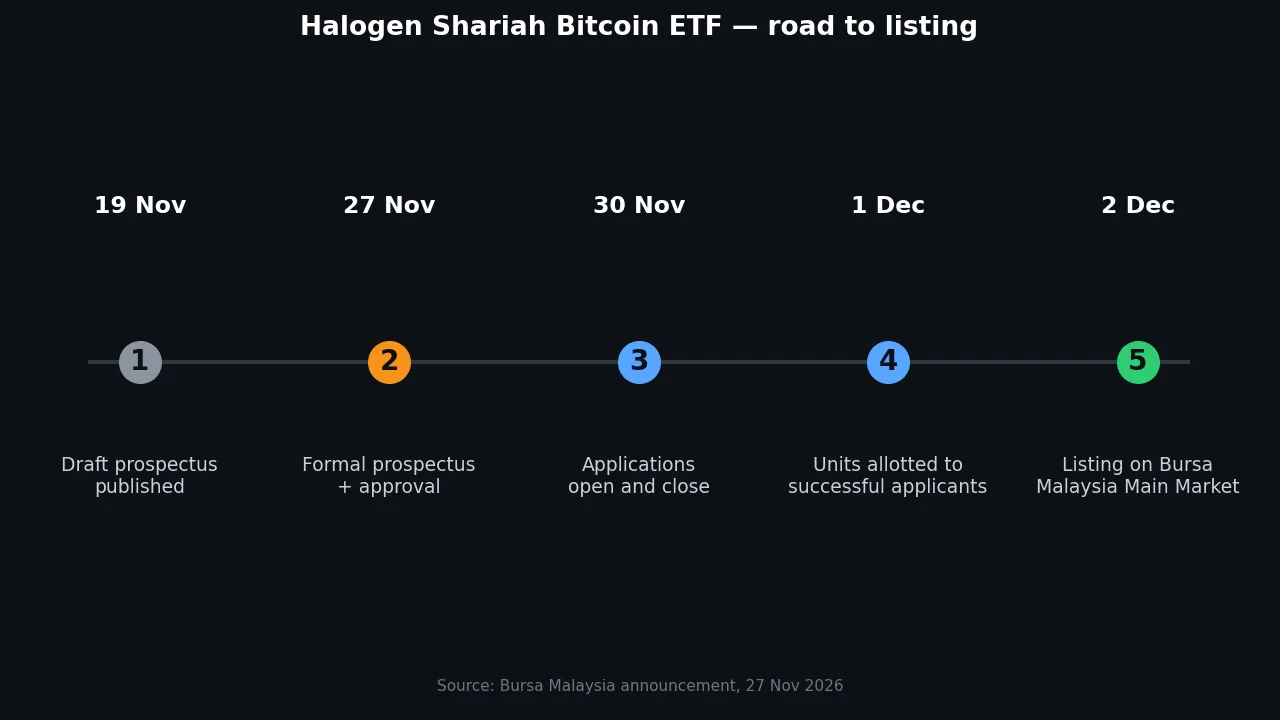
The timetable moved quickly once the draft prospectus appeared on the Securities Commission Malaysia’s website on 19 November. Bursa Malaysia announced the timetable on Friday: applications for units open and close on 30 November, balloting takes place the same day, successful applicants receive their units on 1 December, and the fund lists on 2 December. The dates are indicative and can be extended, but the sequence is set.
Two counters, one fund
The ETF will trade under two tickers, BTCETF-MYR in Malaysian ringgit and BTCETF-USD in US dollars, with stock codes 0840EA and 0840EB. The dual-currency setup is a small but useful design choice: local investors trade in ringgit, while dollar-based investors skip the conversion step. The initial offering can reach up to 1 billion units at $1 each, which could raise around $1 billion, and the minimum board lot is 100 units, about $100 at launch. The annual management fee is up to 0.6% of net asset value, with a trustee fee of up to 0.05%, and the fund plans no income distributions. Large participants can also create and redeem in kind, swapping bitcoin itself for fund units in blocks of 50,000, instead of routing everything through cash.
A crowded week for firsts
Malaysia’s approval is the third notable first in the spot crypto ETF wave this week. Switzerland’s first spot bitcoin ETF, BBIT, began trading on 26 November, becoming Europe’s only spot bitcoin ETF. In the United States, Fidelity filed for a spot Chainlink ETF on 25 November, and Bitwise filed for a spot Zcash ETF on the Texas Stock Exchange. The filings and listings are spreading beyond bitcoin and beyond the United States, and Malaysia’s is the first to carry a Shariah-compliant label.
The contrast with Washington is sharp. The same week Malaysia approved a compliant bitcoin fund, Senate Democrats asked the SEC to rescind its proposed Regulation Crypto Assets rule and withdraw its innovation exemption for tokenized stock venues, warning of a shadow stock market. The Strategic Bitcoin Reserve bill has advanced to the full House, but the regulatory direction in the United States is contested in a way Malaysia’s is not. Asia is also moving on the rails themselves: SBI, SMFG and the Solana Foundation launched SBI Solana Global this week for stablecoin payments and tokenization in Japan.
The price backdrop
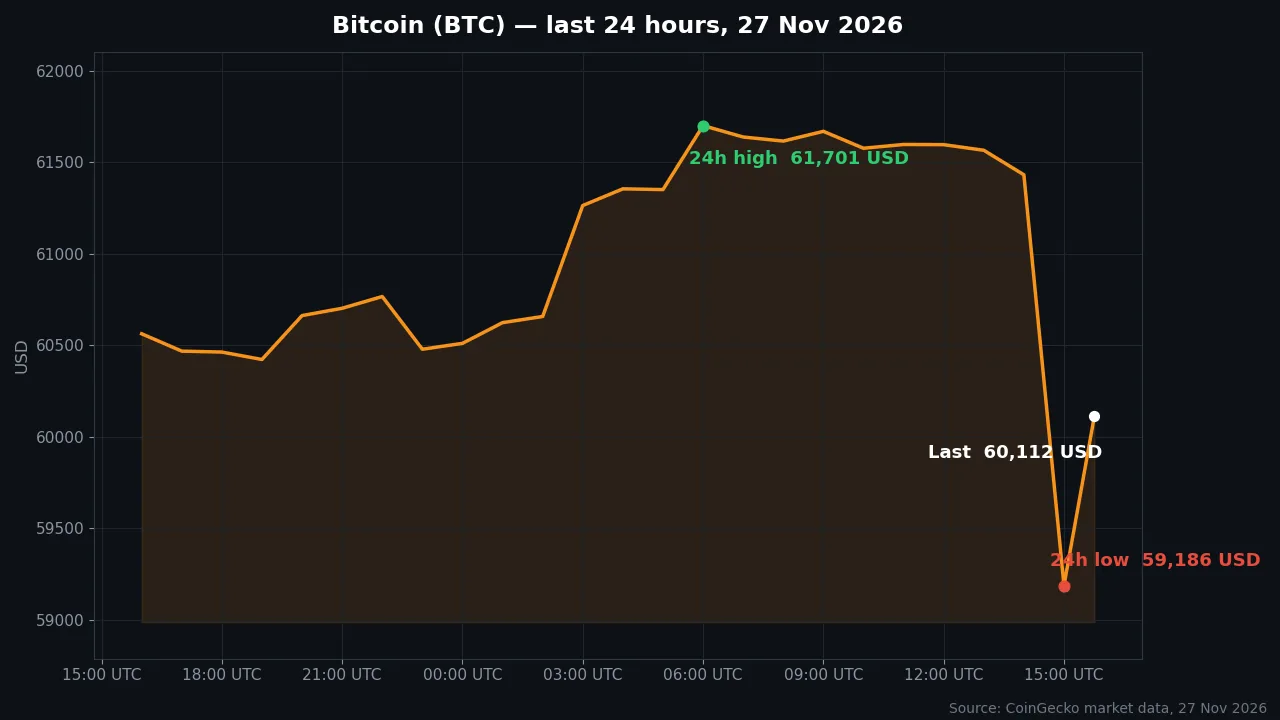
Bitcoin itself had a volatile Friday. It traded between $59,186 and $61,701 over the last 24 hours, topping out in the morning before sliding back toward $59,200 and recovering to about $60,100 by the evening. The listing arrives against a weak flow picture in the United States, where spot bitcoin ETFs are heading for a record $5.39 billion of November outflows, according to The Block. New listings keep coming while the money leaves, which is the tension to watch: the Halogen fund’s first test is whether Malaysian demand shows up on 30 November, not whether the bitcoin price cooperates.
The Shariah label does nothing to dampen volatility, and investors buying in for the compliance stamp should understand that it covers how the fund is structured. The fund’s value will move with bitcoin, the 0.6% fee ceiling adds up over the long holding period the fund targets, and the 95% floor means a small slice of the portfolio is always in something else. What the label does change is who can buy: a large pool of Islamic finance capital that could not touch an unvetted crypto product now has a regulated, exchange-listed route in.
What to watch
Watch the 30 November subscription: how many of the up to 1 billion units are actually taken up, and whether the ringgit or the dollar counter draws more. Watch the 2 December listing for how closely the market price tracks net asset value in the first sessions. And watch whether other Islamic-finance markets follow Malaysia’s template, because the first mover here is a structure, not just a fund.
When does the Halogen Shariah Bitcoin ETF list?
2 December 2026, on the Main Market of Bursa Malaysia. Applications for units open and close on 30 November, successful applicants receive their units on 1 December, and trading begins the next day, according to the timetable Bursa Malaysia announced on 27 November 2026.
What makes the ETF Shariah-compliant?
At least 95% of the fund’s net asset value sits in spot bitcoin, and the remainder goes into Shariah-compliant liquidity instruments. Amanie Advisors, a Shariah adviser registered with the Securities Commission Malaysia, advises on compliance, and the bitcoin is held by BitGo Bank & Trust as sub-custodian. The Shariah label covers how the fund is structured, not the direction of the bitcoin price.
How much does it cost to invest?
The annual management fee is up to 0.6% of net asset value, with a trustee fee of up to 0.05%. Units are offered at an initial price of $1, and the minimum board lot is 100 units, about $100 at launch. The initial offering can reach up to 1 billion units.
Can anyone buy it, or only Muslim investors?
Anyone with a brokerage account can buy it. The fund is built for investors who follow Islamic finance principles, but the units trade like any other listed ETF, in ringgit under the ticker BTCETF-MYR or in US dollars under BTCETF-USD.