
XRP Price Crash: Copilot $0.20 Scenario Is Not a Microsoft Forecast
Microsoft Copilot outlined a hypothetical XRP crash to $0.20, but it is not an official forecast. Here is what the scenario assumes.
Microsoft Copilot has outlined a hypothetical XRP collapse, but the prompt behind the answer matters. The scenario assumes an extraordinary regulatory shock—and does not represent Microsoft’s official market outlook.
- Copilot described a conditional black-swan scenario, not a base-case XRP price prediction.
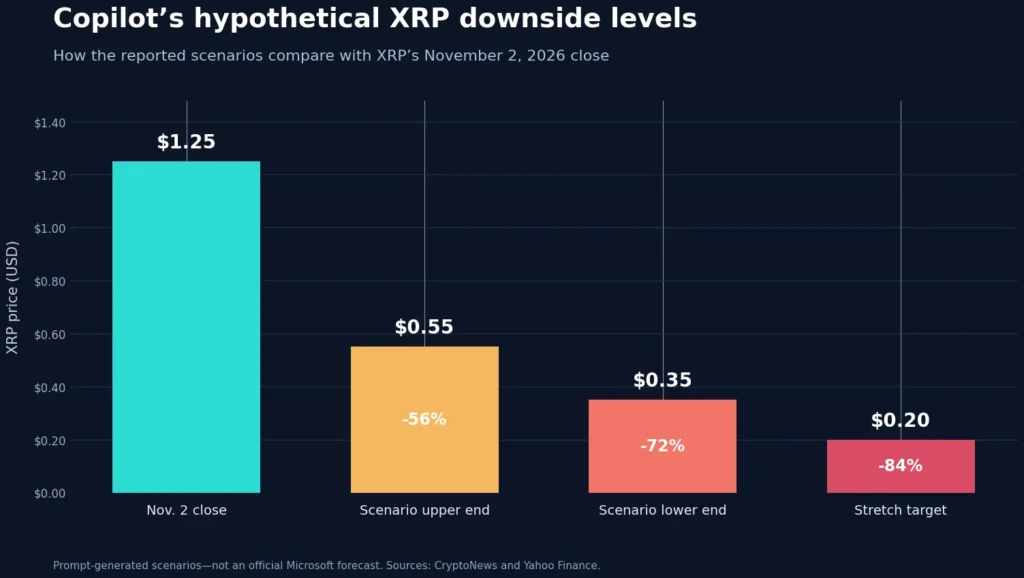
- Its reported $0.35–$0.55 range and $0.20 stretch target would represent declines of roughly 56%–84% from XRP’s November 2 close.
- The value of the exercise lies in examining the risks it identifies, not treating its price targets as established forecasts.

A dramatic price target can look like a firm forecast when it is separated from the question that produced it.
That distinction is essential when assessing Microsoft Copilot’s reported XRP crash scenario. According to CryptoNews, the chatbot was asked to imagine a hypothetical and unlikely black-swan event during the fourth quarter. Its answer explored what could happen under those assumptions—not what Microsoft expects to happen to Ripple or XRP.
The resulting targets are undeniably bearish. Under the most severe version of the scenario, Copilot suggested that XRP could trade between $0.35 and $0.55, with a stretch target toward $0.20 or lower by January 1, 2027. However, the original report also describes the exercise as speculation rather than a realistic base-case outlook.
What Would Have to Happen for XRP to Collapse?
The scenario depends on an extraordinary level of international coordination.
Major economies and international financial bodies would need to classify XRP as a high-risk or non-compliant asset for institutional cross-border settlement at roughly the same time. Banks and payment providers would then face new restrictions—or strong disincentives—against holding XRP or using the XRP Ledger.
That combination could theoretically reduce utility-driven demand, encourage institutions to reduce their exposure, and create sustained selling pressure.
In other words, this is not a scenario in which XRP simply experiences a difficult trading month. It requires a coordinated institutional retreat from the asset and its intended settlement use case. The reported prompt does not establish that such a decision is underway.
How Severe Would the Reported Targets Be?
XRP closed at approximately $1.2497 on November 2, 2026, according to Yahoo Finance market data.
Measured against that closing price:
- A decline to $0.55 would represent a fall of approximately 56%.
- A decline to $0.35 would represent a fall of approximately 72%.
- A decline to $0.20 would represent a fall of approximately 84%.
These percentages describe the scale of the hypothetical losses. They do not indicate the probability of those outcomes.
Why the Prompt Matters More Than the Headline
Generative AI systems respond to the framing supplied by the user. Ask for an extreme downside scenario, and the resulting answer will naturally concentrate on extreme downside conditions.
That does not make the exercise worthless. Scenario generation can help readers identify risks they might otherwise overlook, including regulatory fragmentation, institutional de-risking, weaker liquidity, and a broader retreat from speculative assets.
But there is a difference between mapping a possible risk and forecasting that the risk will materialize.
Microsoft itself cautions that Copilot responses can sound convincing while remaining incomplete or inaccurate. The company advises users to check the underlying sources and independently verify facts before acting on its responses.
ChainAIWire applied the same distinction when examining Copilot’s speculative $873,000 Bitcoin bull-case scenario. Different asset, opposite direction, same editorial rule: examine the assumptions before accepting the headline number.
What XRP Investors Should Actually Monitor
Rather than focusing exclusively on the $0.20 figure, readers can watch for verifiable developments that would support or weaken the scenario:
- Formal regulatory action: Are major jurisdictions introducing coordinated rules that specifically affect XRP or institutional use of the XRP Ledger?
- Institutional behavior: Are banks and payment providers publicly suspending XRP-related services, or are those relationships continuing?
- Network activity: Is there evidence of a sustained decline in relevant ledger usage and liquidity?
- Broader market conditions: Is capital moving out of altcoins generally, suggesting a market-wide contraction rather than an XRP-specific event?
Network developments should also be evaluated independently of AI-generated price narratives. For example, the XRP Ledger Foundation’s recent validator-list update concerns network governance and infrastructure; it neither proves nor disproves a future price scenario.
Copilot’s reported XRP crash scenario illustrates how a chatbot can construct a coherent argument around an extreme assumption. It does not demonstrate that Microsoft has turned bearish on Ripple, and it does not establish that an 84% collapse is likely.
The more useful question is not whether Copilot named a frightening number. It is whether the regulatory and institutional conditions required to reach that number are actually appearing. Until those assumptions are supported by evidence, the $0.20 target belongs in the category of stress testing—not established market forecasting.
This article is for informational purposes only and does not constitute financial advice.