Musk Says SpaceX Is on Track for $100B Run Rate in December, $500B by Late 2027
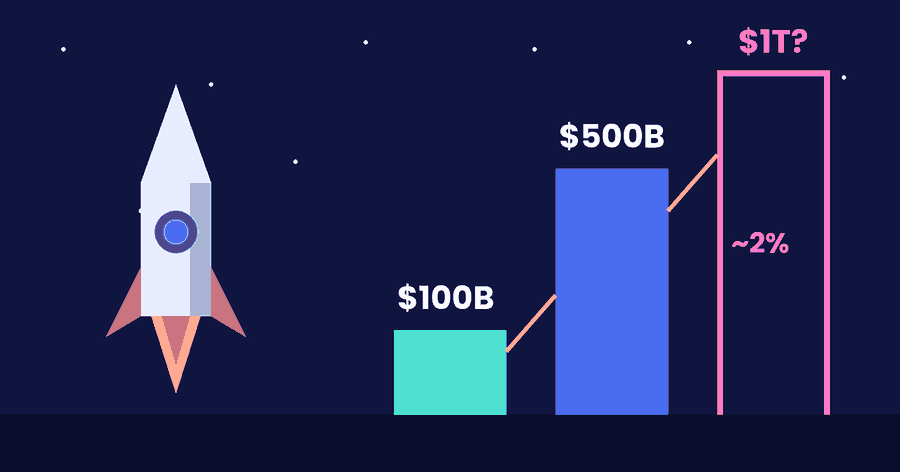
Musk says SpaceX is on track for a $100B revenue run rate in December and a best guess above $500B by late 2027, with $1T at about 2%.

Elon Musk told investors on Friday that SpaceX revenue is on track for an annualized rate above $100 billion in December, expects it to top $500 billion a year later, and gives a $1 trillion run rate about a 2% chance. He called the figures a best guess, not a promise.
Musk spoke in a fireside chat with Ron Baron at the 33rd annual Baron Investment Conference in New York, streamed on X by Baron Capital, as FourWeekMBA reported. SpaceX has traded on Nasdaq as SPCX since its June IPO.
Summary
- Musk said SpaceX is tracking to an annualized revenue rate above $100 billion in December 2026.
- His best guess is annual recurring revenue above $500 billion in December 2027.
- He put the chance of a $1 trillion run rate at maybe 2%, narrower than his October comment of $500 billion to $1 trillion.
- Wall Street analysts model far lower revenue, and spending on AI computing is the main pressure point.
Musk sets December target and a 70% fourth-quarter jump
SpaceX defines annual recurring revenue, or ARR, as December revenue multiplied by 12. Musk said December is close enough that he has good insight into the number, and that only a natural disaster or something similar would stop the company from meeting it.
He also said fourth-quarter revenue would probably rise “something like 70%” from the third quarter. Applied to the $14.58 billion reported for the third quarter, that implies roughly $24.8 billion, according to FourWeekMBA’s arithmetic. The outlet noted that its quotes come from its own machine transcript of the broadcast, not an official one.
A $500 billion best guess and a 2% shot at $1 trillion
For December 2027, Musk said ARR would likely exceed $500 billion, and stressed that this is what he thinks will happen, not something he is promising. He said a trillion dollars was previously out of the question and now is not, which he put at maybe 2%, while noting the odds are rising over time.
That is a narrower claim than the one he made on SpaceX’s Oct. 20 earnings call, when he said ARR by the end of 2027 would be “somewhere between $500 billion and a trillion,” according to Yahoo Finance. For scale, Amazon reported $716.9 billion in revenue for 2025 and Walmart reported $713.2 billion for its fiscal year ended January 2026.
You might also like: Musk claim that space is the cheapest place for AI resurfaces: where orbital data centers stand
What SpaceX’s third quarter shows
SpaceX’s revenue rose 161% year over year to $14.58 billion in the third quarter, with its AI business now the largest segment, according to BigGo Finance’s summary of the results.
| Segment | Q3 revenue | Year over year |
|---|---|---|
| Space (launch and development) | $1.77 billion | +6% |
| Connectivity (Starlink) | $5.25 billion | +69% |
| Super Intelligence (AI) | $7.56 billion | +830% |
| Total | $14.58 billion | +161% |
Operating income was $2.79 billion, while capital spending reached $19.59 billion, including $16.44 billion in the AI segment. Starlink added 1.6 million consumer subscribers to reach 13.6 million. Management guided to first-quarter 2027 revenue of $33 billion to $37 billion and fourth-quarter capital spending of $35 billion to $40 billion.
Analysts remain far below Musk
Thirty-seven analysts put average fiscal 2027 revenue at roughly $180 billion, 24/7 Wall St. reported. Morgan Stanley’s Adam Jonas forecasts $175 billion for 2027 and $289 billion for 2028, according to Tech Insider.
The two numbers are not a direct comparison. An ARR figure takes a single month and multiplies it by 12, while analysts model revenue for a full year, so a $500 billion run rate in December 2027 could sit alongside much lower revenue for 2027 as a whole. It still requires monthly revenue to rise roughly fivefold in a year.
Spending and debt are the pressure points
Growth in AI computing is costing a great deal. Deutsche Bank’s base case has capital spending across SpaceX’s businesses heading toward $200 billion and expects the company to raise more than $100 billion in new debt next year, according to Yahoo Finance. SpaceX has said it is targeting at least 13 gigawatts of computing capacity by the end of 2027.
Musk has argued the spending is worthwhile. Responding on X to a projection of $470 billion in outlays over five quarters, he said SpaceX’s capex efficiency is “greatly underestimated,” Stocktwits reported.
Investors remain divided. The stock has swung from a post-IPO high near $226 to a low around $105, and it fell on Nov. 4 as investors weighed what Democratic gains in the US midterm elections could mean for government contracts and data center spending, BigGo reported.
What to watch next
- Whether December revenue supports the $100 billion run rate, with fourth-quarter results expected in late January 2027.
- First-quarter 2027 results against the $33 billion to $37 billion guide.
- Customer disclosures behind the AI segment, which SpaceX has not named.
- Starship’s next flight, which analysts see as a key data point.
Read more: The X subscription explained: what Grok, Grok Bot and Cursor cost in one plan
This article is for information only and is not investment advice. Forecasts by company executives are not guarantees.