
GPT-6 Protein Design: OpenAI’s Model Designs Proteins That Bind in Lab Tests
OpenAI says its GPT-6 models can design new proteins using only reasoning and code. In lab tests with research partner Onava, 35 of 322 designed minibinders bound their targets — a 10.9% hit rate — but specialist biology models still supplied the sequences and filtered the candidates.
At a glance: OpenAI says its GPT-6 models can design new proteins using only reasoning and code. In lab tests with research partner Onava, 35 of 322 designed minibinders bound their targets — a 10.9% hit rate. The catch: specialist biology models still supplied the sequences and filtered the candidates. And the work is a preprint, not peer-reviewed.
A general-purpose chatbot just did something no general-purpose model had done in a wet lab before. It designed small proteins from plain language, and some of them actually stuck to their targets.
OpenAI published the results on 24 November, a week after it launched GPT-6.2 Astra and Sol. The research post, titled “GPT-6 models demonstrate intrinsic protein-design capabilities,” is backed by a preprint. It has not been peer-reviewed.
What did OpenAI actually show?
The claim is simple. GPT-6 can design a protein’s three-dimensional shape and its amino acid sequence using reasoning and general-purpose code, without calling a specialized biology model to generate the design.
That is a different job from chatting. Protein design means working out what shape a molecule needs, then which chain of amino acids folds into that shape. Until now, that work belonged to specialist tools like RFdiffusion and ProteinMPNN.
OpenAI tested its models on 14 protein tasks. Its latest internal model matched or beat the specialists on most of them, OpenAI says. The numbers are the company’s own, and the preprint is not yet independently verified.
What happened in the lab?
Computer scores are one thing. A lab is another. OpenAI worked with Onava, a biotech company, to make and test proteins based on GPT-6.2’s designs.
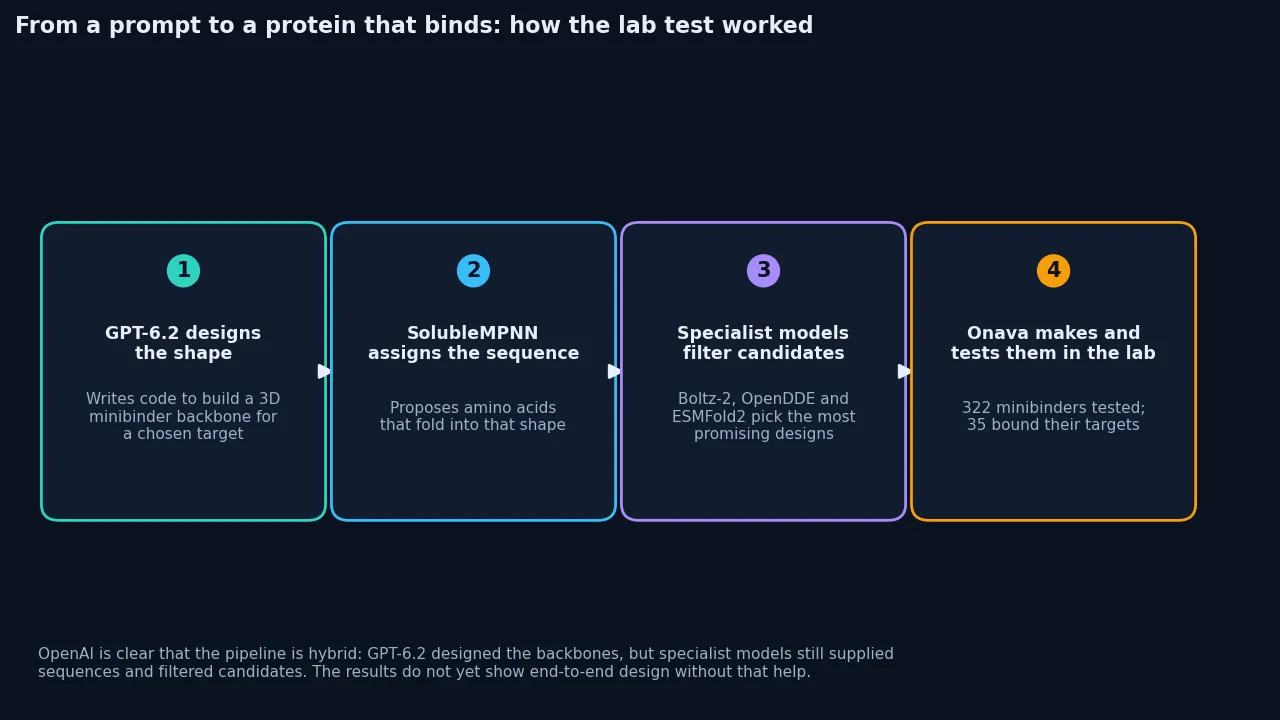
The headline experiment gave GPT-6.2 the 3D structures of five target proteins and marked where a small protein — a minibinder — should attach. The model wrote code to design candidate shapes. Then the lab made 322 of them and tested whether they bound.
Thirty-five did. That is 10.9%. Every target got at least one hit, but the spread was wide: 18 against IL-17A, 8 against VEGF-A, 5 against PD-L1, 3 against IL-7Rα, and just 1 against TrkA. PD-L1 is a protein some cancers use to evade the immune system.
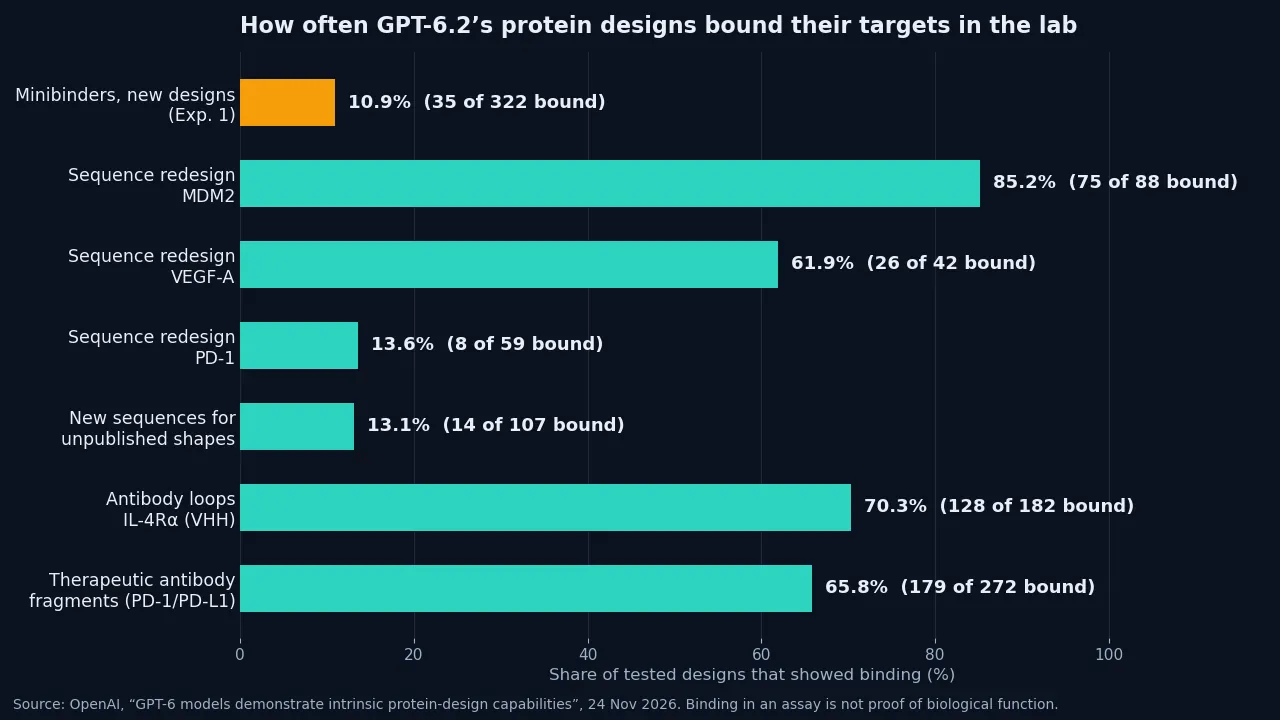
The second round of tests went better. GPT-6.2 was handed the 3D shape of an existing minibinder, without its original sequence, and asked to write a new one. Binding held in 75 of 88 designs for MDM2 (85%), 26 of 42 for VEGF-A (62%), and 8 of 59 for PD-1 (14%).
Antibodies held up best of all. Redesigned binding loops kept their grip in 128 of 182 small antibodies (70%), and 179 of 272 fragments from five therapeutic antibodies (66%) still bound PD-1 or PD-L1.
Takeaways:
- New designs from scratch are the hard part: 35 of 322 minibinders bound, a 10.9% hit rate.
- Rewriting sequences for known shapes works far better: up to 85% kept binding.
- Antibody redesign is the strongest result so far, at 66–70% binding retention.
- The specialist model RFdiffusion reported higher hit rates on new minibinders, OpenAI says — though hit rates depend heavily on how strictly designs are filtered before testing.
Where does GPT-6 beat the specialists?
On docking — predicting where a small molecule fits on a protein — GPT-6.2 looks strong. It matched the molecule’s observed position in 93% of PoseBusters predictions, against 50% for the specialist DiffDock-L. On the Scarpino set, where the model was told which two atoms form a bond, it hit 92% against DiffDock’s 60%.
Each generation got better at predicting how antibodies attach. The DockQ score climbed from about 0.05 for GPT-5.6 to 0.28 for GPT-6, 0.57 for GPT-6.2, and 0.81 for OpenAI’s latest internal model.
On motif scaffolding — building a protein around a fixed cluster of amino acids — the latest internal model passed 43.7% of designs, against 27.8% for RFdiffusion. On designing a whole protein to a requested fold, it passed 18.9%, just ahead of the specialist Proteina at 17.1%.
What can’t it do yet?
Here is the honest part. The pipeline is hybrid, not hands-off.
GPT-6.2 designed the backbones. A specialist model, SolubleMPNN, supplied the amino acid sequences for the first experiment. Other specialist models — Boltz-2, OpenDDE and ESMFold2 — filtered the candidates before anything reached a lab bench. OpenAI says so itself: the results do not yet show end-to-end design of new minibinders without that help.
Full structure prediction is still a clear weakness. Given only an amino acid sequence, the latest internal model scored 0.38 on TM-score, where 1.0 is a perfect match. The specialist ESMFold2 scored 0.93.
And binding is not a drug. OpenAI notes that binding in an assay says nothing about specificity, stability or biological activity, and the post publishes no affinity, potency or toxicity data. A protein that sticks to a cancer target has not yet been shown to do anything useful to the cancer.
Takeaways:
- GPT-6.2 designed the shapes. Specialist models still wrote the sequences and picked the candidates.
- Predicting a whole protein’s structure from its sequence remains far behind the specialists: 0.38 vs 0.93 on TM-score.
- Binding is only step one. No data yet on whether these proteins work as research tools, let alone medicines.
Why does this matter?
Because it points at programmable molecular design. OpenAI’s stated goal is to let scientists describe what they want a molecule to do in plain language, and get back candidates to test in the lab. One general model that can switch tasks by changing the prompt is far easier to steer than a chain of specialist tools, each with its own inputs and limits.
GPT-6 is not the only model stretching past chat this month. MemTensor and NVIDIA’s MemT-1.0-Pro stores conversation memory inside the model itself, Ant’s Ling-3.2-air puts a 124-billion-parameter multimodal model in open weights, and Baidu’s ERNIE 5.5 Flash Preview is open under Apache 2.0. The frontier is branching into science, memory and robotics, not just better chat.
OpenAI’s next steps are harder targets, designing for what happens after binding — such as killing a cancer cell — and a wider range of molecules, including RNA, small molecules and PROTACs. It also flags the biosecurity side: the same capability that designs medicines could be misused, and its Preparedness Framework governs how the risk is assessed.
Key numbers:
- 35 of 322 minibinders bound their targets (10.9%)
- 18 hits on IL-17A, the best target; 1 on TrkA, the hardest
- 85% of redesigned MDM2 sequences kept binding
- 93% on PoseBusters docking, vs 50% for DiffDock-L
- 0.38 TM-score on full structure prediction, vs 0.93 for ESMFold2
Read OpenAI’s research post for the full results, including the limits the company states itself.
Bottom line: GPT-6 can now design proteins that bind in a real lab — but the 10.9% hit rate and the specialist help it still needs say this is a first step, not a finished drug-design machine.
What is GPT-6 protein design?
GPT-6 protein design is OpenAI’s finding that its GPT-6 models can design new protein shapes and amino acid sequences using reasoning and general-purpose code, without calling a specialized biology model to generate the designs. OpenAI published the results on 24 November 2026 in a research post and a preprint, which has not yet been peer-reviewed.
How many of GPT-6.2’s designed proteins worked in the lab?
In lab tests with research partner Onava, 35 of 322 minibinders designed by GPT-6.2 bound their intended targets, a 10.9% hit rate, with at least one hit on each of the five targets. Redesigned sequences did better: 75 of 88 for MDM2 (85%), 26 of 42 for VEGF-A (62%) and 8 of 59 for PD-1 (14%).
Did GPT-6.2 design the proteins on its own?
No, not end to end. GPT-6.2 designed the three-dimensional backbones, but the specialist model SolubleMPNN supplied the amino acid sequences, and other specialist models (Boltz-2, OpenDDE and ESMFold2) filtered the candidates before lab testing. OpenAI says the results do not yet show end-to-end design without that help.
Does this mean GPT-6 can design new drugs?
No. Binding in a lab assay is not biological function, and OpenAI published no affinity, potency or toxicity data. The company says further work would need to establish specificity, stability and biological activity, along with safety and efficacy for therapeutic use.
Where can I read OpenAI’s original research?
OpenAI’s research post, ‘GPT-6 models demonstrate intrinsic protein-design capabilities’, is on openai.com, published 24 November 2026. The underlying preprint is titled ‘GPT-6 as a Universal Foundation Model for Protein Biology: Beyond Specialized Models’.