Toss Launches Non-Custodial Crypto Wallet for Its 30 Million Korean Users, With No Bitcoin Yet
South Korean finance app Toss launches a non-custodial wallet for ETH, USDT and USDC for its 30 million users. What it does, and what it does not.
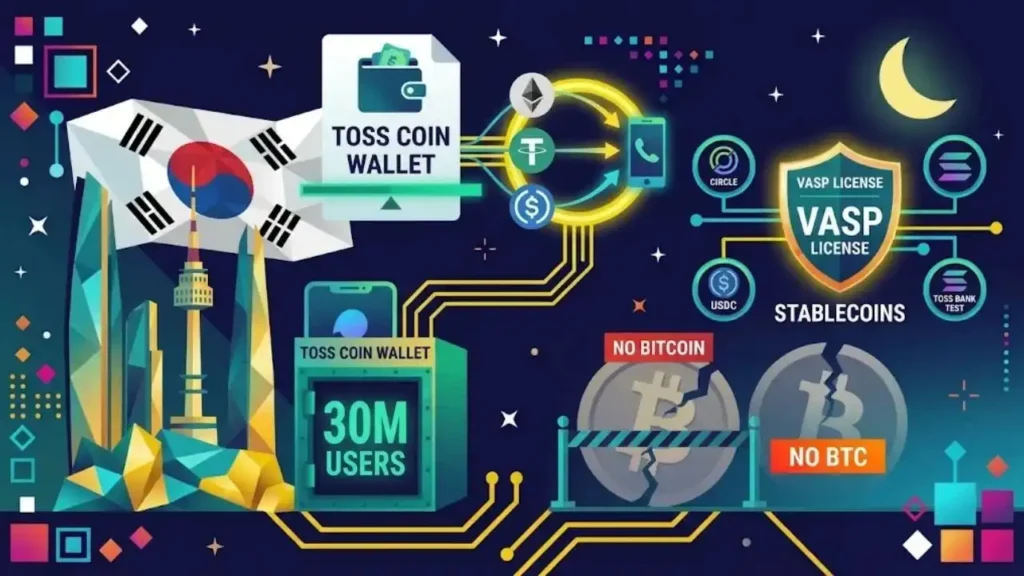
South Korean finance app Toss has launched a non-custodial crypto wallet, giving its roughly 30 million users a way to hold and send Ether, USDT and USDC without leaving the app. The wallet, called Toss Coin Wallet, is the first consumer crypto product from Toss operator Viva Republica.
Reports differ on timing. Viva Republica said on Nov. 16 that the wallet launches this week, according to Stablecoin Insider, citing Electronic Times, while PANews reported it as already live. Posts about the launch often show a Bitcoin logo, but Bitcoin is not among the supported assets.
Summary
- Toss Coin Wallet supports ETH, USDT and USDC on the Ethereum network, and users hold their own private keys.
- Any Toss user can create a wallet from the Assets menu, with no separate application or eligibility check.
- Toss charges no extra fee, but users still pay Ethereum network fees, and Toss is preparing a license application for stablecoin payments.
- Toss has not said how many people use the wallet, and Bitcoin is not supported at launch.

What Toss Coin Wallet does
Users can view balances and transaction history, and send and receive the three assets to and from other wallets and external exchanges, PANews reported, citing Edaily. Because the wallet is non-custodial, Toss does not hold user funds. That also means a lost key or a mistaken transfer cannot be fixed by the company.
The main convenience is contact-based sending. Instead of pasting a long wallet address, a user can pick a person from their phone contacts, according to crypto.news. Toss adds no transfer fee, though Ethereum gas fees still apply.
What it does not do yet
The wallet is not an exchange. It lets users move and hold the three assets but does not appear to offer trading or support for Bitcoin and other coins. It also runs on one network, Ethereum, which means gas fees on every move. Toss says it will add assets and networks gradually once the service is stable.
Why 30 million users matter
Toss says about 30 million people use its app, roughly 60% of South Korea’s population, according to 36Crypto. Most crypto products spend heavily to win users one by one. Toss starts with an installed base that does not need a new app or account.
Viva Republica executive Seo Chang-hoon has said “the core of stablecoins is distribution,” crypto.news reported. The company added that it is reviewing whether to shift to a custodial wallet if regulation pushes in that direction. A launch to 30 million users also does not mean 30 million will use it, and Toss has not disclosed usage.
The stablecoin groundwork
The wallet follows a series of stablecoin moves. Toss set up a dedicated digital-asset unit earlier this year and signed a memorandum of understanding with Circle, the USDC issuer, in July. In November, Toss Bank tested stablecoin remittances using USDC on Solana, Crypto Briefing reported. Toss is also exploring stablecoin payments through its own payment terminals and is preparing to apply for a virtual asset service provider, or VASP, license.
You might also like: Russia central bank approves Bitcoin, Ether and USDT trading for retail investors
What to watch next
- Whether Toss discloses how many users create a wallet.
- New assets and networks, and whether Bitcoin is ever added.
- The outcome of Toss’s VASP license application.
- How Korean regulators treat stablecoin payments from mainstream finance apps.
Read more: CZ at Oxford: “Every country will have to adopt crypto”
This article is for information only and is not investment advice. Self-custody wallets carry risks, including loss of access if keys are lost.