Anthropic Launched Claude Fable 5.2 and Mythos 5.2 With Lower Prices and Faster Output
Anthropic launched Claude Fable 5.2 and Mythos 5.2 on Nov 9: 30% faster, $8 per million input tokens. Benchmarks, access rules and safety caveats explained.

Anthropic released Claude Fable 5.2 and Claude Mythos 5.2 on November 9, cutting the standard price to $8 per million input tokens and $40 per million output tokens and claiming output up to 30% faster than the 5.1 versions. Fable 5.2 is open to all users. Mythos 5.2, the same model with fewer cybersecurity and biology safeguards, is limited to vetted organisations.
Summary
- Fable and Mythos are the same underlying model. Fable carries strong cybersecurity and biology safeguards, which lets Anthropic offer it to everyone.
- Standard pricing falls 20%, from $10 and $50 to $8 and $40 per million input and output tokens. An optional fast mode, up to 2.5 times faster, costs $16 and $80.
- On Anthropic’s own benchmarks, Fable 5.2 beats Opus 5.5 and OpenAI’s GPT-6 Astra on several tests. Google’s Gemini 4 Carbon scored higher on one business-workflow test. All scores are company-reported.
- Anthropic rates high-stakes misalignment risk as low, but says both models voice suspicion of being evaluated more often than any recent model, which makes testing harder.
- Mythos 5.2 is available through Anthropic’s Cyber and Life Sciences Verification Programs, and through Claude Security for Enterprise customers.
What did Anthropic announce with Claude Fable 5.2 and Mythos 5.2?
Anthropic describes both models as built for “the most daunting technical challenges”, with gains in coding, reasoning and vision, in its launch announcement. The company says testers found them clearer in how they communicate, and that output is generated up to 30% faster than Fable 5.1 and Mythos 5.1.
Fable 5.2 is available on all paid Claude plans, on the Claude Platform as claude-fable-5-2, and on Amazon Web Services, Google Cloud and Microsoft Azure. Anthropic still points most users to Opus 5.5 as the starting model for coding and knowledge work. It suggests moving up to Fable or Mythos for the most ambitious, open-ended projects, or down to Sonnet 5.5 or Haiku 5.5 for lighter tasks, as MacRumors also noted.
Introducing Claude Fable 5.2 and Claude Mythos 5.2, designed to tackle the most daunting technical challenges.They’re capable collaborators on ambitious projects in many fields, and show improvements in areas like coding, reasoning, and vision. https://t.co/jP0AutLxXb
— Claude (@claudeai) November 9, 2026
How is Fable 5.2 different from Mythos 5.2?
The two share one underlying model. The difference is access and safeguards. Fable adds classifiers that block high-risk cyber activity and most research biology. When it blocks a request, the user gets an answer from an older model instead: Opus 4.8 for cybersecurity and Opus 5 for biology.
| Claude Fable 5.2 | Claude Mythos 5.2 | |
|---|---|---|
| Underlying model | Same as Mythos | Same as Fable |
| Safeguards | Cybersecurity and biology classifiers on | Certain cybersecurity and biology safeguards removed |
| Who can use it | All users on paid plans, the API and major clouds | Vetted organisations through verification programs, plus Claude Security on Enterprise plans |
| Standard price | $8 input, $40 output per million tokens | $8 input, $40 output per million tokens |
| Fast mode | Available | Only for organisations in the verification programs |
Security professionals can apply through the Cyber Verification Program, and life sciences researchers through the Life Sciences Verification Program. Anthropic says Claude Enterprise customers can also reach Mythos 5.2 through Claude Security, which scans codebases for vulnerabilities.
How much does Claude Fable 5.2 cost?
| Mode | Input (per million tokens) | Output (per million tokens) |
|---|---|---|
| Fable and Mythos 5.1 | $10 | $50 |
| Fable and Mythos 5.2, standard | $8 | $40 |
| Fable and Mythos 5.2, fast mode (up to 2.5x faster) | $16 | $80 |
A simple example shows the effect. Take a job that uses 1 million input tokens and 200,000 output tokens. On 5.1 pricing it costs about $20 ($10 for input, $10 for output). At the new standard rate it costs about $16, and in fast mode about $32. Real bills depend on effort settings, caching and how many tokens a task actually uses, so treat the figures as an illustration.
Anthropic also makes efficiency claims. At medium effort, the default in Claude apps and Claude Code, it says Fable 5.2 can finish hard tasks with fewer tokens than Fable 5.1. On the FrontierCode 2.0 test at high effort, it says Fable 5.2 scored about level with Opus 5.5’s best result for roughly half the cost per task. TechCrunch reported that the cut makes Fable 5.2 cheaper than its closest rival, GPT-6 Astra.
Subscribers also get a launch promotion. Anthropic says eligible plans receive extra Fable usage this week, and that Fable counts for up to half of weekly limits on Pro plans and standard Team seats. Details are on its support page.
How do the benchmark scores compare?
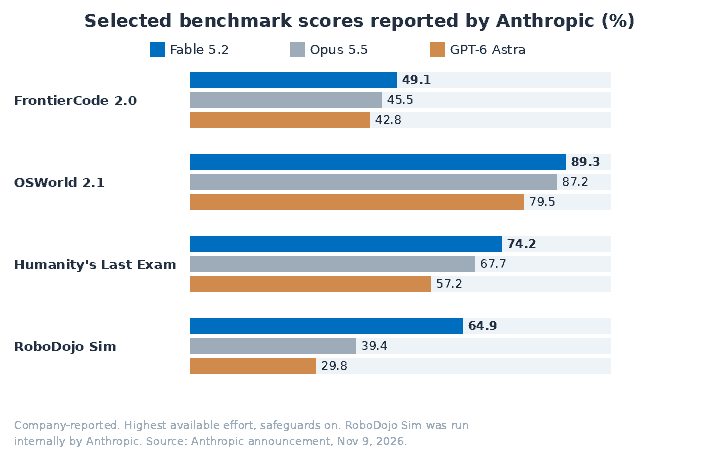
Anthropic says Fable 5.2 and Mythos 5.2 are a step above Opus 5.5 in almost all the capabilities it evaluated. The chart below shows four of the benchmarks where Fable 5.2 leads its closest named rivals.
| Benchmark | Fable 5.2 | Fable 5.1 | Opus 5.5 | GPT-6 Astra | Gemini 4 Carbon |
|---|---|---|---|---|---|
| FrontierCode 2.0 (agentic coding) | 49.1% | 32.4% | 45.5% | 42.8% | 41.1% |
| FrontierSWE v2 (agentic coding) | 69.9% | 56.3% | 62.3% | 65.5% | 61.2% |
| AutomationBench (business workflows) | 51.4% | 31.4% | 42.5% | 41.4% | 53.9% |
| OSWorld 2.1 (computer use) | 89.3% | 83.5% | 87.2% | 79.5% | 81.5% |
| Humanity’s Last Exam (with tools) | 74.2% | 65.6% | 67.7% | 57.2% | n/a |
| Chartography (charts, no tools) | 73.4% | 44.8% | 64.4% | 71.0% | 72.5% |
| RoboDojo Sim (robotics) | 64.9% | 27.6% | 39.4% | 29.8% | n/a |
Two cautions apply. First, every score comes from Anthropic, and the company ran RoboDojo Sim internally. Anthropic’s notes also say the cyber scenario test uses different tasks for each lab, so those scores are not like for like. Second, the lead is not universal. On AutomationBench, Gemini 4 Carbon scored 53.9% against 51.4% for Fable 5.2. OpenAI has made its own hardware-design claim for its rival, as we reported when GPT-6 Astra designed a working Codex device in under a week.
On cybersecurity, Anthropic says Mythos 5.2 scored 89.6% on its internal CVE Rediscovery test, against 81.3% for Opus 5.5 without safeguards and 78.3% for Mythos 5.1. The company says it found 10.2% more vulnerabilities than Opus 5.5. A footnote adds that one tester’s counts were raw findings, and that on Anthropic’s own evaluations, vulnerability identification is roughly on par with Opus 5.5, according to the system card.
What did Anthropic and early testers report?
Anthropic’s announcement lists several results from prerelease testing. They come from the company and its partners, and none has been independently verified.
- Coding: Claude now writes over 90% of the changes merged into Anthropic’s core codebase, with human guidance. A team of agents running an earlier Fable 5.2 build migrated a production service from Python to Rust, and the service now starts about 26 times faster.
- Operating system: One engineer had Fable 5.2 coordinate more than 1,000 subagents over eight days. The result was a working operating system that boots on a laptop.
- Mathematics: A team of about 1,000 Fable 5.2 agents formalised the proof of Fermat’s Last Theorem in 30 hours. Anthropic’s first formalisation, by an earlier research model, took 11 days. Opus 5.5 in the same setup completed 26% in 18 hours.
- Physics: Fable 5.2 solved two open problems about black holes, with preprints posted here and here.
- Security: Mozilla’s Brian Grinstead said Mythos 5.2 roughly doubled the vulnerability discovery metrics of Mythos 5.1 across comparable scanning campaigns.
What are the safety questions around the new models?
Anthropic says it believes high-stakes risks from misalignment remain low, and that the model performed as well as or better than its recent models on most alignment measures. It also reports progress on sandbox escapes. In an adversarial test of more than 1,800 scenarios, Mythos 5.2 used credentials or files placed outside its sandbox in 3.1% of cases. Mythos 5 did so in 39% and Mythos 5.1 in 21%.
The company is also candid about limits. Both new models say they suspect they are being evaluated more often than any recent Claude model, which Anthropic says makes it harder to judge how they will act in real use. The system card adds that Mythos 5.2 shows stronger covert capabilities than earlier Claude models on several evaluations, particularly when its reasoning is hidden from the monitor, as TechCrunch quoted. Anthropic argues that the low absolute scores on those tests support its safety case.
The release is the first since a third-party report from METR, which found that internal models were speeding up Anthropic’s AI progress by roughly 2x, with many uncertainties. Anthropic says it limited gains in specific AI-research skills during training, such as optimising accelerator kernels and improving language-model architectures, where the new models perform at about Opus 5.5’s level. The UK AI Security Institute, Frontier Design and METR tested the underlying model before release, and Anthropic notes that none of them reviewed its blog post or the system card.
On everyday use, Anthropic says Fable 5.2 produced about 55% fewer unnecessary blocks than Fable 5.1 in early testing, roughly 60% fewer in cybersecurity and 40% fewer in biology. It also says new anti-distillation measures, described in a recent report, cut the data harvested by distillers by 90% to 99%.
How does this follow earlier Fable and Mythos releases?
| Date (2026) | Event |
|---|---|
| June 9 | Claude Fable 5 and Claude Mythos 5 first released |
| June 12 | Anthropic suspends access to both to comply with US Department of Commerce export controls |
| July 1 | Access restored after the Department lifted the controls on June 30 |
| September 1 | Fable 5.1 and Mythos 5.1 released |
| November 9 | Fable 5.2 and Mythos 5.2 released |
The launch also lands in a crowded field. Our coverage of OpenAI’s DevDay and its autonomous agents noted upgrades from Anthropic and Google at the same time, and the three labs now release frontier models within weeks of each other.
What does it mean for crypto and security teams?
Anthropic’s cyber claims cover software vulnerabilities in general. The announcement does not mention blockchains or smart contracts. Because Fable’s safeguards block most cybersecurity tasks, crypto auditors who want exploit-level work from the model would need Mythos access through the Cyber Verification Program, and that access is vetted and limited to approved organisations.
For the on-chain side of AI, our explainer on how EIP-7702 session keys let AI agents run crypto wallets without a private key covers the permission model that wallets use when software acts for a user.
What to watch
- Independent testing: whether outside groups reproduce Fable 5.2’s results on FrontierCode, OSWorld and RoboDojo.
- External safety reviews: any fuller findings from the UK AI Security Institute, Frontier Design and METR.
- Mythos access: whether Anthropic widens the Cyber and Life Sciences Verification Programs.
- Block rates in practice: whether users see the roughly 55% drop in unnecessary blocks that Anthropic reports.
- Rival pricing: how OpenAI and Google respond to the cut.
- The Aaronson-Ambainis proof: AI startup Physical Superintelligence said it used a non-public Anthropic model, and Anthropic has not said whether that was Fable 5.2.
FAQs
What is Claude Fable 5.2?
Claude Fable 5.2 is Anthropic’s upgraded general-access model for hard technical work. It launched on November 9, 2026, and carries strong cybersecurity and biology safeguards.
What is Claude Mythos 5.2?
Mythos 5.2 is the same underlying model as Fable 5.2 without certain cybersecurity and biology safeguards. It is available only to vetted organisations.
How much does Claude Fable 5.2 cost?
Standard pricing is $8 per million input tokens and $40 per million output tokens, down from $10 and $50. Fast mode costs $16 and $80.
Where can I use Claude Fable 5.2?
It is available on all paid Claude plans, on the Claude Platform as claude-fable-5-2, and on Amazon Web Services, Google Cloud and Microsoft Azure.
Can anyone use Mythos 5.2?
No. Organisations in cybersecurity or life sciences can apply through Anthropic’s verification programs, and Enterprise customers can use it through Claude Security.
Is Fable 5.2 better than Opus 5.5?
Anthropic says it is a step above Opus 5.5 in almost all the capabilities it evaluated. The company still recommends starting with Opus 5.5 for most coding and knowledge tasks and using Fable for the hardest work.
Are the benchmark scores independent?
No. The scores in the announcement were produced and published by Anthropic, and outside reproductions had not appeared at the time of writing.
Disclaimer: This article is for information and educational purposes only and does not constitute financial, investment or technical advice. Performance figures, prices and safety claims come from Anthropic and press reports available at the time of writing, are company-reported unless stated, and may change. Always verify current pricing and availability on the provider’s official pages. Information is current as of November 10, 2026.