BNB Chain Unveils a New Layer 1 Built for 200-Millisecond Blocks, Private Finance and AI Agents
BNB Chain has published the litepaper for a new Layer 1 built for high-frequency trading, real-time payments, private finance and autonomous AI agents: 200-millisecond blocks, 20-millisecond pre-confirmations, a 100,000 TPS design target — and no new token.

BNB Chain has published the litepaper for a new Layer 1 designed for high-frequency trading, real-time payments, private finance and autonomous AI agents a second chain that runs alongside BNB Smart Chain, keeps BNB as its only native token, and targets 200-millisecond blocks with transaction pre-confirmations in about 20 milliseconds. The document, published on 26 Novembe, is the clearest statement yet of where the exchange-linked chain thinks blockchains need to go next: fast enough for a trading desk, private enough for a treasury, and programmable enough for software that spends money on its own.
The speed pitch is specific
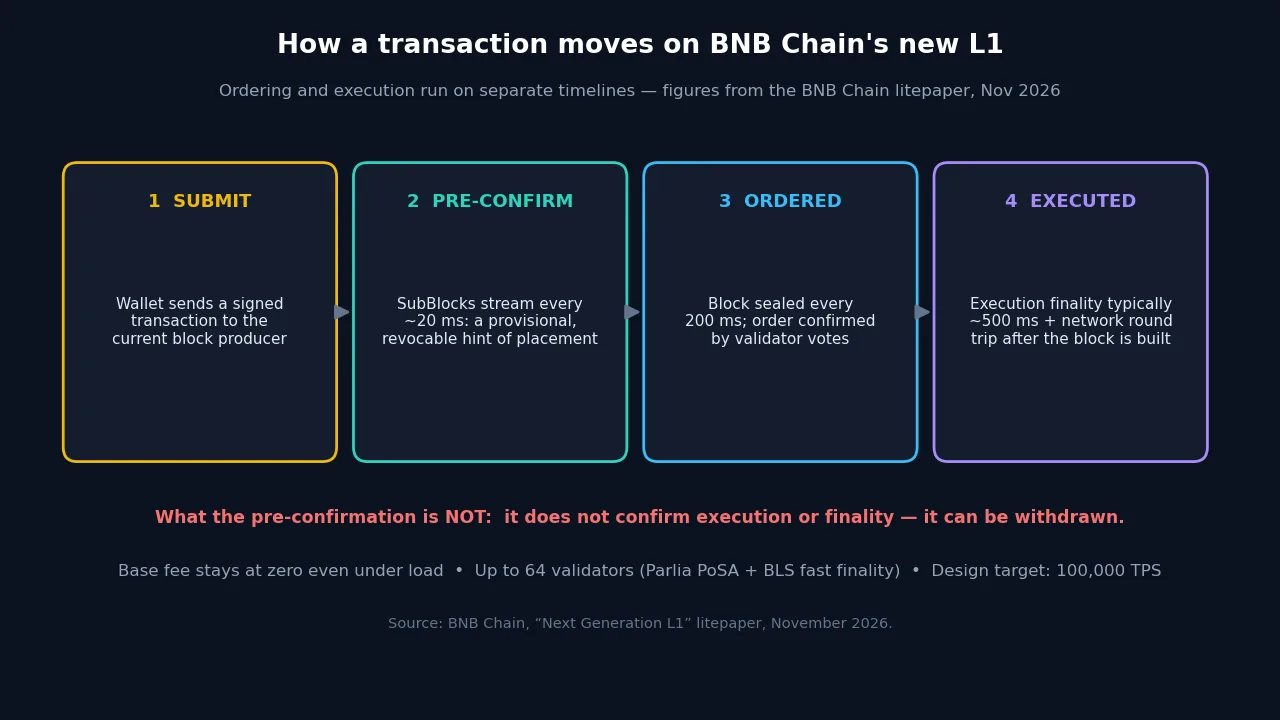
The headline numbers are unusually precise for a design document. Blocks arrive every 200 milliseconds under Parlia proof-of-staked-authority consensus with aggregated BLS signatures, small groups of transactions called SubBlocks stream to applications at roughly 20-millisecond intervals, and execution finality typically follows in about 500 milliseconds plus network round-trip time. The design arget is 100,000 transactions per second. For comparison, BNB Chain’s own 2026 roadmap put BNB Smart Chain at a 450-millisecond block interval in June, with benchmark throughput of about 5,200 transactions per second.
The mechanism behind the speed is a separation of ordering and execution onto different timelines. Validators can order a new block while the previous one is still executing, which keeps the pipeline full but the litepaper is candid about the limit. Under heavy load, execution can lag by up to eight blocks, at which point block production pauses to let execution catch up. Sustained demand still has to fit the network’s processing capacity, and the 100,000 TPS figure is a design target, not a measured result: nothing here has been tested on a public network yet.
| Feature | Design target | Status |
|---|---|---|
| Block interval | 200 milliseconds | Core design |
| SubBlock pre-confirmation | About 20 milliseconds, provisional and revocable | Core design |
| Execution finality | About 500 milliseconds plus network round-trip time | Core design |
| Throughput | 100,000 transactions per second | Design target, untested |
| Validators | Up to 64, Parlia proof-of-staked-authority with BLS fast finality | Core design |
| Base fee | Zero, even under load | Core design |
| Parallel EVM execution | Planned extension | Planned |
| TEE ordering gateway | Protected ordering inside a trusted execution environment | Proposed |
| Shielded pool and AtomicCall | Private settlement for BNB and admitted BEP-20 tokens | Core design |
| Official BSC bridge | Cross-chain bridge to BNB Smart Chain | Ready with Devnet-2 |
Pre-confirmation is not confirmation
The 20-millisecond figure needs careful reading, because it is the number most likely to be quoted out of context. A SubBlock gives an application an early, best-effort indication of where its transaction is expected to land and the litepaper says plainly that the indication can be withdrawn and does not confirm successful execution or finality. Applications must check the receipt and the finalized execution result before acting on a state change. That distinction matters most for payments and bridge releases, where acting on a provisional signal would be expensive.
Transactions also take a different route into the network. Instead of broadcasting into a public mempool, they go straight to the current block producer through a mechanism called TxStream, which removes the window that front-running and other forms of harmful MEV exploit. A proposed trusted-execution-environment gateway would go further, protecting transaction contents before ordering but that gateway is proposed, not built, and its protection depends on trusted hardware and correct attestation. The ordering design is the part of the litepaper with the most caveats attached, and the caveats are doing real work.
Reserved capacity and a different state design
Two quieter design choices may matter as much as the raw speed. The first is Multi-Lane, which reserves a share of block capacity for eligible activity such as payments, oracles, liquidations and bridges, so a rush elsewhere cannot crowd out the traffic that needs to land. Unused reserved capacity returns to the general lane, and a reserved share does not guarantee that any individual transaction meets its deadline but it changes who competes with whom for blockspace, which is the practical problem for a payment flow during a busy market.
The second is a redesigned state commitment. The new chain replaces the traditional Merkle-Patricia trie with a flat key-value store under an incremental lattice-hash commitment, which updates only the entries that change and reduces the work of recording state as the chain grows. The trade-off is stated openly: the new commitment does not provide the account and storage membership proofs that applications may expect from a Merkle-based state tree, so applications that depend on such proofs need an explicitly supported verification path. It is a genuine engineering trade, not a free lunch.
Accounts built for agents
The feature that ties the litepaper to the AI-agent economy is native account abstraction. Passkeys, delegated authority, batching and fee sponsorship are built into the protocol itself, validated directly by nodes without a separate bundler or EntryPoint contract. An application can sponsor the network fee so a user can interact without holding BNB first, and a paymaster can quote reimbursement in a stablecoin while paying the underlying fee in BNB. Most importantly for agents, an account owner can grant an agent permission to perform a task within limits the owner sets — and revoke it.
That is a bet on a trend already visible on BNB Smart Chain, where 330,604 AI agent registrations were recorded in October about 61% of the ERC-8004 registrations tracked across blockchains. It is also a crowded bet: Flop Network’s AI-agent chain opened its public testnet this week, and the Aave App is already selling onchain finance to ordinary savers with no wallet to manage. The new L1’s answer is to make the agent permissions part of the chain rather than part of an ap — and to make the economics plain: the base fee stays at zero even under load, but fees are charged on the declared gas limit, including when application execution fails, so accurate gas estimation directly affects what a user or sponsor pays.
Private money, public apps
The litepaper’s most distinctive idea is its privacy design. A shielded pool, proven with a unified zero-knowledge STARK, holds BNB and admitted BEP-20 tokens as private notes, and a mechanism called AtomicCall lets shielded assets fund selected public operations — a supported swap, for example — without exposing who owns the assets. The limits are spelled out alongside the promise: public calls and some settlement details remain visible, AtomicCall does not cover every application interaction, and the design makes no unconditional withdrawal guarantee through every failure state. Users can grant scoped viewing access to selected information without giving anyone permission to spend their assets, which is the disclosure model a treasury or a regulated fund would actually need.
What exists today, and when the rest arrives
Right now the new L1 runs as a multi-validator development network, and the official bridge to BNB Smart Chain is ready for launch with Devnet-2. The planning targets in BNB Chain’s own documentation, dated 2 November, put the public testnet in the first quarter of 2027 and mainnet in the second half of 2027 — explicitly subject to testing and release readiness, not committed launch dates. That is already a slip from the July roadmap, which aimed for a public testnet by late 2026 and mainnet in early 2027. The litepaper invites builders and researchers to bring feedback to the BNB Forum, which is the honest signal: this is a design under discussion, not a launch.
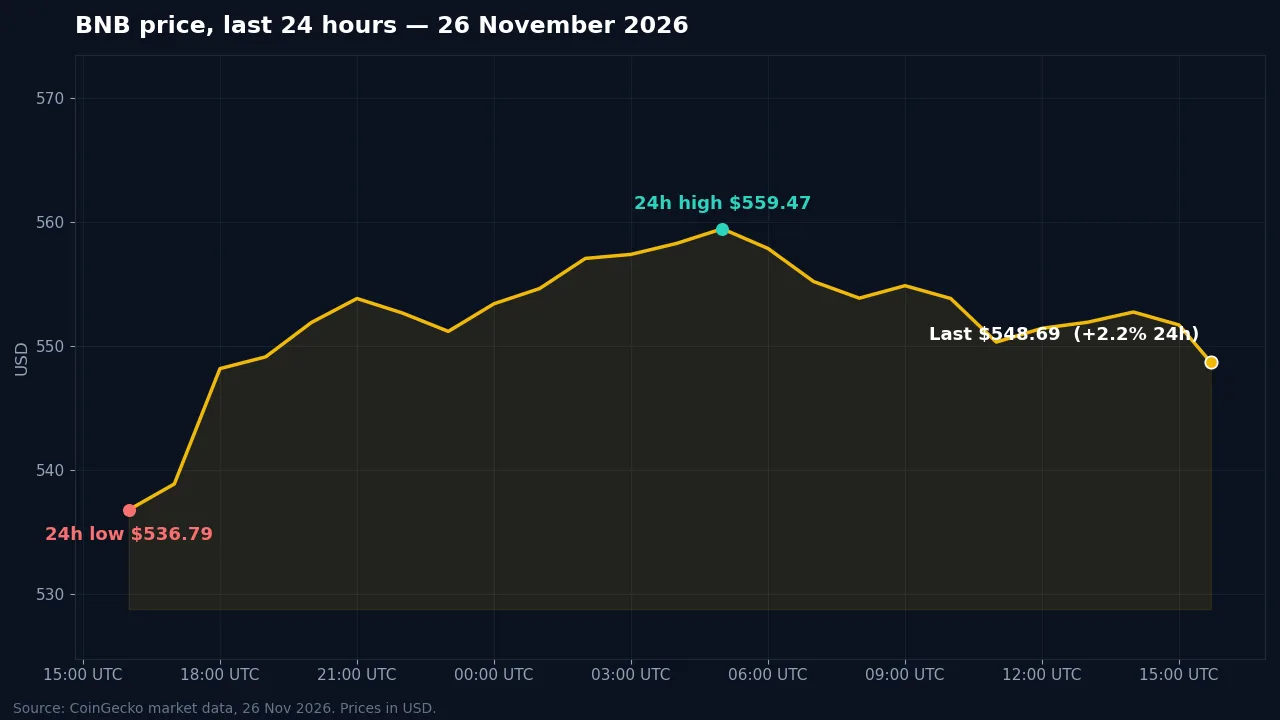
The timing also lands in the middle of a fast-chain race. SBI Solana Global launched this week with Japan’s largest banks building stablecoin payments and tokenized assets on Solana, and LayerZero’s ATLAS trading infrastructure goes live on 30 November. Fidelity has filed for a spot Chainlink ETF that would hold LINK directly, a reminder that institutional crypto is moving in parallel. BNB itself traded at $548.96 at the time of writing, up about 2.7% over 24 hours — a modest move on a day when the chain, not the token, was the news.
What to watch
Whether the first-quarter 2027 testnet date holds — it has alread slipped once, from late 2026.
Whether independent performance data backs the 100,000 TPS design target once real users can test it, and how the eight-block execution lag behaves under genuine load.
Whether developers build on it: parallel EVM execution is planned, the TEE ordering gateway is only proposed, and a new chain needs liquidity and applications, not just a litepaper.
What is BNB Chain’s new L1?
A new EVM-compatible Layer 1 blockchain published as a litepaper by BNB Chain on 26 November 2026. It is designed for high-frequency trading, real-time payments, private finance and autonomous AI agents, and it runs alongside BNB Smart Chain rather than replacing it. BNB is the native token; there is no new token.
When will BNB Chain’s new L1 launch?
The new L1 currently runs as a multi-validator development network. BNB Chain’s partner-facing planning targets, dated 2 November 2026, are a public testnet in the first quarter of 2027 and mainnet in the second half of 2027, subject to testing and release readiness. These are planning targets, not committed launch dates.
Will there be a new token for the new L1?
No. BNB remains the native asset for fees, staking and governance on the new L1, and the litepaper states there is no separate native network token.
What does a 20-millisecond pre-confirmation actually guarantee?
Very little on its own. A SubBlock gives an application an early, provisional indication of where its transaction is expected to be placed, and that indication can be withdrawn. It does not confirm execution or finality, so applications must verify the receipt and the finalized execution result before acting.
How is the new L1 different from BNB Smart Chain?
BNB Smart Chain remains the ecosystem’s broad-base network. The new L1 is a separate chain that combines new rules — 200-millisecond blocks, SubBlock pre-confirmations, reserved capacity lanes, native account abstraction and a shielded pool — in one protocol, without requiring existing BSC applications to change.