Amini’s Soma-1X Lite Turns Paper Records Into Structured Data — on a Single GPU
Amini has released Soma-1X Lite, a 2-billion-parameter open-weight model that turns paper documents into structured, machine-readable data — scoring 84.7 on olmOCR-Bench and running on a single GPU.

Amini has released Soma-1X Lite, a 2-billion-parameter open-weight model that turns paper documents into structured, machine-readable data. The model went live on Hugging Face on 25 November 2026, alongside a press release from Bridgetown, Barbados, and a technical write-up from the company itself.
Note that this is not another general-purpose chatbot model. Soma-1X Lite does one job: it reads a page — a typed form, a handwritten letter, a table, a faded scan — and returns its content with its layout intact, so the result can go straight into a database instead of sitting in a filing cabinet.
What Soma-1X Lite does
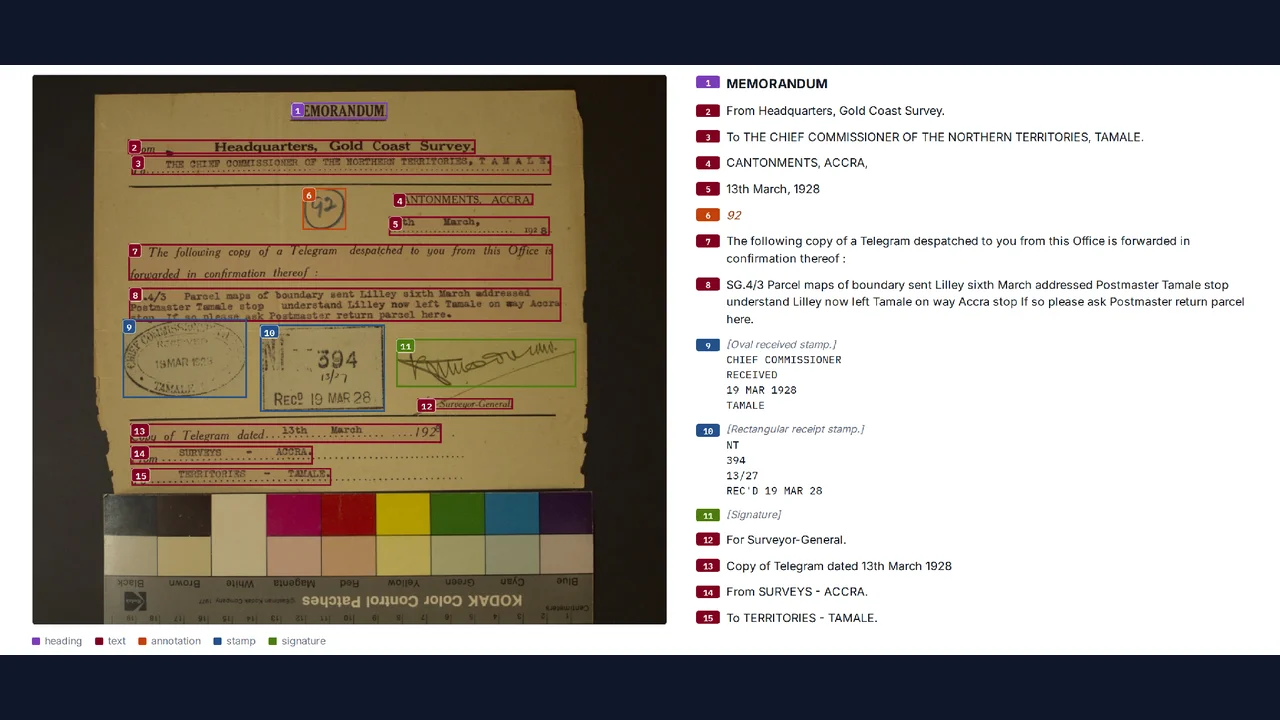
Soma-1X Lite is a vision-language model built for document intelligence. Give it an image of a document and it returns each element — headings, paragraphs, tables, equations, stamps, signatures — with a semantic label, a bounding box and its place in the reading order. Tables come out as HTML and mathematical expressions as LaTeX, so the output is usable without a second round of cleanup.
The model is small enough to run on a single GPU inside an institution’s own infrastructure, which is the point. Amini’s argument is that governments and archives should not have to send sensitive records to an outside service to make them searchable. The weights, inference instructions and evaluation code are all public, under the Apache 2.0 licence, and the model is available now on Hugging Face.
How it was trained
Soma-1X Lite was trained in two stages. First came supervised fine-tuning, where the model learned to produce structured document representations across different layouts and languages. Then came reinforcement learning with verifiable rewards, using Group Relative Policy Optimisation (GRPO) — a method that works well here because many properties of a document parse, such as whether the text matches and the table structure holds, can be checked objectively against ground truth.
Alongside real records, Amini built Soma-Sim, a programmable engine that generates synthetic documents with controlled layouts, multilingual content, complex tables and degraded scans, each with exact ground-truth annotations. When an evaluation or a deployment exposes a failure mode, Soma-Sim generates targeted training examples for it. The approach grew out of Amini’s own work over the past year digitising millions of government records in private, sovereign environments — handwritten police diaries and cabinet papers in Barbados, geological maps and mineral resource records in Botswana — with domain partners such as ROAD in Barbados.
What the numbers say
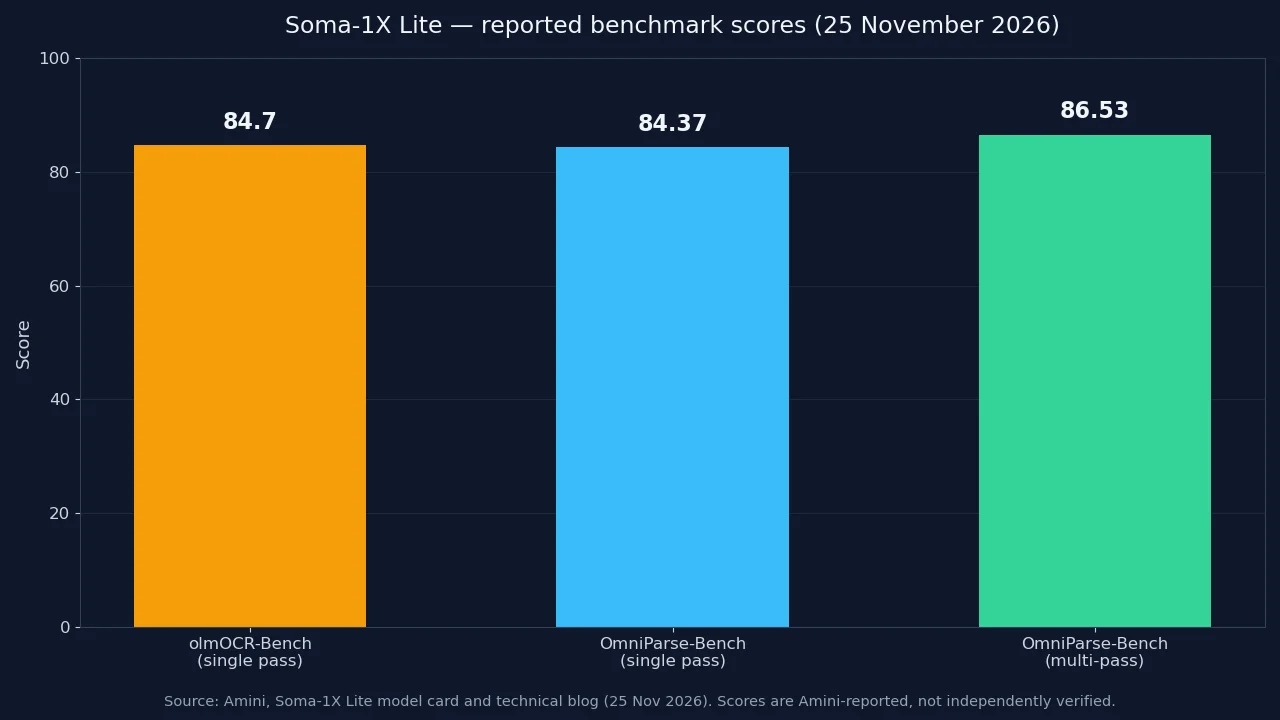
On the public benchmarks, Amini reports 84.7 on olmOCR-Bench, which tests document transcription across tables, mathematical content, multi-column layouts and historical scans. On OmniParse-Bench, which tests text, table structure and layout understanding, the model scores 84.37 in a single pass and 86.53 with a multi-pass harness that reprocesses difficult regions, with the largest gain on tables, up 5.0 points. These are Amini’s own reported figures, not independently verified results, and the comparison charts Amini published place the 2B model alongside much larger frontier systems.
The more distinctive result is in languages that most document models handle badly. Amini evaluated Soma-1X Lite against four other open-weight document models on 435 held-out pages spanning ten African languages, including Swahili, Yoruba, Hausa and Wolof. Soma-1X Lite recorded the lowest mean character error rate, 2.90%, and the best result in seven of the ten languages. The detail that matters here is not just the average: Yoruba uses dotted letters such as ẹ, ọ and ṣ, Hausa uses hooked letters including ɓ, ɗ and ƙ, and Lingala uses open vowels ɛ and ɔ. A model can score well overall while silently dropping exactly the characters that carry meaning, and Amini’s test was designed to catch that.
| Figure | Soma-1X Lite (Amini-reported) |
|---|---|
| Parameters | 2 billion |
| olmOCR-Bench | 84.7 |
| OmniParse-Bench, single pass | 84.37 |
| OmniParse-Bench, multi-pass | 86.53 |
| Mean character error rate, ten African languages | 2.90% (best in 7 of 10) |
| Throughput | Up to 15,000 pages per hour on one NVIDIA RTX PRO 6000 GPU |
| Estimated compute cost | About $0.22 per 1,000 pages; about $224 per million pages |
| Licence | Apache 2.0 |
On cost, Amini says the model processes up to 15,000 pages per hour on a single NVIDIA RTX PRO 6000 GPU, which works out at roughly $0.22 per 1,000 pages at an on-demand cloud rate of about $3.36 per hour — around $224 in compute to process a million pages. That is Amini’s own estimate, built on its own benchmark runs, and the press release frames the model as beating frontier systems on a leading public document benchmark at a tenth of their cost. The claim is Amini’s, and it rests on the company’s own charts rather than an independent head-to-head.
What it doesn’t mean
- It is not a frontier model. Soma-1X Lite is a specialist: it parses documents. It is not built to reason, write or code at the level of the large general-purpose systems it is compared against on one benchmark.
- The benchmarks are the vendor’s own. The olmOCR-Bench and OmniParse-Bench scores, the African-language error rates and the cost figures all come from Amini’s evaluations. They have not been independently reproduced, and the African-language test set is Amini’s own internal collection.
- It does not solve digitisation by itself. A model that reads a page still needs scanning, storage, search and access control around it. Soma-1X Lite removes one bottleneck — turning paper into structured data — not the whole pipeline.
- Open weights are not the same as a finished product. The model ships with code and instructions, and it can be served through vLLM with an OpenAI-compatible API, but running it still takes a GPU, some setup and someone responsible for the results.
Why it matters beyond the benchmark
The release is worth watching for a reason that has little to do with the leaderboard. Most of the world’s institutional memory still sits on paper: land records, court files, health registers, colonial archives. The countries that hold those records often have the least access to the infrastructure that would make them usable, and the models that could read them tend to be trained on English and a handful of European languages. A small model that runs on one GPU, handles Yoruba diacritics and Hausa hooked letters, and keeps the records inside the country’s own systems is a different proposition from a slightly higher score on a benchmark.
As Amini puts it in its launch post: “capable document intelligence should be accessible to institutions without requiring frontier-scale infrastructure or sending sensitive records to external services.” That is the bet behind Soma-1X Lite, and it is also the test it will be judged on — not whether a 2B model can match a frontier system on a chart, but whether archives and ministries can actually run it on their own hardware and trust what it reads.
The timing fits a wider pattern in open-weight releases. The past week has brought a run of small, specialised models built to run where the data already is: Ant Ling’s Ling-3.2-air, a 124B open-weight multimodal model; Baidu’s ERNIE 5.5 Flash Preview, open-sourced under Apache 2.0; Z.ai’s GLM-5.4, a vision-capable flagship; and SenseTime’s SenseNova U1.6, an image model that checks its own work. Soma-1X Lite is the smallest of the group, and the most narrowly aimed.
What to watch
Whether independent users reproduce the benchmark scores once the weights are in wider hands, and whether the olmOCR-Bench leaderboard confirms the 84.7 figure. Whether Amini follows through on the larger Soma models it has signalled, and whether the multilingual coverage expands beyond the ten African languages tested so far. And whether any government or archive publishes a real deployment — a million pages processed in production would tell us more than any benchmark.
This article is for information only and is not financial advice.
What is Amini Soma-1X Lite?
Soma-1X Lite is a 2-billion-parameter open-weight vision-language model from Amini that turns paper documents into structured, machine-readable data, preserving text, layout, semantic elements and reading order. It was released on 25 November 2026 under the Apache 2.0 licence.
How accurate is Soma-1X Lite?
Amini reports 84.7 on olmOCR-Bench and 84.37 on OmniParse-Bench in a single pass, rising to 86.53 with multi-pass inference. On 435 held-out pages across ten African languages, it recorded a mean character error rate of 2.90%, the lowest of the five open models Amini evaluated. All figures are Amini-reported and have not been independently verified.
What hardware does Soma-1X Lite need?
Amini says Soma-1X Lite can process up to 15,000 pages per hour on a single NVIDIA RTX PRO 6000 GPU, at an estimated compute cost of about $0.22 per 1,000 pages. It can be served through vLLM with an OpenAI-compatible API.
Is Soma-1X Lite free to use?
Yes. Soma-1X Lite is released under the Apache 2.0 licence, with the model weights, inference instructions and evaluation code available on Hugging Face at AminiTech/Soma-1X-lite.
Which languages does Soma-1X Lite handle?
Soma-1X Lite handles widely spoken languages such as English, French and Spanish, and Amini highlights its performance on underrepresented African languages including Swahili, Yoruba, Hausa, Wolof and Lingala, preserving language-specific characters and diacritics such as Yoruba ẹ, ọ and ṣ and Hausa ɓ, ɗ and ƙ.