PrismML’s Ternary Bonsai 2.5 Puts a 27B Coding Model in 5.9GB — and It Runs on Your Phone
PrismML's Ternary Bonsai 2.5 27B packs a 27-billion-parameter coding model into 5.9GB using ternary weights. Its SWE-bench Verified score jumped from 60.8 to 75.6, and it runs on Mac, iPhone and iPad — free under Apache 2.0.

At a glance: PrismML released Ternary Bonsai 2.5 27B on 24 November, a 27-billion-parameter coding model squeezed into 5.9GB. Its SWE-bench Verified score jumped from 60.8 to 75.6, and its AppWorld tool-use score nearly doubled, from 51.2 to 90.5. It runs on a Mac, an iPhone or an iPad, with no cloud and no per-token bill. The weights are free under Apache 2.0.
What is Ternary Bonsai 2.5?
It is an upgrade to Ternary Bonsai 2, the model PrismML released in September.
It is based on Qwen3.8 27B, the same base model as before. The trick is compression. Each weight is stored as one of three values — minus one, zero or plus one — instead of a full-precision number. That is what ternary means, and it is how 27 billion parameters fit in 5.9GB.
The size did not change. The capability did. PrismML rebuilt the model for long sequences of tool calls: reading a result, adjusting when a step fails, and keeping the goal in mind through the whole task. It also fixed two habits of the old model — excessive thinking and repetitive loops. Tasks now finish in fewer turns, with fewer tokens.
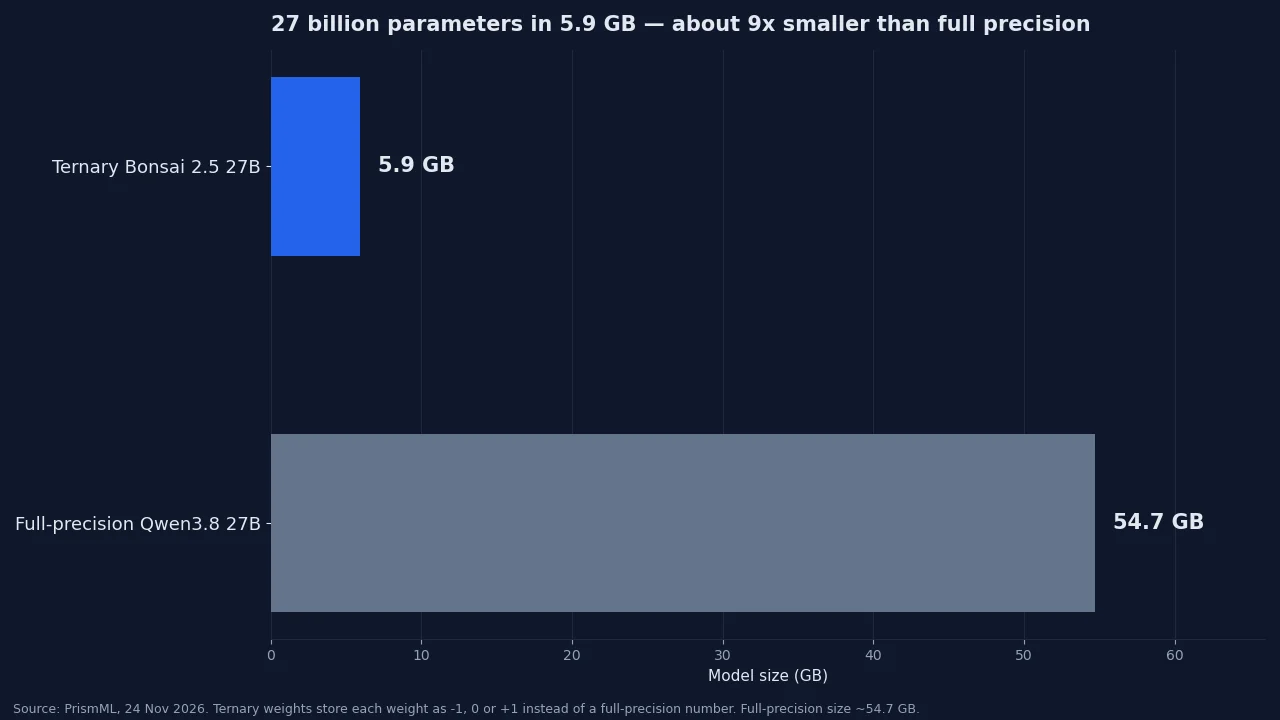
- Same footprint, stronger model. 5.9GB, unchanged from Bonsai 2 — the gains come from training, not size.
- Built for agents, not chat. The focus is multi-step tool use on private files, on your own device.
- Free to download. Apache 2.0, available since 24 November.
How much better is it?
A lot, on the tests that matter for coding agents. PrismML reports gains on six of the seven benchmarks it highlights.
SWE-bench Verified, the standard test of fixing real software issues, rose from 60.8 to 75.6. The full-precision base model scores 80.6, so Bonsai 2.5 has closed most of the gap that compression opened. AppWorld, which tests tool use across apps, jumped from 51.2 to 90.5 — within three points of the base model’s 93.2. DeepSWE, where Bonsai 2 scored zero, now reads 27 against the base model’s 30.1. And on τ³-Bench, Bonsai 2.5 beats the full-precision model outright, 73.9 to 72.8.
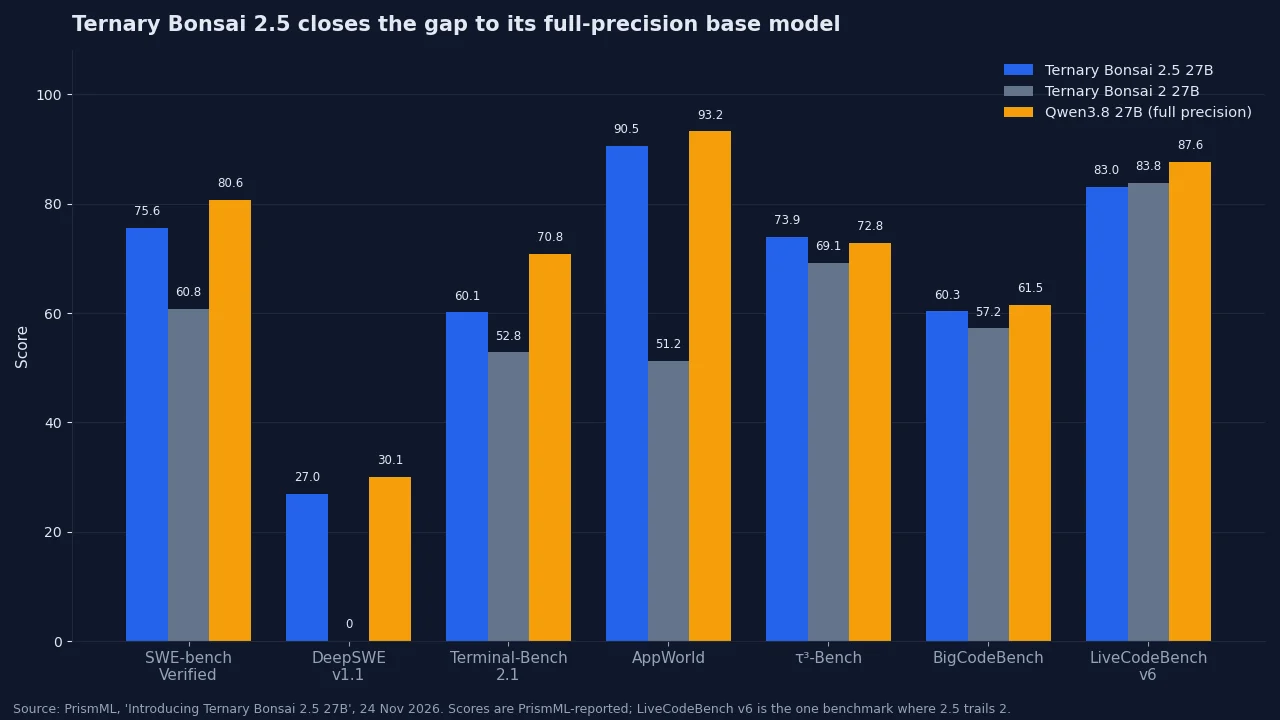
Across the three agentic coding benchmarks, the average score rose from 37.9 to 54.2. Across the two tool-calling benchmarks, it rose from 60.2 to 82.2. One benchmark went the other way: LiveCodeBench v6 dipped slightly, from 83.8 to 83.0. PrismML published the full table, dip included.
- Key numbers: SWE-bench Verified 75.6 (was 60.8) · AppWorld 90.5 (was 51.2) · DeepSWE 27 (was 0) · Terminal-Bench 2.1 60.1 (was 52.8) · LiveCodeBench v6 83.0 (was 83.8, the only fall).
- The honest read: it still trails the full-precision base model on five of seven tests. But the gap is now small, and on one test it wins.
- All scores are PrismML’s own. No independent evaluation exists yet.
What can it run on?
Almost anything you already own. It runs on NVIDIA and Intel GPUs through llama.cpp, and on Mac, iPhone and iPad through MLX. The Apple silicon package is about 8.9GB.
Speed is the surprise. PrismML reports 291 tokens a second on a single NVIDIA H100 with multi-token prediction, and 204 tokens a second on a consumer RTX 4090. In the company’s demo, the model reproduces and fixes a pytest regression entirely offline, working through the failure, running the tests and revising its fix without sending anything to a server.
That is the use case PrismML is selling: a coding assistant that reads a private repository, or a document app that summarises sensitive files, with nothing leaving the device. PrismML is a small team of Caltech researchers backed by Khosla Ventures, Cerberus, Google and Samsung. It drew attention in July when chief executive Babak Hassibi told CNBC that Apple was evaluating its technology, after it claimed the first model of this size to run on an iPhone.
- No cloud needed. Coding help and document work can run fully on-device.
- Fast enough to feel instant. 204 tokens a second on a consumer GPU, per PrismML.
- Private by design. Your files never leave your machine.
What does it cost?
Nothing for the weights. Bonsai 2.5 is free under Apache 2.0, downloadable since 24 November. There is no API, no per-token price and no subscription. You pay for the hardware you already own, and PrismML offers paid help to teams that want the model tuned for their own applications.
It joins a run of open-weight releases this month, from Tencent’s Hy4 to China Telecom’s Xing4.1 and the K2-Horizon fleet. The difference is the size. Those models need data-centre hardware. Bonsai 2.5 needs a laptop.
What’s the catch?
Compression still costs something. Bonsai 2.5 trails its full-precision base on most benchmarks, and the LiveCodeBench dip shows the trade-off is real, even if it is small.
Every score above comes from PrismML’s announcement, not an independent test. The speed figures are the company’s own, measured with multi-token prediction. And a 27B model, however compressed, is still a mid-size model — it will not match frontier models on the hardest reasoning. What it offers instead is a capable coding agent that runs in your pocket, for free, with your data staying yours.
- Still behind full precision. Five of seven benchmarks trail the base model.
- Vendor numbers only. Wait for independent runs before treating the scores as settled.
- Mid-size, not frontier. It trades peak capability for size, speed and privacy.
Bottom line: Bonsai 2.5 is the first version of this idea that is actually good enough to use — a 27B coding agent in 5.9GB, free, on your own device.
What is Ternary Bonsai 2.5 27B?
Ternary Bonsai 2.5 27B is PrismML’s open-weight coding model, released on 24 November 2026. It is based on Qwen3.8 27B and uses ternary weights — each weight stored as -1, 0 or +1 — to squeeze 27 billion parameters into a 5.9GB footprint, about nine times smaller than the full-precision model.
How good is Ternary Bonsai 2.5 at coding?
According to PrismML’s own benchmarks, Bonsai 2.5 scores 75.6 on SWE-bench Verified, up from 60.8 for Bonsai 2 and close to the full-precision base model’s 80.6. Its AppWorld tool-use score jumped from 51.2 to 90.5. No independent evaluation exists yet, so these are vendor-reported figures.
Can Ternary Bonsai 2.5 run on a phone?
Yes. It runs on Mac, iPhone and iPad through MLX, with an Apple silicon package of about 8.9GB, and on NVIDIA and Intel GPUs through llama.cpp. PrismML says it delivers 204 tokens a second on a consumer RTX 4090. Its first Bonsai model was claimed in July 2026 to be the first model of its size to run on an iPhone.
Is Ternary Bonsai 2.5 free?
Yes. The weights are free under the Apache 2.0 licence, downloadable since 24 November 2026. There is no API, no per-token price and no subscription; you run it on your own hardware.