Google DeepMind’s Humanity’s First Exam Exposes the Reliability Gap in Frontier AI Models
Google DeepMind's Humanity's First Exam asks frontier models to answer simple questions correctly every time. GPT-6.2 Astra leads at 92.4% family pass⁴, but the top five average just 85.8% — and vision failures cause 73% of wrong answers.

Google DeepMind launched a new benchmark on 24 November that asks frontier AI models to do something they are supposed to find trivial: answer simple questions correctly, every single time. The result is a leaderboard that looks nothing like the ones the industry is used to. The best model in the world, OpenAI’s GPT-6.2 Astra, scores 97.8% when asked once — and 92.4% when it has to get every variation right. The gap between those two numbers is the point of Humanity’s First Exam, the first benchmark built to measure the reliability floor of large language models rather than their capability ceiling.
The test measures consistency, not capability
Humanity’s First Exam, or HFE, is a set of 544 elementary text and image prompts spread across 20 foundational capabilities: reading, counting, comparing, following directions and describing what is in a picture. The prompts are organised into 136 families. Each family starts with one seed question and adds three controlled variants that preserve the underlying task while changing the entities, the clause order or the visual layout. A model only passes a family by getting all four prompts right across repeated draws, a measure DeepMind calls family pass⁴. A softer measure, family pass@4, counts a family as passed if any attempt succeeds. The difference between the two is the Family Reliability Gap, and it is the number the benchmark exists to expose.
The questions are easy on purpose, and the screening was strict. DeepMind started from 315 candidate families and kept only those whose seed question was solved by at least three of four independent human raters. Single-rater human accuracy on the retained seeds was 90.8%. Only 112 of the 544 prompts are public, released under a CC-BY-4.0 licence; the other 432 stay private to limit contamination and overfitting. The example DeepMind publishes gives the flavour: a photograph of a neon sign, with the instruction to list the colour of the third letter of each word in order. The answer is green; yellow; white; blue; blue. Another asks how many coffee mugs in the foreground do not have steam rising from them. The answer is four. Both are straightforward for a person, and both are the kind of question frontier models get wrong.
The leaderboard in full
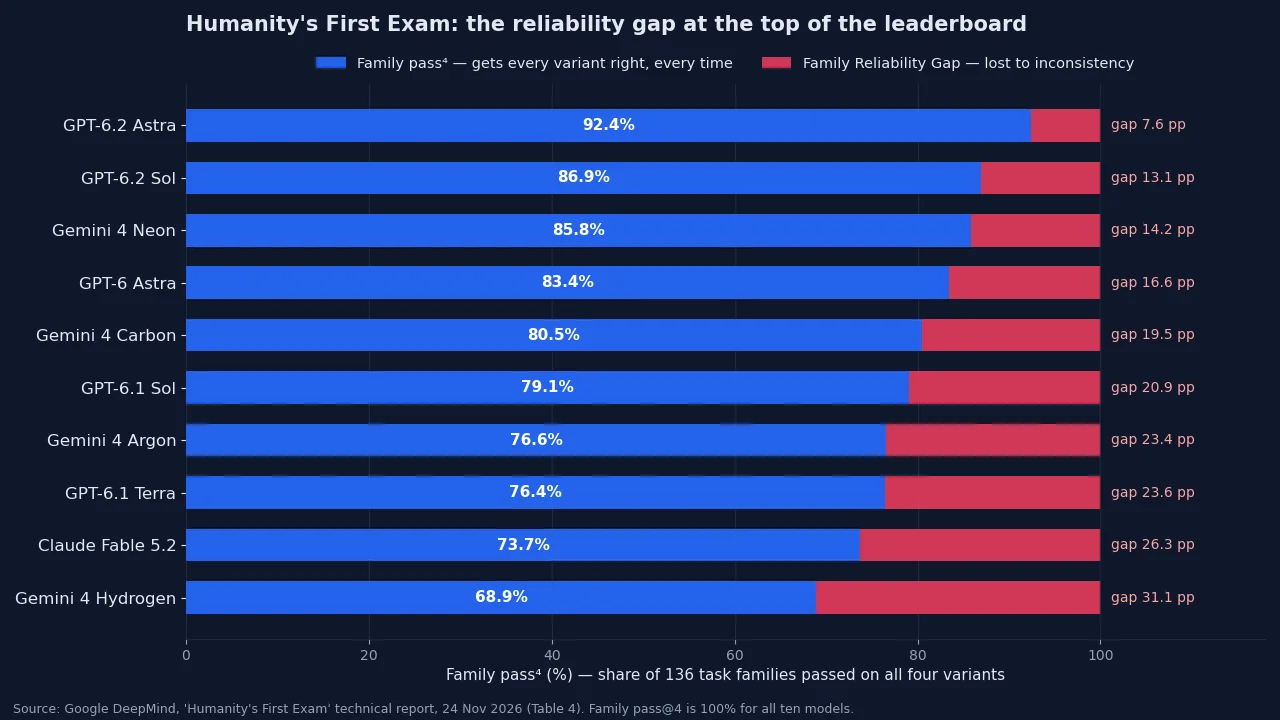
DeepMind’s technical report evaluates 18 frontier and fast-tier models from OpenAI, Google and Anthropic. The top five score between 95.6% and 97.8% on a single attempt, and all five reach 100% on family pass@4. Yet on family pass⁴ — the measure that demands every variation right, every time — they average only 85.8%. GPT-6.2 Astra leads at 92.4%, a full 5.5 points clear of GPT-6.2 Sol in second. Gemini 4 Neon, Google’s own mid-tier model, takes third at 85.8%. Anthropic’s best entry, Claude Fable 5.2, ranks ninth at 73.7%, with a reliability gap of 26.3 points. The bottom of the field falls away fast: GPT-6 Luna manages 25.6% and Gemini 3.5 Flash-Lite 18.6%, leaving an 80.1-point gap between what it can do once and what it can do reliably.
| Rank | Model | Effort | Pass@1 | Family pass@4 | Family pass⁴ | Reliability gap |
|---|---|---|---|---|---|---|
| 1 | GPT-6.2 Astra | xhigh | 97.8% | 100.0% | 92.4% | 7.6 pp |
| 2 | GPT-6.2 Sol | xhigh | 97.3% | 100.0% | 86.9% | 13.1 pp |
| 3 | Gemini 4 Neon | xhigh | 96.8% | 100.0% | 85.8% | 14.2 pp |
| 4 | GPT-6 Astra | xhigh | 96.8% | 100.0% | 83.4% | 16.6 pp |
| 5 | Gemini 4 Carbon | high | 95.6% | 100.0% | 80.5% | 19.5 pp |
| 6 | GPT-6.1 Sol | xhigh | 96.1% | 100.0% | 79.1% | 20.9 pp |
| 7 | Gemini 4 Argon | high | 94.1% | 100.0% | 76.6% | 23.4 pp |
| 8 | GPT-6.1 Terra | xhigh | 94.7% | 100.0% | 76.4% | 23.6 pp |
| 9 | Claude Fable 5.2 | max | 93.4% | 100.0% | 73.7% | 26.3 pp |
| 10 | Gemini 4 Hydrogen | xhigh | 92.5% | 100.0% | 68.9% | 31.1 pp |
One detail in the table deserves attention. The gap is not a rounding error on a hard test. Family pass@4 sits at 100% for the entire top ten, which means every one of these models can solve every family at least once. What they cannot do is solve every family every time. That distinction is the difference between a model that impresses in a demo and a model an organisation can build a workflow on, and it is a distinction no mainstream benchmark measured until now. The live Kaggle leaderboard, which runs the same test under slightly different sampling settings, currently lists Astra at 90.7%, Sol at 87.5% and Neon at 85.6% — the same order, slightly lower numbers.
Vision is where the floor gives way
The failures are not spread evenly. DeepMind’s failure analysis attributes 73% of wrong-answer rollouts to visual perception, including 31% involving position, direction or paths in images and 23% involving object counting. The pattern shows up in the category breakdown. The top nine models reach 83% to 97% family pass⁴ on text-only families, but only 64% to 89% on multimodal ones. GPT-6.2 Astra is the most even performer, dropping just 8 points between text and images; Claude Haiku 5.5, Gemini 4 Hydrogen and Claude Fable 5.1 lose 45 points or more. On vision tasks alone, Astra scores 90.2% while Gemini 4 Carbon — near-identical to Astra on maths at 97.5% — falls to 69.9%.
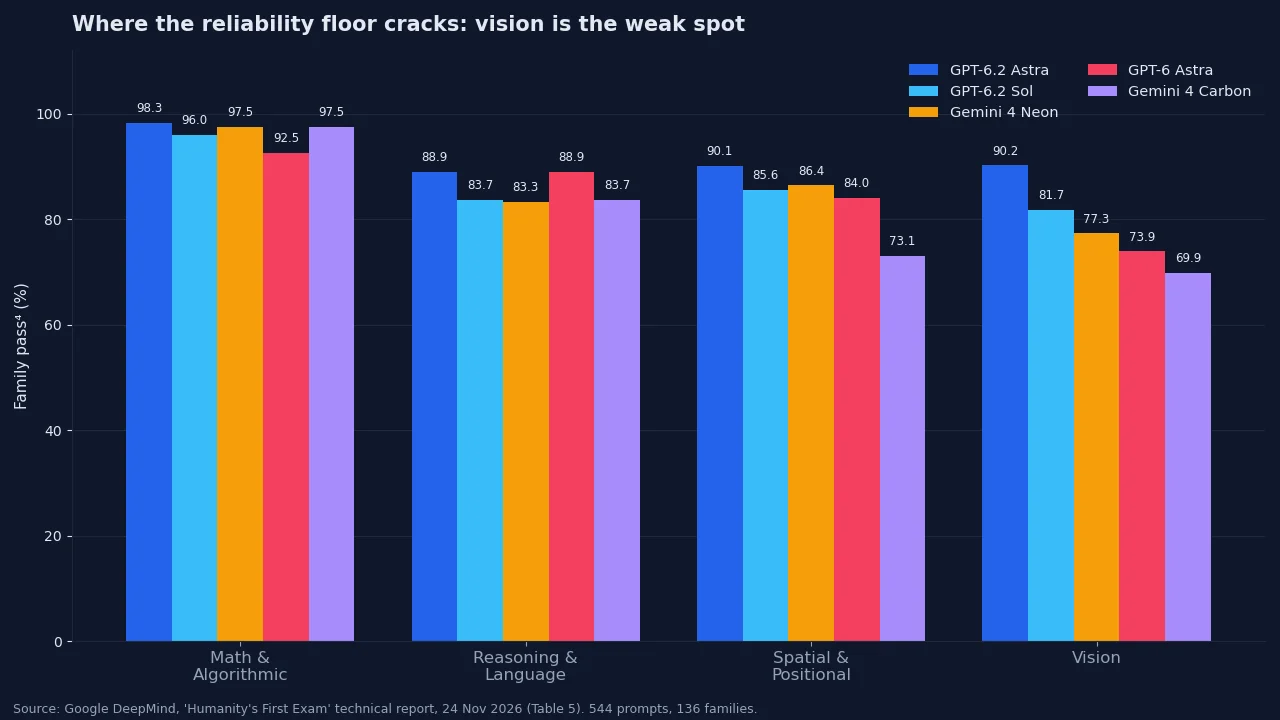
That split matters because it is not a capability problem in the usual sense. The models can see the images well enough to answer correctly most of the time; they fail to see them the same way twice. In 83 of the 122 families where at least two models fail, a single prompt accounts for at least half of all failed rollouts. In one spatial reasoning family, 15 of the 18 models fail the same variant while the other three prompts in the family account for only 11 failed rollouts between them. The models are not missing a skill. They are tripping over the same step, repeatedly, while getting the steps around it right.
More thinking helps — mostly on text
Raising the reasoning effort lifts the reliability floor, not the capability ceiling. Family pass@4 stays close to 100% at both low and high effort, while family pass⁴ rises by 17.4 points on Gemini 4 Carbon, from 63.1% to 80.5%, and by 32.3 points on Claude Sonnet 5.5, from 35.3% to 67.6%. But the gains are uneven in a revealing way. On Carbon, cutting effort from high to low costs 42.4 points on maths and algorithmic tasks and only 3.1 points on vision tasks. Extra thinking fixes arithmetic. It barely helps eyesight, which suggests the vision failures are perceptual rather than a matter of not reasoning long enough.
Some models barely need the extra effort at all. Gemini 4 Neon and Gemini 4 Hydrogen are statistically flat between low and maximum effort, and GPT-6 Astra loses only 2.5 points at low effort. GPT-6.2 Astra, GPT-6.2 Sol and Gemini 4 Argon lose between 18.1 and 19.9 points when thinking is dialled down. The practical reading is that the most reliable models are not necessarily the ones that think longest; they are the ones whose first answer is already the right one, most of the time.
Humans fail differently
The human comparison runs in the opposite direction to the model results, which is the paper’s most striking finding. Humans are least accurate on maths and algorithmic seeds, at 76%, and most accurate on vision seeds, at 84%. Models show the reverse order, from 98% on maths to 83% on vision. Across the subcategories with enough data, human and model accuracy are negatively correlated. Humans are least accurate on logical deduction, which models almost always solve, while models are among the least accurate on object counting and reading text in images, which are among the easiest tasks for people. And human agreement does not predict model accuracy: seeds that all four raters solved are no easier for models than seeds solved by three, at 89% versus 93% pass@1. The test is easy for people in exactly the places it is hard for models.
What the benchmark does not prove
HFE is a stress test, not a census of everyday failure, and DeepMind says so in the report. The tasks were adversarially selected to expose blind spots rather than sampled uniformly from everyday queries, so the scores do not estimate how often models fail in ordinary use. Most multimodal prompts pair text with Gemini-generated images, the grading relies on a single Gemini autorater family, and human testing covered the seeds rather than the full families. The benchmark also scopes itself to single-turn tasks with no tools, so it says nothing directly about agentic workflows — though, as staff at OpenAI and Anthropic have warned about their most powerful unreleased models, reliability under repeated, slightly varied conditions is precisely what agentic deployment demands. HFE measures the floor. Whether that floor is high enough for the jobs models are being given is a separate question, and now there is a number to argue about.
What to watch
DeepMind is running a three-week Kaggle competition through 15 December, offering $50,000 in Kaggle swag for everyday questions that today’s models still get wrong. The dataset will grow, and the leaderboard will move with it. The more interesting question is whether providers start training for consistency rather than capability, and whether the next model generation closes the vision gap that extra thinking alone cannot fix.
What is Humanity’s First Exam?
Humanity’s First Exam (HFE) is a Google DeepMind benchmark launched on 24 November 2026 that tests whether frontier AI models can answer simple, everyday questions reliably every time. It contains 544 elementary text and image prompts across 20 foundational capabilities, organised into 136 four-prompt families. Unlike most benchmarks, it measures the reliability floor rather than the capability ceiling.
What is family pass⁴ in Humanity’s First Exam?
Family pass⁴ is HFE’s headline metric: the probability that a model answers all four prompts in a task family correctly across repeated draws. A family only passes when every variant is right, every time. Family pass@4 is the softer measure of whether at least one attempt succeeds. The difference between the two is the Family Reliability Gap.
Which model tops the Humanity’s First Exam leaderboard?
OpenAI’s GPT-6.2 Astra leads DeepMind’s technical report at 92.4% family pass⁴, ahead of GPT-6.2 Sol at 86.9% and Gemini 4 Neon at 85.8%. The live Kaggle leaderboard, which runs the same test under slightly different sampling settings, currently lists Astra at 90.7%, Sol at 87.5% and Neon at 85.6%.
Why do frontier models fail such easy questions?
According to DeepMind’s failure analysis, 73% of wrong-answer rollouts trace back to visual perception, including 31% involving position, direction or paths in images and 23% involving object counting. The models can usually answer correctly once; they fail to answer the same task the same way across slight variations. Extra reasoning effort helps maths far more than vision.
How can I try Humanity’s First Exam?
The live leaderboard runs on Kaggle, and 112 of the 544 prompts are public under a CC-BY-4.0 licence for inspection. DeepMind is also running a three-week Kaggle competition through 15 December 2026, inviting submissions of everyday questions that today’s models still get wrong, for a share of $50,000 in Kaggle swag.