
CNBC Did Not Say the AI Bubble Is About to Burst. Bitcoin Is Falling, Not Winning.
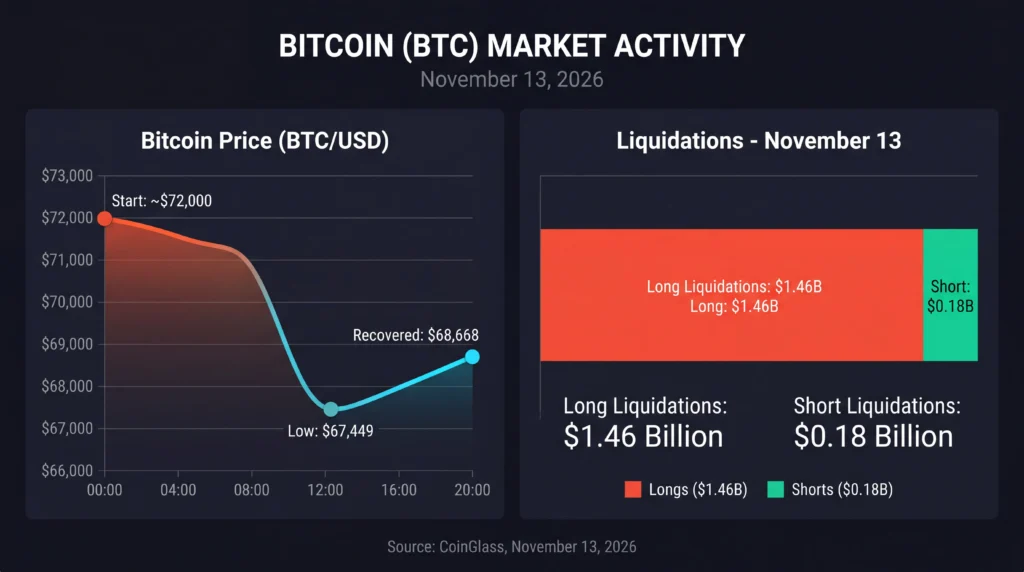
Bitcoin fell below $68,000 on November 13, touching $67,449, its lowest in months, with roughly $1.6 billion in liquidations, about 89% of them long positions

Summary
- Bitcoin fell below $68,000 on November 13, touching $67,449, its lowest in months, with roughly $1.6 billion in liquidations, about 89% of them long positions .
- Hayes’s thesis requires AI stocks to fall first, credit to tighten, authorities to print money, and that liquidity to flow into Bitcoin. Only the first step is visibly underway .
- The Federal Reserve held rates at 3.75%–4% on October 28 in a 10-2 vote, with two policymakers preferring a hike. Chair Kevin Warsh has signaled a smaller balance sheet .
- AI-related borrowers now account for almost half of long-dated U.S. investment-grade corporate debt issuance, according to PIMCO, confirming the credit link is real but not yet a crisis .
The sentences belong to Hayes. The CNBC attribution does not.
The post presents itself as a breaking news alert from CNBC. The searchable record does not support that framing.
Arthur Hayes, co-founder of BitMEX and chief investment officer of Maelstrom, published an essay on November 5 titled “D is for Dilution.” In it, he argued that money printing following an AI bust would be “glorious for Bitcoin and crypto hodlers,” then added: “Be patient.” He wrote that “changing the behavior of the Fed and all other central banks requires the glimmer of a financial crisis” .
The viral post removes the patience and the sequence. It converts a conditional, multi-step forecast into a present-tense CNBC announcement.
There is a separate data point that may explain the confusion. On November 6, commentator Matt Stoller posted that “CNBC pundits discuss how an AI government bailout will happen for national security” after a market crash . That is a discussion of a hypothetical scenario, not a network declaring a bailout imminent. The aggregator post appears to have merged that discussion with Hayes’s written thesis and presented the combination as a single breaking claim.
🇺🇸 BREAKING: CNBC JUST SAID THE AI BUBBLE IS ABOUT TO BURST, AND #BITCOIN IS THE WINNER"WE’RE GONNA GET AN AI BAILOUT, AND THEY’RE GONNA PRINT ALL KINDS OF MONEY""ANY ASSET IN THE WORLD IS NOW GOING TO BE ON CHAIN"AI MONEY OUT. MONEY PRINTER ON. EVERYTHING ON CHAIN.#BITCOIN IS ABOUT TO SEE "AN ABSOLUTELY HUGE GROWTH CURVE" 🚀
— CryptoReviewing (@CryptoReviewing) November 13, 2026
What Hayes actually argued, in order
First, AI equity prices fall. Hayes focused on share dilution. He estimated roughly 8.6 billion SpaceX shares unlock by June 2027, about 50% dilution, and put Anthropic’s dilution at 83% by June 2027. At a $1.5 trillion valuation, he calculated the price would need about $1.245 trillion of new capital merely to stand still . Anthropic’s amended registration statement does show 825 million Class A shares on sale at $70 to $78, raising up to $64.35 billion .
Second, credit to AI tightens. This link is no longer theoretical. PIMCO noted on November 10 that AI-related borrowers account for almost half of year-to-date gross issuance of non-financial U.S. investment-grade debt with maturities beyond 15 years. Goldman Sachs forecasts about $250 billion of hyperscaler dollar bond issuance this year, with wider AI-ecosystem issuance estimated between $300 billion and $570 billion .
Third, authorities respond with liquidity. This is where Hayes himself concedes the awkward part. He wrote that “the Fed, at least for now, is on strike.” Chair Kevin Warsh, who took office in May 2026, has said he wants a smaller balance sheet. The Fed held rates at 3.75% to 4% on October 28 in a 10-2 vote, with two policymakers preferring a 25-basis-point hike . The printer is not currently running in the direction the post implies.
Fourth, that liquidity finds its way into Bitcoin. Every step must happen in order. The last one is the least certain, and it cannot occur before the third.
The market is testing the first link, not celebrating the last
Bitcoin’s price action on November 13 does not resemble a market pricing in an imminent liquidity wave.
The asset fell below $68,000 and touched $67,449, its lowest since mid-August, before a partial rebound . CoinGlass data put 24-hour liquidations at roughly $1.6 billion, with about $1.46 billion in long positions, meaning traders betting on higher prices were forcibly closed out. The Crypto Fear & Greed index dropped to 20 out of 100, entering “extreme fear” territory .
This is the opposite of the “huge growth curve” the post promises. It is the first link of Hayes’s chain, playing out in real time: AI-adjacent risk assets, including crypto, are being repriced lower as the AI trade cools.
What would need to change for the Hayes thesis to activate
The viral post’s most significant omission is the Fed’s current posture. A bailout requires an authority willing to provide one. Warsh has emphasized that tightening financial conditions is how policy is being implemented, and the October vote’s two hawkish dissents establish the baseline .
Hayes’s own timeline points to late 2027 or 2028, when much of the new data center capacity is delivered and AI companies face their compute commitments . That is when he expects the overcapacity and the financial stress to become visible.
Until then, the post is a forecast dressed as a news alert, published on a day when Bitcoin was falling, not rising.
What to Watch
- Fed language: Whether Warsh’s stance shifts from balance-sheet reduction toward accommodation. The October vote’s two hawkish dissents are the current baseline .
- AI credit spreads: Whether investment-grade issuance from AI borrowers continues at the pace PIMCO documented, or whether pricing deteriorates .
- Bitcoin liquidation cascades: Whether the long-position flush of November 13 marks a local bottom or the beginning of deeper deleveraging. The $67,449 low is the level to watch .
- Hayes’s own timeline: His essay points to late 2027 or 2028 for the bailout scenario to become actionable. Any claim that it is happening “now” should be measured against that stated horizon
Did CNBC actually say the AI bubble is about to burst?
No public transcript or segment carrying those lines could be located. The language matches Arthur Hayes’s written thesis, not a CNBC broadcast .
Who is Arthur Hayes?
Is the Fed printing money right now?
No. The Fed held rates at 3.75%–4% in October, and Chair Warsh has signaled a preference for a smaller balance sheet. Two policymakers voted for a hike .
What is Bitcoin’s price doing today?
BTC fell below $68,000 on November 13, touching $67,449, its lowest since mid-August, amid roughly $1.6 billion in liquidations .
Does “everything on chain” come from CNBC?
No source connects that phrase to a CNBC broadcast. It appears to be commentary added by the aggregator account.