
CFTC Chair Selig Vows to Work With New Democratic Lawmakers on Crypto
CFTC Chair Selig says the frontier of finance is built in the US and plans to work with new Democratic lawmakers. What it means for crypto rules.

CFTC Chair Mike Selig said the frontier of finance is built in the United States, and that he plans to keep pursuing his agenda for the next two years while working with new Democratic members of Congress, according to a clip posted by Bitcoin.com News. The remarks come after the November 3 midterms, as Selig runs the agency alone and pushes ahead with crypto rules without a market structure law.
Summary
- A clip from Cantor Convergence shows Selig saying the frontier of finance is built in the United States, covering crypto assets and blockchain technology.
- Bitcoin.com News added that he plans to continue his mission over the next two years and work with new Democratic members of Congress. We could not find a full transcript to confirm that wording.
- Selig is the CFTC’s only commissioner, so he can write rules alone. Analysts say Democrats have little or no power to remove him.
- The CFTC’s crypto rule proposals are still at the notice stage. Public comments close on December 14, and nothing is final.
- The tone is softer than in August, when Selig blamed Democratic obstruction for the stalled CLARITY Act.
What did Selig say at Cantor Convergence?
Bitcoin.com News posted a short video of Selig speaking at Cantor Convergence, a conference that ran from November 10 to 12. In the clip, he says the frontier of finance is built in the United States and names crypto assets and blockchain technology. The outlet’s caption adds that he plans to continue his mission over the next two years and to work with new Democratic members of Congress.
NEW: 🏛️ "The frontier of finance is built in the United States… crypto assets, and blockchain technology," says CFTC Chair Mike Selig.Selig says he plans to continue his mission over the next two years, working with new Democratic members of Congress. https://t.co/WXiaQ4dGi8
— Bitcoin.com News (@BitcoinNews) November 12, 2026
That caption is the only source we found for the second part. We did not find a full transcript or a write-up of the session, so the wording of the Democratic pledge is the outlet’s summary, not a verified quote.
Where does the “frontier of finance” line come from?
It is Selig’s signature phrase. In January, he renamed the agency’s tech panel the Innovation Advisory Committee and said the commission would develop fit-for-purpose market structure rules for this new frontier of finance, as The Block reported. In August, he said the new frontier of finance is being built in the United States, according to CasinoBeats.
His list of technologies is wider than crypto. He has also named artificial intelligence, tokenisation and prediction markets, and our earlier report covered how the CFTC has been weighing how to police AI in autonomous trading. The location is part of his message. As he put it at a New York Fed event in September, the next decade could bring more change to markets than the last several decades combined, The Block reported.
Other governments are moving as well. China, for example, has built its own blockchain AI registration system, and Binance founder CZ told Oxford students that every country will have to adopt crypto.
How did the midterms change the picture for the CFTC?
November 12, the Associated Press’s count of the November 3 election shows Democrats with 255 House seats and Republicans with 169. In the Senate, AP’s count shows Democrats with a total of 55 seats, which includes 2 others who caucus with them, and Republicans with a total of 44. In the AP results, 11 House seats and 1 Senate seat are counted as won for no party, and the results do not say why or which way those seats will go. These numbers may have changed since then.
The label “Majority reached” beside the Democrats in the House count, and “Control reached” beside the Democrats in the Senate count, are not calls by AP.
For the CFTC, the main change is political attention. Democrats on the House Agriculture Committee already pressed Selig in an April hearing on insider trading in prediction markets, as DL News reported. Republicans also asked him for help writing legislation to curb insider trading. Scrutiny of the agency has not been limited to one party.
Why does Selig need Democrats if he can write rules alone?
He can write them, but they are easier to defend if they have support from both parties. The commission has five seats, and Selig holds the only one that is filled. Forbes reported that the CFTC has no minimum quorum rule and that Selig has said he is prepared to finalise prediction-market and other derivatives rules by himself. Neither the SEC nor the CFTC has a Democratic commissioner at present.
Holland & Knight’s Josh Kirschner told SBC Americas the agency itself is unlikely to change quickly. The same report said Democrats have little or no power to remove Selig and only limited ability to force more commissioner nominations. Rules can still be challenged. The Motley Fool noted that Congress can try to overturn a rule through a Congressional Review Act resolution, but the president can veto it.
His own stated goal points the same way. In an October interview, Selig said he wants a framework that is bipartisan and “future proof”, so that a later administration would not unwind it, according to a Bankless transcript. That is a different tone from August 20, when he said that if the CLARITY Act kept stalling because of “Democrat obstruction”, the CFTC would use its existing authority to build a regime for crypto markets.
Where do the CFTC’s crypto rules stand?
They are at an early stage. On October 5, the CFTC issued an advance notice of proposed rulemaking for two frameworks: Regulation Crypto Asset Transactions (CTX) and Regulation Crypto Asset Markets (CAM). The agency’s press release says the framework rests on its existing statutory authority. FinanceFeeds reported that the notice was published in the Federal Register on October 13 and that comments close on December 14.
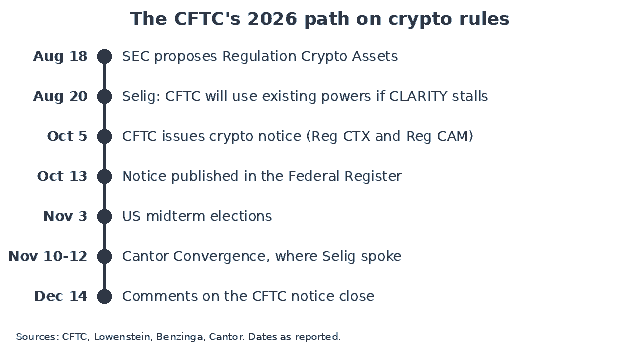
The CFTC positions its plan as a complement to the SEC’s proposed Regulation Crypto Assets, released on August 18, according to a Lowenstein Sandler client alert. Reg CAM would create a crypto-specific category of exchange registration within the CFTC’s existing system. After the comment period, the agency may revise its approach and issue a more detailed proposal, so a final rule is still some way off.
Congress has not filled the gap. The CLARITY Act, which would split crypto oversight between the SEC and CFTC, passed the House in 2025 and then failed to advance in the Senate, as The Hill reported. TD Cowen analyst Jaret Seiberg wrote on election day that he does not expect the bill to pass over the next two years, according to The Crypto Desk. Forbes reported that House Democrats are discussing a new bill that would give the SEC a larger role and the CFTC a limited one.
What does it mean for crypto and prediction markets?
For crypto firms, the near-term effect is continuity. The CFTC’s rule process keeps moving, and the comment window is the first formal chance to shape it. A bipartisan approach could make the rules harder to reverse, but it could also mean compromises on issues such as retail leverage and the CFTC’s role against the SEC.
For prediction markets, the pressure is mostly about trust and jurisdiction. Selig has taken the position that the CFTC has exclusive jurisdiction over event contracts and has backed legal action against state regulators. Democrats and some Republicans have asked how the agency handles insider trading, and Selig has said he is working on a proposed rulemaking for the sector.
What to watch
- December 14: the close of public comments on the CFTC’s crypto notice, and what industry and consumer groups say.
- A fuller transcript: whether Selig’s Cantor Convergence remarks are published in full, which would confirm what he said about working with Democrats.
- Commissioner nominations: whether the White House fills any of the four empty CFTC seats, including Democratic ones.
- A new market structure bill: whether the House Democratic proposal takes shape and how it divides power between the SEC and the CFTC.
- Prediction-market rules: the CFTC’s proposed rulemaking and any new hearings on insider trading.
FAQs
What did CFTC Chair Mike Selig say?
In a clip from Cantor Convergence, he said the frontier of finance is built in the United States, naming crypto assets and blockchain technology. Bitcoin.com News added that he plans to continue his mission over the next two years and work with new Democratic members of Congress.
Where did Selig speak?
The clip’s backdrop shows Cantor Convergence, a conference held from November 10 to 12, 2026.
Can Selig write crypto rules without Congress?
The CFTC says it is using its existing statutory authority, and Selig is the commission’s only member. Rules still go through a comment process and can face legal or congressional challenge.
What are Regulation CTX and Regulation CAM?
They are two proposed CFTC frameworks. CTX covers certain retail crypto transactions under existing law, and CAM would create a crypto-specific category of exchange registration.
When do public comments on the CFTC crypto notice close?
December 14, 2026, according to the Federal Register notice published on October 13.
Is the CLARITY Act dead?
It passed the House in 2025 but failed to advance in the Senate this year. One analyst does not expect it to pass over the next two years, and House Democrats are discussing a different bill.
Can Democrats remove Selig?
Analysts quoted by SBC Americas say they have little or no power to remove him and only limited ability to force more commissioner nominations.