
Why Is Bitcoin Price Down Today? 4 Reasons BTC Fell to $75K
Why is Bitcoin price down today? BTC fell about 6% to $75K as the Nasdaq tumbled, $1.2B of longs were liquidated and ETFs lost $430M. Key levels inside.

Why is Bitcoin price down today? BTC slid about 6% to roughly $75,000 between 5 and 6 November, its lowest level in about seven weeks, as an AI-driven rout in US tech stocks, more than $1.2 billion of liquidated long positions and fresh spot ETF outflows hit the market at the same time.
Bitcoin closed Thursday near $75,600 and traded between about $74,900 and $76,400 on Friday. That wiped out the rally above $80,000 that followed the US midterm elections only a day earlier, and it leaves the price roughly 40% below its October 2025 record of about $126,000. The slide comes days after Binance reopened withdrawals following the record $6.3 billion Binance hack, which had already shaken confidence.
Summary: why Bitcoin fell
- Bitcoin fell about 6% to roughly $75,000, a seven-week low, reversing the post-election bounce above $80,000.
- The Nasdaq lost 5.5% and the S&P 500 4.3% on AI and data-center fears, and crypto traded like any other risk asset.
- About $1.25 billion of crypto positions were liquidated, roughly 89% of them longs, and US spot Bitcoin ETFs lost $430.2 million on Thursday.
- $75,000 is the level traders are watching. Analysts point to $73,000 and $68,000 below, and $80,000 to $82,000 above.
Why is Bitcoin price down today? A tech-stock rout hits risk assets
The trigger came from Wall Street rather than from crypto. On Thursday the Nasdaq Composite tumbled 5.5%, its worst day since April 2025, and the S&P 500 fell about 4.3%, according to AP reporting. The Dow dropped roughly 1,800 points. Nvidia lost more than 9%, and the seven biggest US tech companies shed over $1 trillion in market value in a single session, CNBC reported.
Analysts linked the sell-off to a weak outlook from chipmaker Qualcomm and to fears that the new Congress could tighten rules on AI data centers, which would slow the spending boom behind the sector’s rally. Bitcoin and other crypto assets fell in step. K33 Research’s Vetle Lunde described the move as highly correlated with the Nasdaq, according to Bloomberg’s reporting as relayed by crypto.news. Shares of Coinbase and Strategy dropped about 10%, and altcoins fell harder than Bitcoin, with Ether losing around 7%.
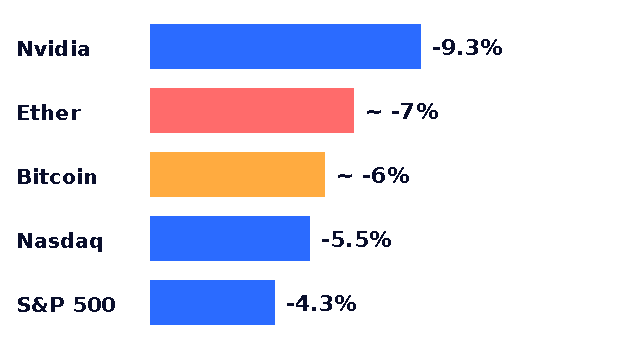
The link between crypto and tech stocks has been strong all year. When investors rush to cut risk, the assets with the most speculative appeal tend to be sold first, and Bitcoin has been behaving more like a high-growth tech stock than like a safe haven.
How $1.2 billion in liquidations deepened the drop
Data from CoinGlass showed roughly $1.25 billion of crypto positions wiped out over 24 hours, with about 89% of them long bets. Bitcoin positions accounted for around $330 million, and some 239,000 traders were liquidated across the market.
Liquidations work like a chain reaction. Traders who borrow to bet on rising prices are closed out automatically when the price falls far enough. Those forced sales push the price down further, which triggers more closures. The post-election bounce had been driven in part by a squeeze on short sellers, a type of rally that can leave the market crowded with fresh long positions. When stocks turned, many of those positions had little room to absorb the shock.
Bitcoin ETF outflows add to the pressure
US spot Bitcoin ETFs recorded about $430.2 million of net outflows on Thursday, according to flow data reported by crypto media. Fidelity’s FBTC lost roughly $199.9 million, BlackRock’s IBIT about $105 million and Grayscale’s GBTC about $49.9 million. The outflows interrupted a brief recovery, since the funds had taken in around $74.6 million the day before.
ETF demand matters because these funds have become a major source of steady buying. Bloomberg reported that close to $1 billion left the products in the days after the Binance theft, so Thursday’s withdrawals extend a weak run for flows rather than start a new one.
Short-term holders are underwater
On-chain data from Glassnode, cited by Bloomberg, shows that most Bitcoin held by recent buyers is now trading at a loss, a sharp change from a month ago, when nearly all of it was in profit. Investors who bought at higher prices often sell into rallies to get back to break-even, which can cap bounces and keep pressure on price. It also helps explain why the market has struggled to hold gains.
Bitcoin price outlook: key levels to watch
Technical analysts are focused on one number. Bitcoin has held around $75,000, which lines up with a pivot-point support level and with the lower Bollinger Band near $75,085. Here is how the levels stack up:
- Support: $75,000 first, then the 200-day moving average near $73,200. Wintermute’s Jasper De Maere has flagged $73,000 and $68,000 as downside zones if $75,000 breaks.
- Resistance: about $79,800, then $81,000 to $82,000. October’s highs above $84,800 are the bigger hurdle for a full recovery.
- Momentum: the relative strength index sits in the high 30s, which signals weak momentum but not yet an extreme oversold reading.
What could change the picture? A steadier Nasdaq, a return to ETF inflows and a cleaner leverage market would all help. If stocks keep falling, however, analysts warn that Bitcoin could revisit the low-$70,000s. Short-term moves are very hard to predict, and nobody can say where the bottom is.
What to watch next
- Wall Street follow-through: whether tech stocks stabilize or keep sliding when US markets reopen on Monday.
- Daily ETF flows: a streak of inflows would show that institutions are buying the dip.
- Support at $75,000: a daily close below it could trigger another wave of liquidations.
- Binance: updates on its reserves and withdrawals, which affect confidence across the market.
This article is general information, not financial advice. Crypto prices are highly volatile, and figures change quickly.
Why is Bitcoin price down today? Frequently asked questions
Why is Bitcoin price down today?
Bitcoin fell about 6% to roughly $75,000 because a sharp sell-off in US tech stocks spilled into crypto, more than $1.2 billion of leveraged long positions were liquidated, and US spot Bitcoin ETFs recorded about $430 million of outflows on Thursday.
Is Bitcoin crashing?
Bitcoin has dropped to a seven-week low and is about 40% below its October 2025 record, but the fall is far smaller than in past bear markets. Whether it becomes a deeper crash depends largely on stocks, ETF flows and leverage.
How low could Bitcoin go?
Analysts watch support at $75,000, then the 200-day moving average near $73,200, with Wintermute flagging $73,000 and $68,000 if support breaks. These are possibilities, not predictions.
Will Bitcoin recover?
Nobody can promise a recovery. Signs of improvement would be a steadier stock market, ETF inflows returning and a move back above $80,000 to $82,000.
Sources