
US Strategic Bitcoin Reserve Bill Reaches the Full House: H.R. 8957 Would Lock Government Bitcoin for 20 Years
H.R. 8957 would write the US Strategic Bitcoin Reserve into law and bar the government from selling its bitcoin for 20 years. It now awaits a House vote — with five weeks left on the clock.

H.R. 8957 would write the US Strategic Bitcoin Reserve into federal law.
The government could not sell its bitcoin for at least 20 years.
The bill cleared its last committee hurdle on 24 November. It now needs a House vote.
Time is short. Congress ends on 3 January 2027.
A bill that would lock the US government’s bitcoin away for 20 years is one step from a vote in the full House.
H.R. 8957, the American Reserve Modernization Act of 2026, was formally reported to the House on 24 November. It is now on the Union Calendar, which means House leaders can schedule a floor vote at any time.
The bill was introduced on 21 May by Representative Nick Begich, a Republican from Alaska, with Representative Jared Golden, a Democrat from Maine, as co-sponsor. It now has 23 cosponsors.
What does the bill actually do?
It turns an executive order into a law. That is the whole point.
Washington has been moving on crypto rules from several directions at once. The CFTC recently said regulated venues may count bitcoin and ether toward their operating reserves, and the Fidelity spot Chainlink ETF filing shows traditional finance still wants in. This bill is the legislative half of that push.
The Strategic Bitcoin Reserve exists today only because President Donald Trump created it by executive order on 6 March 2025. An order can be undone by the next president. A law cannot, not without Congress.
Here is what H.R. 8957 would require:
- A reserve, by law. The Treasury secretary would have to set up a Strategic Bitcoin Reserve, plus a separate stockpile for other cryptocurrencies, within 180 days of the bill becoming law.
- A 20-year lock. For at least two decades, the government’s bitcoin could not be sold, swapped, auctioned, encumbered or otherwise disposed of for any purpose.
- Proof, not promises. The bill requires proof-of-reserve reports and tells federal agencies to account for the digital assets they hold.
- No shopping spree. It covers bitcoin the government already holds, largely from criminal and civil seizures. It does not order new purchases.
Takeaways: the bill is about permanence, not accumulation. It does not buy bitcoin. It stops the government selling the bitcoin it already has.
How far has it got?
Further than most crypto bills get. Not far enough to matter yet.
The House Financial Services Committee approved it 28-21 on 16 September. Every Republican voted yes. Every Democrat voted no. On 24 November the committee formally reported it to the full House as House Report 119-894, and it went onto the Union Calendar as number 789.
That is the last step before a floor vote. But no vote date has been set.
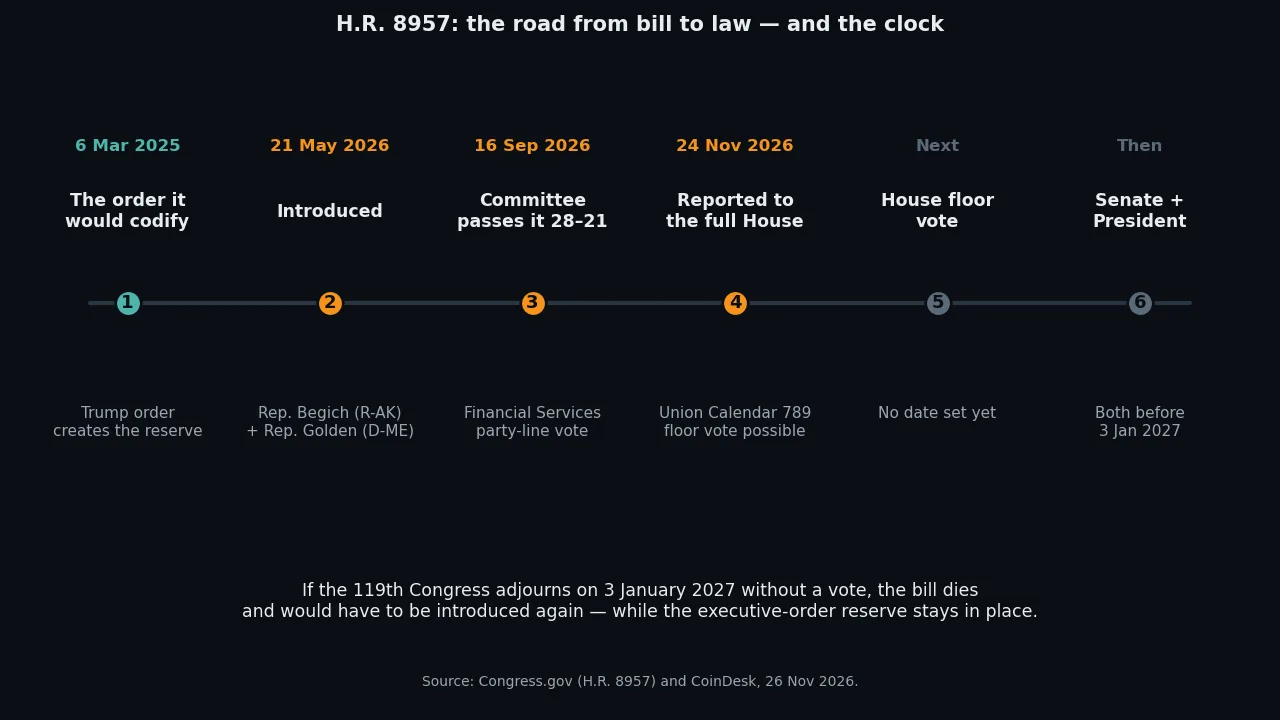
Takeaways: the committee stage is done. The hard part — floor time, a Senate vote and a signature — is still ahead, with the holiday season in between.
What are the odds it becomes law?
Low. That is the honest answer.
The current Congress ends on 3 January. That leaves just over five weeks, much of it spanning the holidays, for the bill to clear the House, win Senate approval and be signed. CoinDesk calls the deadline the main problem, and The Block describes the path as narrow.
Traders agree. Polymarket puts the chance of the US establishing a national bitcoin reserve before 2027 at under 5%.
The politics get harder after January. Democrats are set to control both chambers in the next Congress, which makes reintroducing the bill a tougher sell.
Takeaways: the bill’s best chance is a lame-duck vote in the next five weeks. If it misses that window, it dies and starts again from scratch.
What happens if it fails?
Nothing changes on day one. The reserve created by the executive order stays in place.
But it stays fragile. A future president could change it or end it without asking Congress. That is exactly the risk the bill was written to remove.
The stakes are not small. Addresses linked to the US government held 306,795 BTC at the time of writing, worth over $18.7 billion, according to data tracked by Arkham and cited by CoinDesk. That stockpile is currently protected by nothing stronger than an order signed in March.
Takeaways: failure does not kill the reserve. It leaves it one signature away from being undone.
What about the bitcoin price?
Bitcoin climbed back above $60,000 on 26 November, the same day the bill’s progress made headlines across crypto media. It still leads the top 100 cryptocurrencies by market cap, and the move came as Japan’s biggest banks put stablecoins and tokenized assets on Solana — a reminder that the institutional story runs wider than one bill.
At 18:40 UTC it traded at $60,516.59, up 1.5% over 24 hours, after touching a high of $61,097 and a low of $59,609. The move followed days of heavy selling that had pushed bitcoin toward $57,000-$58,000 earlier in the week.
Do not read too much into one day. The rebound also followed an oversold market and the clearing of overleveraged positions. The bill is one piece of a much bigger picture.
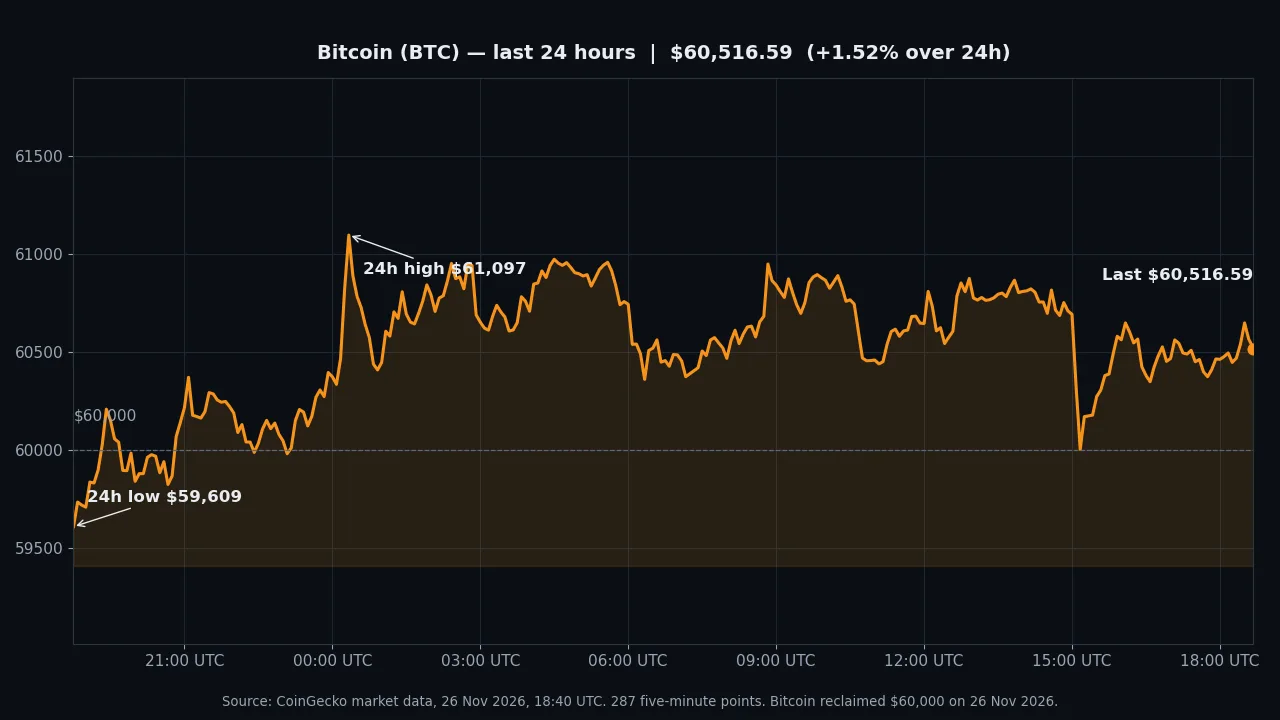
Takeaways: bitcoin is back above $60,000. The bill did not cause that on its own, but it gave traders a reason to look up from a brutal month.
Key numbers:
- 20 years — the minimum hold on government bitcoin
- 180 days — the deadline to set up the reserve once the bill becomes law
- 28-21 — the committee vote, strictly along party lines
- 306,795 BTC — the government’s holdings, worth over $18.7 billion
- 23 — cosponsors on the bill
- 3 January 2027 — the day the current Congress ends
- Under 5% — Polymarket’s odds of a national bitcoin reserve before 2027
The bottom line: H.R. 8957 would turn America’s bitcoin reserve from a presidential order into a law with a 20-year lock — but with five weeks left on the clock, it may never get its vote.
What is H.R. 8957?
H.R. 8957 is the American Reserve Modernization Act of 2026. It would write the US Strategic Bitcoin Reserve into federal law, direct the Treasury to set it up within 180 days, and bar the government from selling its bitcoin for at least 20 years.
Has the Strategic Bitcoin Reserve bill passed?
No. H.R. 8957 cleared the House Financial Services Committee 28-21 on 16 September 2026 and was reported to the full House on 24 November 2026, making it eligible for a floor vote. It still needs a House vote, Senate approval and the President’s signature before Congress ends on 3 January 2027.
How much bitcoin does the US government hold?
About 306,795 BTC, worth over $18.7 billion, according to data tracked by Arkham and cited by CoinDesk on 26 November 2026. Most of it comes from criminal and civil seizures.
Would H.R. 8957 order the government to buy more bitcoin?
No. The bill covers bitcoin the government already holds. It does not order new purchases. Its purpose is to stop the government selling what it has, for at least 20 years.
What happens if the bill fails?
The reserve created by President Trump’s March 2025 executive order would stay in place, but a future president could change or end it without Congress. The bill would have to be introduced again in the next Congress, where Democrats are set to control both chambers.