Fidelity Files for a Spot Chainlink ETF: FLNK Would Hold LINK Directly, With No Staking
Fidelity has filed an S-1 for a spot Chainlink ETF, the Fidelity Chainlink Fund (FLNK), to list on Nasdaq. It would hold LINK directly — and, unlike Fidelity's Solana fund, it would not stake a single token.

Fidelity has filed a Form S-1 with the U.S. Securities and Exchange Commission to launch a spot Chainlink exchange-traded fund, the Fidelity Chainlink Fund, which would hold LINK directly and list on Nasdaq under the ticker FLNK. Fidelity, one of the largest asset managers in the United States, is the biggest name yet to file for a LINK fund, and the filing carries one detail that sets it apart from Fidelity’s own Solana fund: the trust will not stake its LINK. The registration, filed on Wednesday 25 November, is the start of a process, not an approval — the fee is blank, the seed capital is blank, and no trading date is given.
A fourth fund, and a different answer on yield
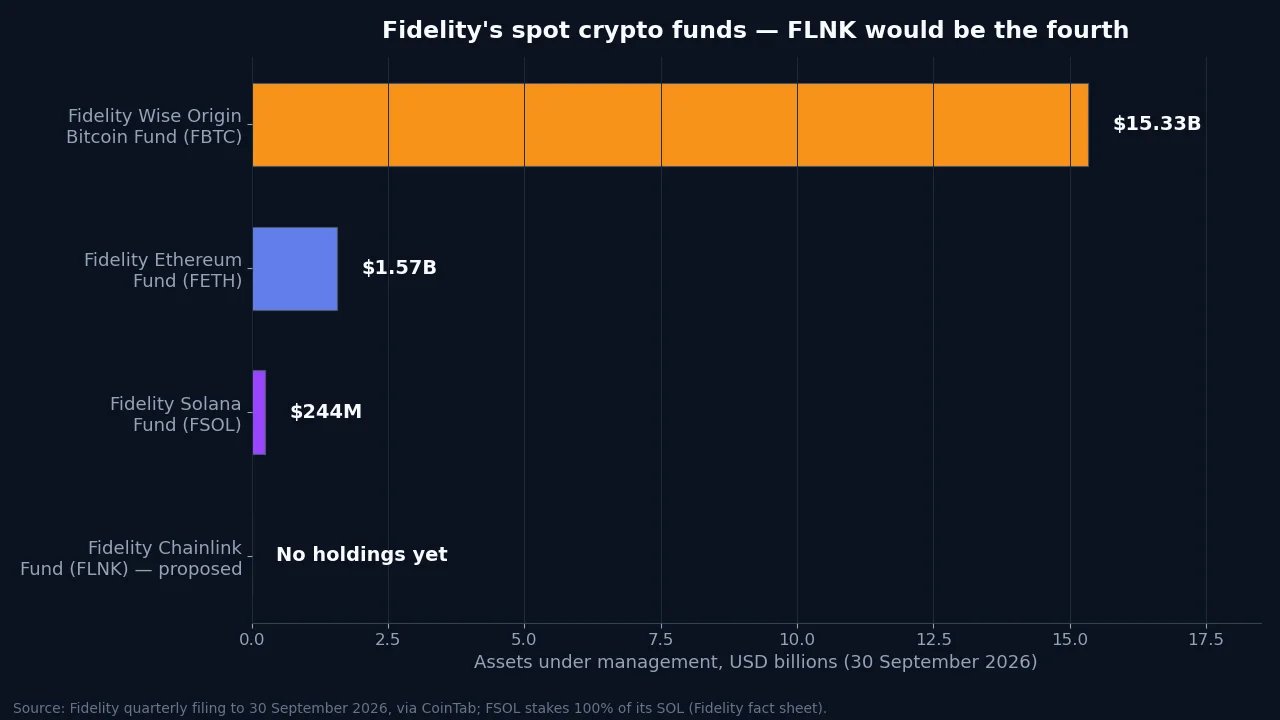
Fidelity already runs three spot crypto funds. Its bitcoin fund, FBTC, held 183,167 BTC worth about $15.33 billion at the end of September, its ether fund held 583,807 ETH worth about $1.57 billion, and its Solana fund held 2,058,204 SOL worth about $244 million — roughly $17.1 billion across the three, according to the firm’s quarterly filing. The Solana fund stakes all of its SOL: Fidelity’s own fact sheet puts it at 100% staked, earning a net reward rate of 4.95% a year. FLNK would take the opposite route. The S-1 is blunt: “The Trust will not stake its LINK, and Shareholders will not receive staking rewards through the Trust.” Holders would get LINK’s price, and nothing else. That is a deliberate trade. Staking would add yield but also operational complexity, and Fidelity has chosen the simpler product. The choice also tells you how Fidelity reads the market: with LINK ranked 15th among the top 100 cryptocurrencies by market cap at about $7.1 billion, a plain price-tracking fund is the safer way to test demand.
| Fund | Asset | Holdings at 30 September 2026 | What holders get |
|---|---|---|---|
| Fidelity Wise Origin Bitcoin Fund (FBTC) | Bitcoin | 183,167 BTC (about $15.33B) | Bitcoin price exposure |
| Fidelity Ethereum Fund (FETH) | Ethereum | 583,807 ETH (about $1.57B) | Ethereum price exposure |
| Fidelity Solana Fund (FSOL) | Solana | 2,058,204 SOL (about $244M) | Solana price plus staking rewards |
| Fidelity Chainlink Fund (FLNK) | Chainlink | Proposed — no holdings yet | Chainlink price only, no staking |
What the filing actually says
The trust behind FLNK was formed in Delaware on 19 November, six days before the filing, and is sponsored by FD Funds Management, a Fidelity affiliate, with CSC Delaware Trust Company as trustee. Shares would be created and redeemed in blocks of 25,000, in LINK or in cash. Three custodians would hold the fund’s LINK: Anchorage Digital Bank, BitGo Bank & Trust and Coinbase Custody. Pricing would follow the Fidelity Chainlink Reference Rate, a volume-weighted median across eligible spot markets, recalculated every 15 seconds, with Coin Metrics as the independent calculation agent. The prospectus leaves the annual sponsor fee blank and the seed investment open, which is normal for a first filing; both will be filled in through amendments. The fund would not operate under the Investment Company Act of 1940, and it would not be a commodity pool. The filing also cites the SEC and CFTC’s March 17 interpretation, which names LINK as an example of a “digital commodity” rather than a security — the regulatory hook the whole product hangs on. Washington has moved quickly on crypto market structure this autumn: a CFTC staff letter in November let regulated derivatives venues count bitcoin and ether toward their operating reserves, a sign of how far the framework has shifted in a year.
Late to LINK, but the biggest name yet
Fidelity is not first to Chainlink. Grayscale’s Chainlink Trust ETF, GLNK, began trading in December 2025 and held about $112 million in assets as of 24 November; Bitwise followed in January 2026 with CLNK, at about $42 million. Together the two funds held about $173 million on 13 November, according to SoSoValue data. Fidelity’s entry would make it the third issuer — and the largest asset manager in the group by a wide margin. The timing is not an accident. A day before the filing, Fidelity added LINK, Aave and Uniswap to the assets available for trading on its retail Fidelity Crypto platform, putting the token in front of its brokerage customers before asking the SEC to let it wrap the same token in a fund. The pattern is familiar from the wider altcoin ETF wave: Bitwise has already filed for a spot Zcash ETF, and the queue behind bitcoin and ether keeps lengthening.
A cold market for a new filing
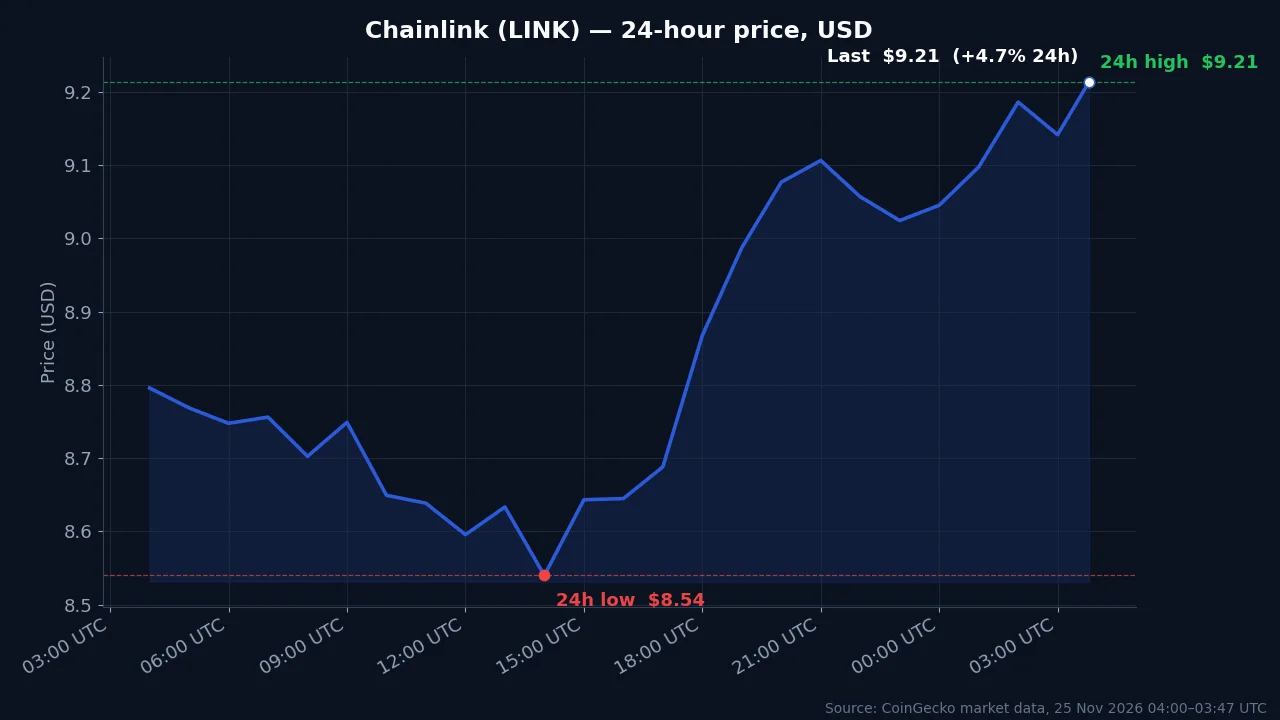
The filing lands in a cold market. U.S. spot bitcoin ETFs recorded about $4.94 billion in net outflows in November through 24 November, and the crypto Fear & Greed Index stood at 13, in extreme fear, when the S-1 was filed. LINK itself traded near $9.05 when the filing was first reported, up about 2% on the day. By the early hours of 26 November it was near $9.21, up about 4.7% over the previous 24 hours on CoinGecko data, after touching $8.54 earlier in the session. That is still more than 80% below its May 2021 high of $52.70. An S-1 creates no flows of its own: until the SEC declares the registration effective and Nasdaq approves the listing, FLNK is paperwork. Whether it becomes a fund depends on the regulator, and whether it becomes a big one depends on demand that, for LINK, has so far totalled about $150 million across two funds.
What to watch
Whether the SEC declares the S-1 effective, and what fee Fidelity sets when it amends the filing — the blank sponsor fee is the first number to look for.
Whether FLNK takes share from GLNK and CLNK or simply splits the same pool of LINK demand; about $150 million across two funds is a small base to fight over.
Whether LINK holds above $9 while the filing works through the queue, and whether Fidelity’s retail platform keeps adding altcoins ahead of further filings.
What is the Fidelity Chainlink Fund (FLNK)?
A proposed spot exchange-traded fund that would hold Chainlink’s LINK token directly and track its price, minus expenses. Fidelity filed a Form S-1 for the fund with the SEC on 25 November 2026, and the shares are expected to list on Nasdaq under the ticker FLNK, subject to approval.
Will the Fidelity Chainlink ETF stake its LINK?
No. The S-1 states plainly: “The Trust will not stake its LINK, and Shareholders will not receive staking rewards through the Trust.” That sets FLNK apart from Fidelity’s own Solana fund, FSOL, which stakes 100% of its SOL at a net reward rate of 4.95% a year.
When will FLNK start trading?
No date has been given. An S-1 is a registration statement, not an approval: the SEC must declare it effective, Nasdaq must approve the listing, and the fee and seed capital — both blank in the first filing — must be set through amendments. Shares cannot be sold until the registration becomes effective.
How does FLNK differ from the existing Chainlink ETFs?
Two spot LINK funds already trade: Grayscale’s GLNK, which began trading in December 2025 and held about $112 million as of 24 November, and Bitwise’s CLNK, at about $42 million. Fidelity would be the third issuer, and the largest asset manager of the three to file.
What happened to LINK’s price on the news?
LINK traded near $9.05 when the filing was first reported on 25 November, up about 2% on the day. By the early hours of 26 November it was near $9.21, up about 4.7% over the previous 24 hours on CoinGecko data, after touching $8.54 earlier in the session. It remains more than 80% below its May 2021 high of $52.70.